JEE Main 2027: Exam Dates, Eligibility, Pattern, Syllabus and Registration
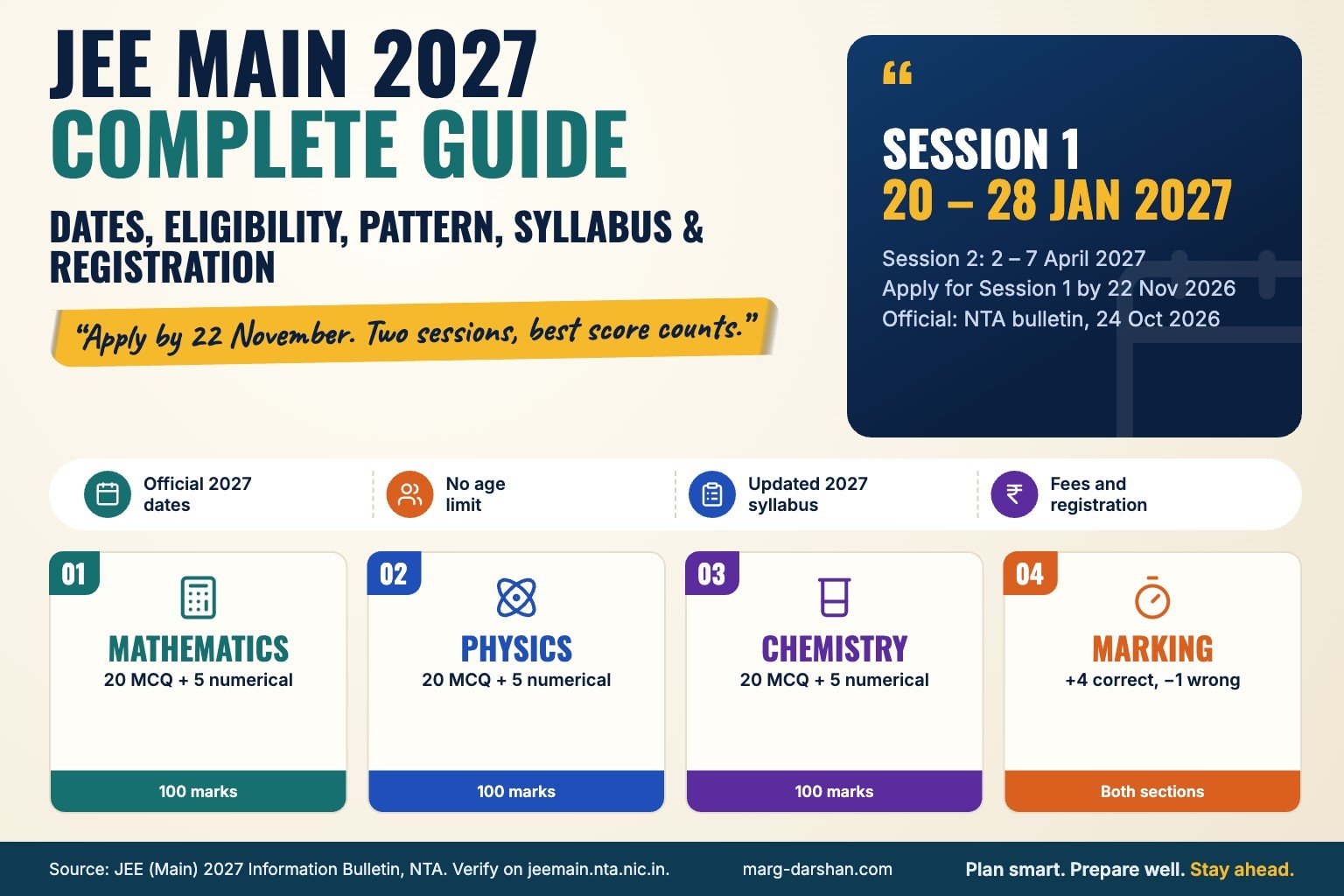
JEE Main 2027 Session 1 is on 20, 21, 22, 23, 24 and 28 January 2027, and Session 2 is on 2–7 April 2027. Registration for Session 1 is open now and closes on 22 November 2026. NTA published the Information Bulletin and the 2027 syllabus on 24 October 2026, so every date, fee and rule below comes from that bulletin.
This guide covers dates, eligibility, the exam pattern, the syllabus, how to register, and how to prepare from now to January.
JEE Main 2027 important dates
All dates below are from the JEE Main 2027 Information Bulletin (NTA, 24 October 2026).
| Event | Session 1 (January) | Session 2 (April) |
|---|---|---|
| Online application | 24 Oct – 22 Nov 2026 (11:50 PM) | 5 Jan – 3 Feb 2027 (11:50 PM) |
| Application with late fee (+₹500) | 23 – 26 Nov 2026 | 4 – 7 Feb 2027 |
| Correction window | 27 – 29 Nov 2026 | 8 – 10 Feb 2027 |
| City intimation slip | 30 Dec 2026 | 12 Mar 2027 |
| Admit card | 13 Jan 2027 | 25 Mar 2027 |
| Exam dates | 20, 21, 22, 23, 24 and 28 Jan 2027 | 2, 3, 4, 5, 6 and 7 Apr 2027 |
Exam shifts for Paper 1: 9:00 AM – 12:00 noon and 3:00 PM – 6:00 PM (IST).
Yes, if you can. NTA merges the NTA scores from both sessions and uses the better of your two total scores for the merit list. A weak January paper is not the end of your attempt.
Eligibility for JEE Main 2027
- No age limit to appear in JEE Main 2027.
- Class 12 year: you can appear if you passed Class 12 (or equivalent) in 2025 or 2026, or are appearing in 2027.
- Institute rules still apply: the institutes you apply to may have their own age or eligibility conditions for admission.
To take a seat at an NIT, IIIT or other centrally funded institute through JoSAA, you also need 75% in Class 12 (65% for SC/ST) or a top-20-percentile result in your board. This comes from the admission rules, not the JEE Main bulletin, so a good JEE score alone is not enough. Our 75% criteria explainer covers it, and you can check yourself with the eligibility checker.
JEE Main 2027 exam pattern (Paper 1: B.E./B.Tech)
| Subject | Section A (MCQ) | Section B (numerical) | Marks |
|---|---|---|---|
| Mathematics | 20 | 5 | 100 |
| Physics | 20 | 5 | 100 |
| Chemistry | 20 | 5 | 100 |
| Total | 60 | 15 | 300 |
Mode and duration
Computer-based test, 3 hours. Section B answers are entered as integers on an on-screen keypad, rounded to the nearest integer.
Marking
+4 for a correct answer and −1 for a wrong one, in both sections. Unanswered or marked-for-review questions score 0.
No choice in Section B
All 5 numericals per subject count. A wrong numerical loses a mark just like a wrong MCQ, so guessing on numericals costs you.
Ties
Ties on total NTA score are broken first by the NTA score in Mathematics, then by the other subjects, in the order the bulletin sets out.
JEE Main 2027 syllabus
NTA released the 2027 Paper 1 syllabus with the bulletin. It follows the reduced syllabus used since 2024: 14 units in Mathematics, 20 in Physics and 20 in Chemistry.
| Subject | Units |
|---|---|
| Mathematics | Sets, relations and functions · Complex numbers and quadratic equations · Matrices and determinants · Permutations and combinations · Binomial theorem · Sequence and series · Limit, continuity and differentiability · Integral calculus · Differential equations · Coordinate geometry · Three-dimensional geometry · Vector algebra · Statistics and probability · Trigonometry |
| Physics | Units and measurements · Kinematics · Laws of motion · Work, energy and power · Rotational motion · Gravitation · Properties of solids and liquids · Thermodynamics · Kinetic theory of gases · Oscillations and waves · Electrostatics · Current electricity · Magnetic effects of current and magnetism · Electromagnetic induction and alternating currents · Electromagnetic waves · Optics · Dual nature of matter and radiation · Atoms and nuclei · Electronic devices · Experimental skills |
| Chemistry | Some basic concepts in chemistry · Atomic structure · Chemical bonding and molecular structure · Chemical thermodynamics · Solutions · Equilibrium · Redox reactions and electrochemistry · Chemical kinetics · Classification of elements and periodicity · p-block elements · d- and f-block elements · Coordination compounds · Purification and characterisation of organic compounds · Some basic principles of organic chemistry · Hydrocarbons · Organic compounds containing halogens · Organic compounds containing oxygen · Organic compounds containing nitrogen · Biomolecules · Principles related to practical chemistry |
To decide which of these units to revise first, use our JEE Main chapter-wise weightage for 2027.
Application fee (per session, Paper 1 only)
| Category | Male | Female |
|---|---|---|
| General | ₹1,000 | ₹800 |
| Gen-EWS / OBC (NCL) | ₹900 | ₹800 |
| SC / ST / PwD | ₹500 | ₹500 |
| Third gender | ₹500 | |
Fees are for centres in India. Applying for Paper 1 together with B.Arch or B.Planning costs more, as listed in the bulletin.
How to register for JEE Main 2027
- Go to jeemain.nta.nic.in and open the JEE Main 2027 Session 1 application.
- Register with your email and mobile number, then fill in personal details, Class 10 and Class 12 details, and your exam city choices.
- Upload a recent photograph and your signature in the format the bulletin specifies.
- Pay the fee online (card, net banking or UPI) by 22 November 2026, and download the confirmation page.
- Check every detail during the correction window, 27–29 November 2026.
For Session 2, you can log in again in January and pay the fee for Session 2 without filling a new form.
How to prepare for JEE Main 2027
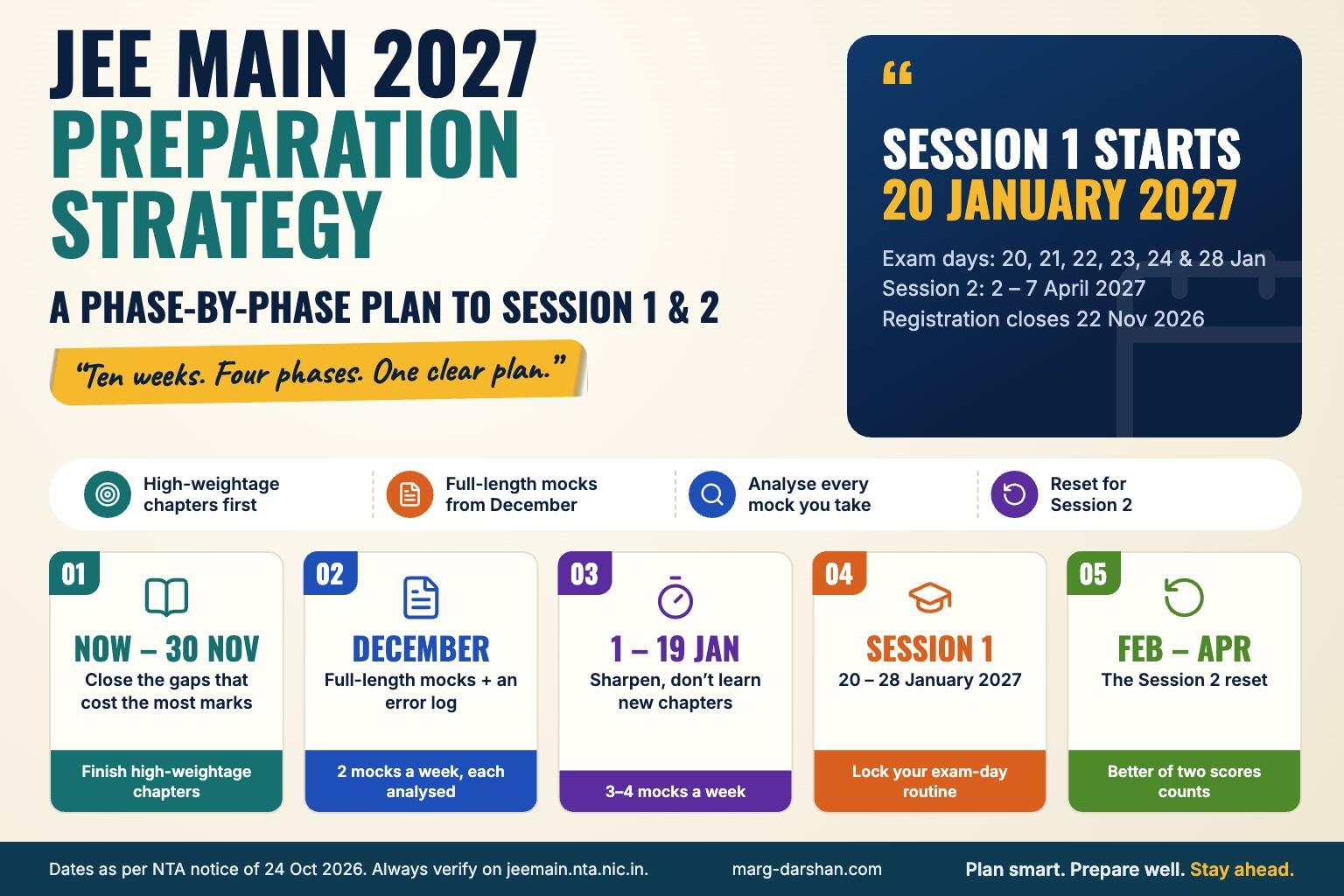
Finish or repair the chapters that carry the most questions and that you are weakest in. Take one full-length mock as a baseline.
Two mocks a week, each analysed the same day with the 4-bucket method.
Three or four mocks a week. Revise from your error log and formula sheets, and lock your attempt order.
The full phase-by-phase plan is in our JEE Main 2027 preparation strategy. For shorter runways, see 45 days to JEE Main 2027 and the last 30 days strategy.
Practise on the real pattern, then check your colleges
The Margdarshan JEE Main Test Series gives you full-length mocks on an NTA-style interface with the 2027 pattern (75 questions, 300 marks, compulsory numericals with negative marking), a worked solution for every question, and a report after every mock. Start with three full mocks free.
Once you have a mock score, the JEE Main college predictor shows which NITs, IIITs and GFTIs are realistic for your rank and category.
Start free: take Mock 1 →Frequently asked questions
Session 1 is on 20, 21, 22, 23, 24 and 28 January 2027. Session 2 is on 2–7 April 2027.
22 November 2026 (11:50 PM), or 26 November 2026 with a ₹500 late fee.
No. You need to have passed Class 12 in 2025 or 2026, or be appearing in 2027.
Yes. A wrong answer loses one mark in both Section A and Section B.
The better of your two total NTA scores.
JEE Main Test Series
50 full-length mocks on the exact NTA interface, with a worked solution for every question and a chapter-wise report. Start with free mocks.
Need Mentorship?
Want a personalised career roadmap? Book a 1-on-1 counselling session.
College Predictor
Confused which college to target? Use our JEE Main Predictor to see your college options by rank.
Comments
Leave a Comment
Please log in to leave a comment.
Newsletter
GET STARTED WITH MARGDARSHAN
Get weekly: JEE strategy, college cutoff updates, career paths after PCM, and insider tips from IITians. Free. Unsubscribe anytime.