Last 30 Days Strategy for JEE Main 2027: A Week-by-Week Plan to Session 1
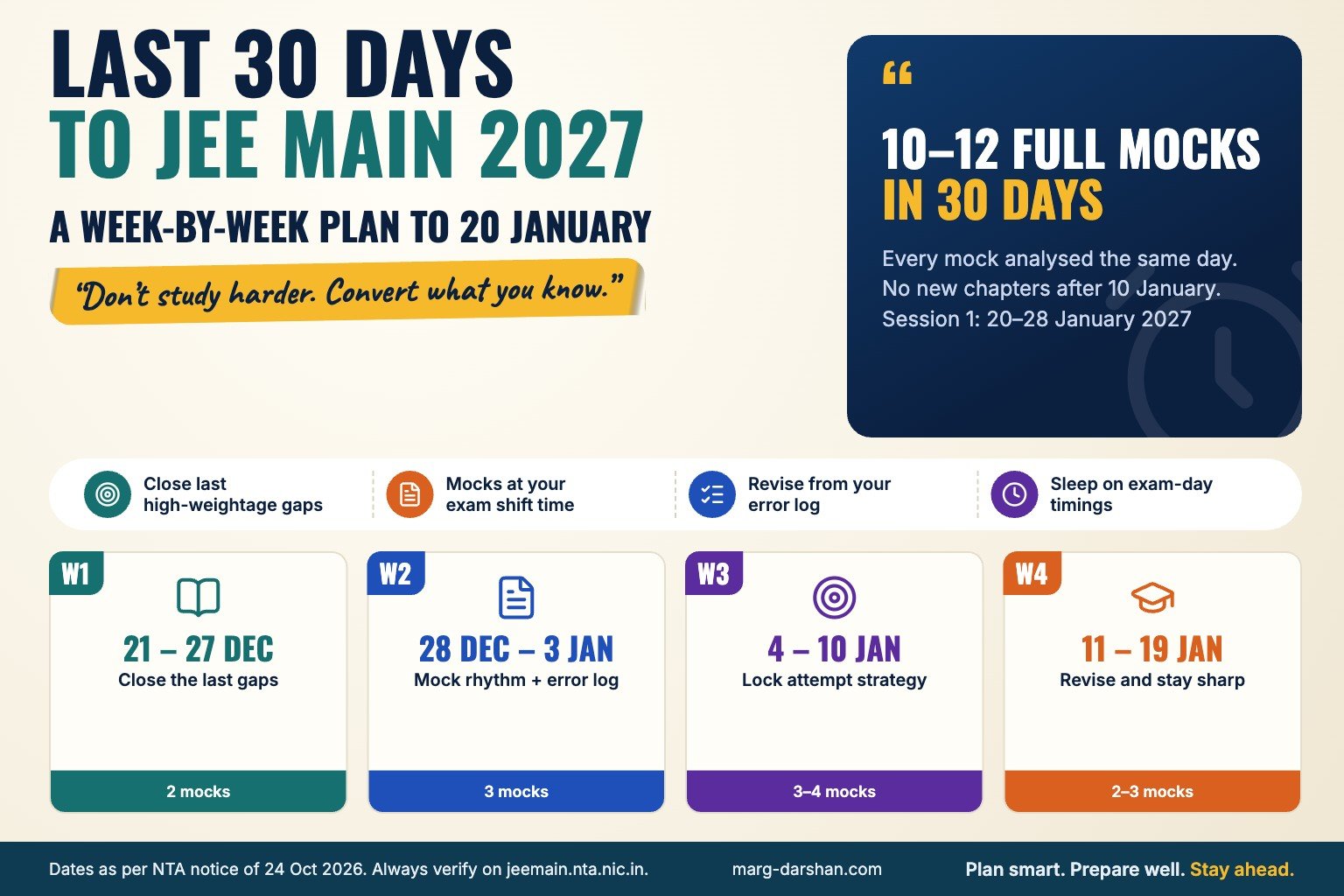
The last 30 days before JEE Main 2027 Session 1 are not for studying harder. They are for converting what you already know into marks. If your exam is on 20 January, your 30 days start on 21 December; shift the plan by a few days if your slot is later.
Below is a week-by-week plan, the daily routine that goes with it, what to stop doing, and a checklist for the last 72 hours and exam day.
What changes in the last 30 days
- Starting new chapters after about 10 January
- Making fresh, detailed notes
- Watching full lecture videos
- Solving random questions with no timer
- Comparing scores in group chats
- Full-length mocks at your exam shift time
- Analysing every mock the same day
- Revising from your error log and formula sheets
- Line-by-line NCERT for Inorganic Chemistry
- Sleeping and waking on exam-day timings
A half-learned chapter usually costs more marks through confusion than it earns. In the final month, depth in what you know beats breadth in what you do not.
The 30-day plan, week by week
- Pick at most two or three chapters per subject that are high weightage and still shaky. Use the chapter-wise weightage list to choose.
- For each: revise the core ideas, then solve 25–30 previous-year and mock questions on it.
- Two full-length mocks this week, each analysed the same day.
- Three full-length mocks, on alternate days, at 9 AM or 3 PM.
- On non-mock days, revise the chapters each mock exposed and re-solve every wrong question.
- Sort lost marks into four buckets (silly mistake, concept gap, time trap, bad guess) using the 4-bucket method.
- Three or four mocks. Try two different subject orders and keep the one with the higher first-attempt score.
- Set time boxes of roughly 60 minutes per subject, and a rule to leave any question after three minutes.
- Stop opening new chapters by 10 January.
- Two or three mocks, the last one about 3–4 days before your exam.
- Revision only: error log, formula sheets, NCERT Chemistry, your own short notes.
- Download your admit card as soon as it is out and check every detail.
| Week | Dates | Full mocks | Analysis per mock | New chapters? |
|---|---|---|---|---|
| Week 1 | 21–27 Dec | 2 | 2–3 hours | Only 2–3 high-weightage gaps |
| Week 2 | 28 Dec – 3 Jan | 3 | 2 hours | No |
| Week 3 | 4–10 Jan | 3–4 | 60–90 min | No |
| Week 4 | 11–19 Jan | 2–3 | 60 min | No |
| Total | 30 days | 10–12 | Every mock analysed | |
A daily routine for the last 30 days
Use the mock-day routine on alternate days and the revision-day routine in between. If your exam is in the afternoon shift, move the mock to 3–6 PM.
| Time | Mock day | Revision day |
|---|---|---|
| 6:30 – 8:30 AM | Light revision: formula sheet of your weakest subject | Physics: error-log questions + formulas |
| 9:00 AM – 12:00 PM | Full-length mock (exam conditions) | Maths: timed practice on weak chapters |
| 12:00 – 1:30 PM | Lunch and rest | Lunch and rest |
| 1:30 – 4:30 PM | Analyse the mock: buckets, error log | Chemistry: NCERT Inorganic + Physical numericals |
| 5:00 – 7:00 PM | Re-solve wrong questions | Re-solve last mock's wrong questions |
| 7:30 – 9:30 PM | Revise the chapters the mock exposed | Organic reaction maps / mixed PYQs |
| 10:30 PM | Sleep | Sleep |
Subject-wise focus for the final month
Physics
Mechanics, Electrostatics and Current Electricity, Modern Physics and Optics carry the most questions. Revise formulas daily and re-solve error-log questions instead of new ones.
Chemistry
The fastest subject to improve now. Inorganic rewards NCERT line-by-line revision; Physical rewards formula practice; Organic rewards reaction maps.
Mathematics
Calculus, Coordinate Geometry, Vectors and 3D, and Algebra carry the bulk. The main risk is time: practise recognising and skipping long questions in round one.
Numericals (all subjects)
All five per subject are compulsory and carry −1 for a wrong answer. Attempt only what you have actually worked out; do not guess.
The last 72 hours
- No new topics and no full mocks in the final two days. Light revision of formula sheets and your error log only.
- Print your admit card (and a spare), check the centre address, and visit or map the route.
- Keep your photo ID and any documents listed on the admit card in one folder.
- Sleep at your normal time. Wake up at the time you will on exam day.
- Eat what you usually eat. Exam week is not the time for new food.
Exam-day checklist
Admit card, valid photo ID, any documents the admit card asks for, a transparent water bottle if allowed. Reach well before the reporting time.
Follow the attempt order you fixed in your mocks. First round: attempt everything you are sure of. Second round: come back to marked questions. Leave any question after three minutes.
Do not discuss the paper between shifts or check answer keys on the same day. Your next job, if anything, is Session 2.
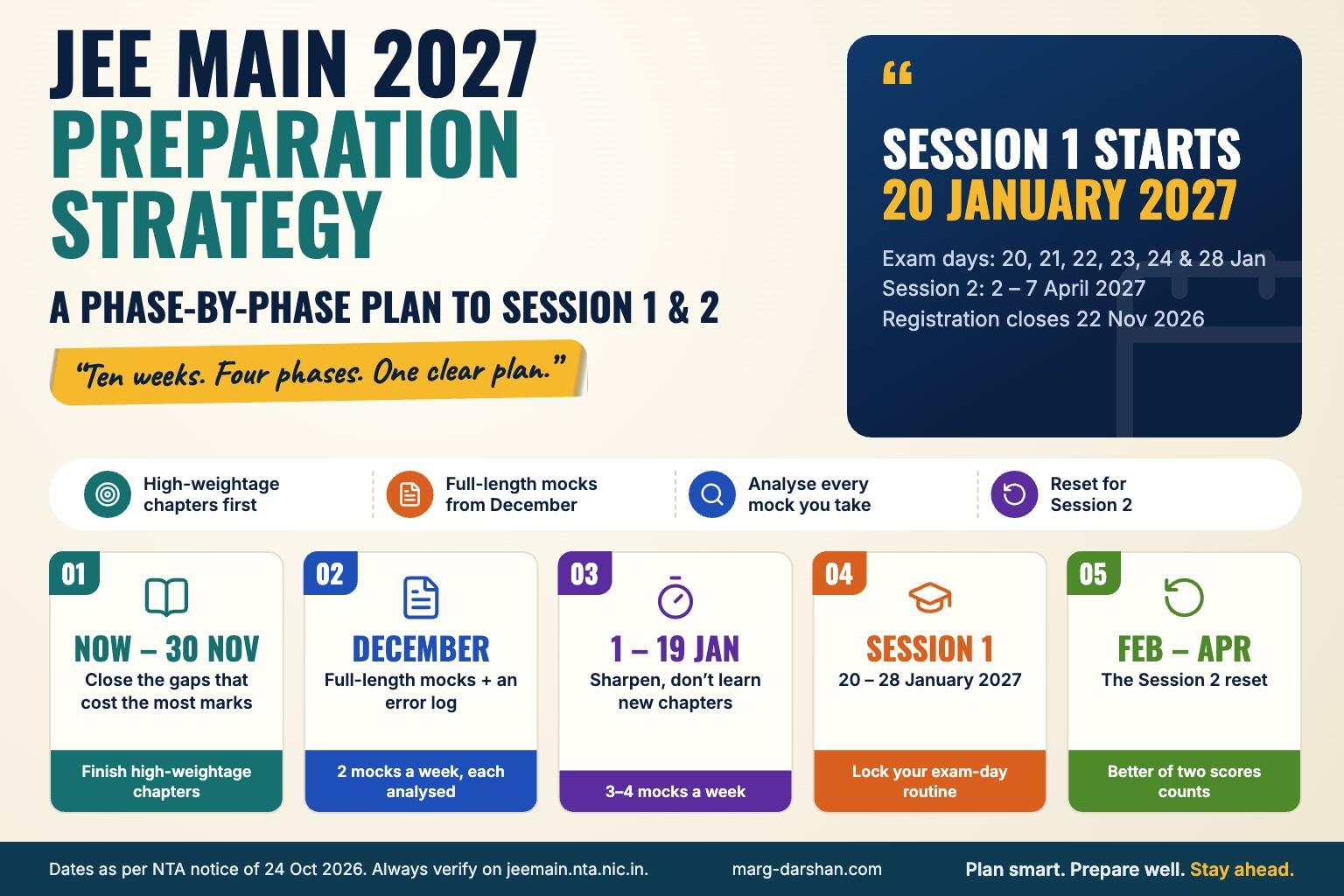
Session 2 runs from 2–7 April 2027, and NTA uses your better score of the two sessions. A tough day in January is not the end. See our JEE Main 2027 preparation strategy for the Session 2 reset plan.
Take your final-month mocks on the real interface
Ten to twelve full mocks in 30 days needs fresh papers that behave like the real exam. The Margdarshan JEE Main Test Series gives you full-length mocks on an NTA-style interface with the current 75-question, 300-mark pattern, a worked solution for every question, and a report after every mock that separates silly mistakes from concept gaps.
Class 12 students and droppers can start with three full mocks free, phone number only.
Start free: take Mock 1 →Frequently asked questions
About 10–12 full-length mocks, two or three a week at first and three or four in the middle weeks, with the last one 3–4 days before your exam. Each one should be analysed.
Only if it is high weightage and you can finish it in the first week. After about 10 January, do not start anything new.
Around 9–10 focused hours a day works for most students, including mock and analysis time. Sleep of 7–8 hours matters more than an extra hour of study now.
Yes. Most of the gain comes from fewer silly mistakes, fewer bad guesses and a fixed attempt order, which mocks and analysis can deliver in a month.
JEE Main Test Series
50 full-length mocks on the exact NTA interface, with a worked solution for every question and a chapter-wise report. Start with free mocks.
Need Mentorship?
Want a personalised career roadmap? Book a 1-on-1 counselling session.
College Predictor
Confused which college to target? Use our JEE Main Predictor to see your college options by rank.
Comments
Leave a Comment
Please log in to leave a comment.
Newsletter
GET STARTED WITH MARGDARSHAN
Get weekly: JEE strategy, college cutoff updates, career paths after PCM, and insider tips from IITians. Free. Unsubscribe anytime.