How to Analyse a JEE Main Mock Test: The 4-Bucket Method
Your mock score tells you where you are. Your mock analysis decides where you will be. Two students who take the same 20 mocks can end up 40 marks apart, and the difference is almost always what they did in the hours after each paper.
This guide gives you a simple method to analyse any JEE Main mock in about two hours: sort every lost mark into one of four buckets, add up what each bucket cost, and fix the biggest one first. A worked example follows.
- Check the total, feel good or bad
- Glance at solutions for 20 minutes
- Take the next mock two days later
- Make the same mistakes again
- List every question that cost marks or time
- Put each one in exactly one bucket
- Count the marks each bucket cost
- Fix the biggest bucket before the next mock
Why analysis matters more than the number of mocks
A full-length mock shows you every weakness at once: chapters you never finished, calculations you rush, question types that eat your time, and guesses that cost you marks. If you only look at the total and move on, the same weaknesses show up in the next mock, and in the exam.
Every wrong answer loses a mark, in MCQs and in numericals, and all five numericals in each subject are compulsory. The marks you lose to avoidable errors are not just missed; they are subtracted from what you earned.
The 4-bucket method, step by step
- One sitting, three hours, at your exam shift time (9 AM or 3 PM).
- On a laptop or desktop, because JEE Main is a computer-based test.
- No pausing and no checking answers mid-paper.
- Count only your first attempt. Re-attempts are useful practice, but those scores are inflated.
- Questions you got wrong (−1 each).
- Questions you skipped (0, but possibly marks you could have earned).
- Questions you got right but took more than four minutes on.
Do not skip the third group. A question you solved correctly in seven minutes may have cost you two easier questions at the end.
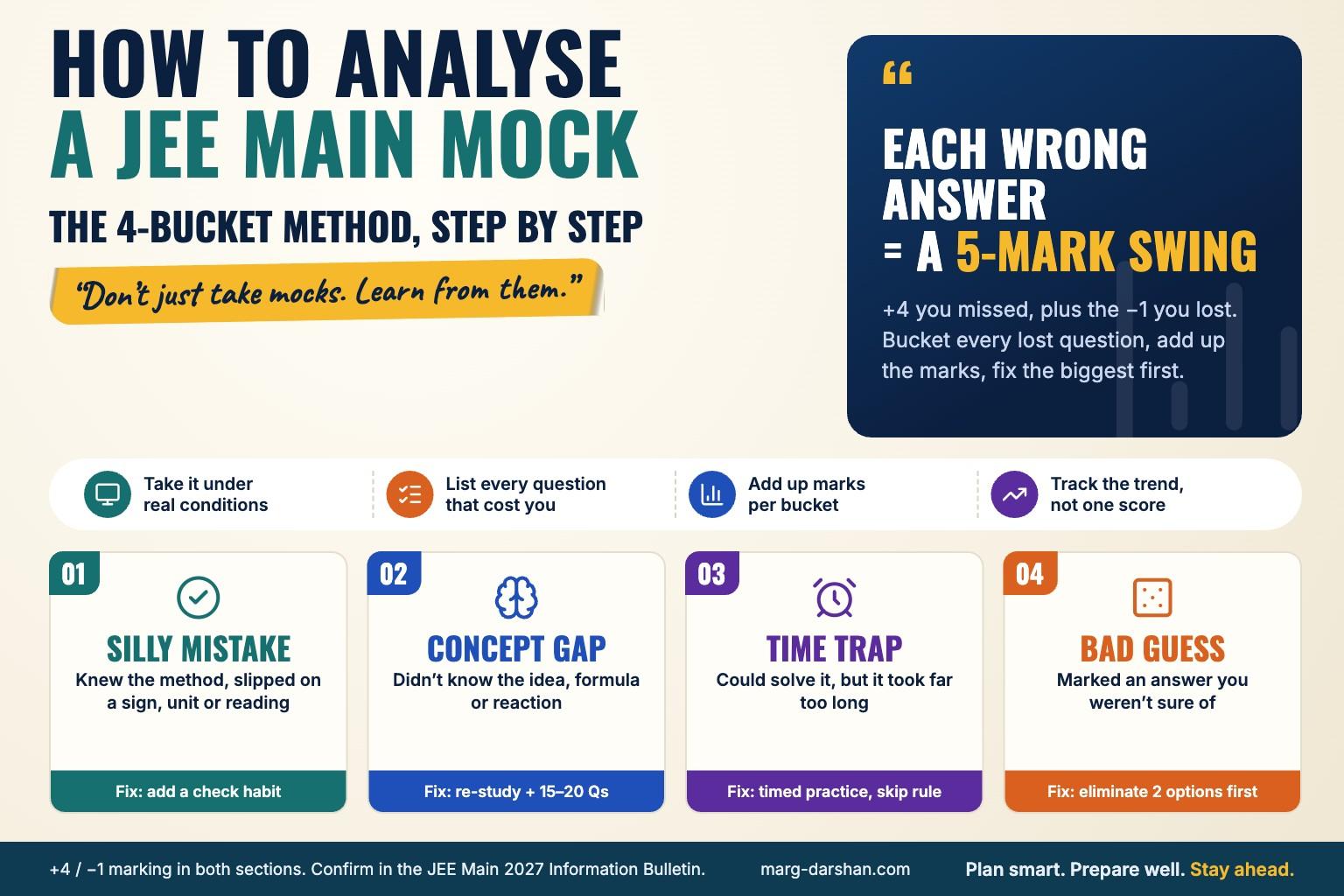
1. Silly mistake
You knew the method. A sign, unit, arithmetic step or misread option went wrong.
Fix: note the exact slip, re-solve without looking, add one check habit (units, signs, re-reading the stem).
2. Concept gap
You did not know the idea, formula or reaction.
Fix: re-study the topic from notes or NCERT, then solve 15–20 questions on it before your next mock.
3. Time trap
You could solve it, but it took far too long.
Fix: practise that question type against a timer; learn the shortcut, or learn to skip it in round one.
4. Bad guess
You marked an answer you were not sure of and lost a mark.
Fix: attempt an MCQ only if you can eliminate two options; a numerical only if you actually worked it out.
Calling a concept gap a "silly mistake" feels better, but it sends you to the wrong fix.
For wrong answers, count 5 marks each: the 4 you missed plus the 1 you lost. For skipped questions you could have solved, count 4. The bucket with the biggest total is next week's priority.
Worked example: Arjun's December mock
Arjun scores 156/300 in a December mock. His analysis:
| Bucket | Questions | Marks at stake |
|---|---|---|
| Silly mistakes | 6 wrong | 30 |
| Concept gaps | 5 wrong, 7 skipped | 53 |
| Time traps | 4 skipped at the end (ran out of time) | 16 |
| Bad guesses | 4 wrong | 20 |
| Total recoverable | 26 questions | 119 |
The cheapest marks to recover: no new chapter, only habits. Next week he checks units and signs before marking, and stops guessing.
Spread across chapters, but seven of the twelve come from Electrostatics and Coordinate Geometry. Those two chapters become his week.
He spent too long on Maths integration in round one. New rule: skip anything in Maths that is not clear in 90 seconds, and come back.
Arjun does not need to study "everything harder". He needs two chapters, two habits and one skipping rule.
Step 5: Write it into your error log
Keep one error log for the whole preparation, in a notebook or a spreadsheet, with these columns:
| Date / Mock | Subject & chapter | Bucket | Correct idea (one line) | Re-solved? |
|---|---|---|---|---|
| 12 Dec · Mock 4 | Physics · Electrostatics | Concept gap | Field inside a conducting shell is zero; potential is constant | Yes |
| 12 Dec · Mock 4 | Maths · Definite integrals | Time trap | Use King's property before expanding | Yes |
Re-read the log every Sunday. Before Session 1, it becomes your most useful revision material, because every line is a mistake you have actually made.
Step 6: Check the trend, not just the score
After five or six mocks, compare your buckets over time:
- If silly mistakes are not falling, slow down your first round slightly and add one checking step.
- If concept gaps keep coming from the same chapters, those chapters need proper study time, not just more questions. Use our chapter-wise weightage list to decide which ones are worth it now.
- If time traps are rising, change your attempt order or time boxes and test the new order in the next two mocks.
A rising score with a falling silly-mistake count is the best sign you are ready.
How long should analysis take?
| Stage | Time per mock | Focus |
|---|---|---|
| First few mocks | About 3 hours | Every lost question, full error log |
| December | 2–3 hours | Biggest bucket first |
| Final 3 weeks | 60–90 minutes | New error types only |
If you cannot analyse every mock properly, take fewer mocks. An unanalysed mock is three hours spent repeating the same mistakes.
Let the report do the counting
Sorting 75 questions by hand takes time. The analysis report in the Margdarshan JEE Main Test Series does the counting after every mock: it separates marks lost to silly mistakes from marks lost to gaps, shows time spent on each question, and lists the chapters to fix next. Your first attempt is saved as your exam-condition score, and you can re-attempt any mock for practice.
You still do the most important part yourself: re-solving and keeping your error log. But you start from a clear list instead of a blank page. Class 12 students get three complete mocks free, with full solutions and the report.
Take a free mock and analyse it →Frequently asked questions
List every question you got wrong, skipped or spent more than four minutes on. Put each in one bucket: silly mistake, concept gap, time trap or bad guess. Add up the marks each bucket cost and fix the biggest bucket first.
Early on, about as long as the mock itself (around three hours). In the last three weeks before the exam, 60–90 minutes is enough.
Yes. Re-solving the questions you got wrong is the best way to fix them. Just do not count the re-attempt score as your real score.
Write down each slip in your error log, re-solve the question, and add one checking habit (units, signs or re-reading the question) before marking an answer. Track whether your silly-mistake marks fall over five or six mocks.
JEE Main Test Series
50 full-length mocks on the exact NTA interface, with a worked solution for every question and a chapter-wise report. Start with free mocks.
Need Mentorship?
Want a personalised career roadmap? Book a 1-on-1 counselling session.
College Predictor
Confused which college to target? Use our JEE Main Predictor to see your college options by rank.
Comments
Leave a Comment
Please log in to leave a comment.


Newsletter
GET STARTED WITH MARGDARSHAN
Get weekly: JEE strategy, college cutoff updates, career paths after PCM, and insider tips from IITians. Free. Unsubscribe anytime.