JEE Advanced 2027: Expected Dates, Eligibility, Pattern and Syllabus

JEE Advanced 2027 is expected in the second half of May 2027, about six weeks after JEE Main Session 2. The Joint Admission Board (JAB) has not yet named the organising IIT or published the 2027 brochure. Until it does, the dates and rules below are expected, based on JEE Advanced 2026 (organised by IIT Roorkee), and each one is marked that way.
This guide covers the expected dates, eligibility, the exam pattern, syllabus, registration and fees, and how to prepare alongside JEE Main.
JEE Advanced 2027 dates (expected, based on 2026)
The 2027 schedule will come on the official website, jeeadv.ac.in, once JAB announces it. Here is how 2026 ran, which is the best guide to 2027.
| Event | 2026 date (official) | 2027 status |
|---|---|---|
| Registration for JEE Main qualified candidates | 23 Apr – 2 May 2026 | Expected late April 2027 |
| Last date for fee payment | 4 May 2026 | Expected early May 2027 |
| Admit card | 11 – 17 May 2026 | Expected a week before the exam |
| Exam: Paper 1 (9 AM – 12 noon) and Paper 2 (2:30 – 5:30 PM) | Sunday, 17 May 2026 | Expected mid–late May 2027 |
| Candidate responses online | 21 May 2026 | Expected |
| Provisional answer keys | 25 May 2026 | Expected |
| Result and final answer key | 1 Jun 2026 | Expected early June 2027 |
| JoSAA counselling begins | 2 Jun 2026 | Expected early June 2027 |
| Architecture Aptitude Test (AAT) | 4 Jun 2026 | Expected early June 2027 |
Organising IIT for 2027: not yet announced. Several coaching sites expect IIT Delhi under the usual rotation, but JAB has not confirmed it.
Eligibility for JEE Advanced 2027
JAB publishes five criteria every year, and you must meet all of them. The 2026 versions are below, with the years moved forward one year where that is how the rule has worked in the past. Treat the 2027 years as expected until the brochure is out.
The 2026 split was 10% GEN-EWS, 27% OBC-NCL, 15% SC, 7.5% ST and 40.5% OPEN, with 5% for PwD candidates within each.
For 2026 the cut-off was 1 October 2001. SC, ST and PwD candidates get five years' relaxation.
For 2026 it was 2025 or 2026. Physics, Chemistry and Mathematics must be compulsory subjects.
Students who joined only an IIT preparatory course can still appear.
At least 75% aggregate in Class 12 (65% for SC, ST and PwD), or a place in the top 20 percentile of your board, with PCM as compulsory subjects.
Exam pattern
Two papers, both compulsory
Paper 1 in the morning and Paper 2 in the afternoon, each 3 hours, computer-based. Each paper has Physics, Chemistry and Mathematics.
The pattern changes every year
The number of questions, question types and total marks are not fixed, and are only revealed in the paper. Recent papers have mixed single-correct MCQs, multiple-correct questions with partial marks, numerical answers and matching questions.
Negative marking varies by question type
Some question types carry negative marks and some do not. Read each section's instructions before you start it.
Rank is on the total
Your rank uses the aggregate of both papers, so a poor Paper 1 can still be recovered in Paper 2.
Syllabus
JAB publishes the JEE Advanced syllabus on jeeadv.ac.in (the 2026 syllabus is there now). It covers Class 11–12 Physics, Chemistry and Mathematics like JEE Main, but the two syllabi are not identical, and JEE Advanced asks for more depth. Compare the two official syllabi chapter by chapter, and add any topic that appears only in JEE Advanced to your plan after JEE Main Session 1.
Registration and fee (2026 fees; 2027 expected similar)
| Candidate (centres in India) | 2026 fee |
|---|---|
| Female candidates (all categories) | ₹1,600 |
| SC, ST and PwD candidates | ₹1,600 |
| All other candidates | ₹3,200 |
You register on the JEE Advanced portal after the JEE Main results, using your JEE Main details. The window is short (about 10 days in 2026), so keep your documents ready by April.
How to prepare for JEE Advanced 2027
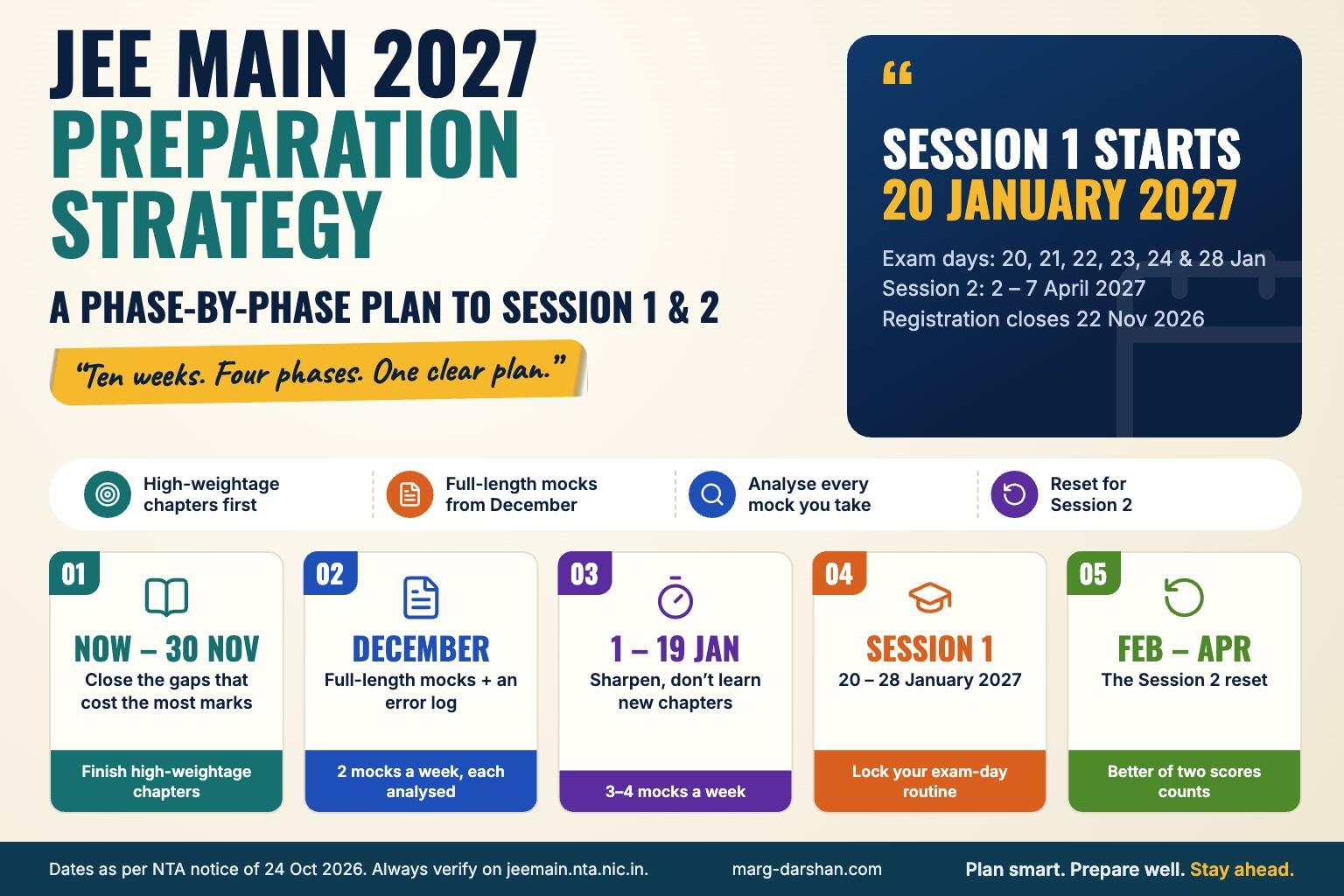
- Until January: prepare for JEE Main. Most of the syllabus is shared, and clearing JEE Main comfortably is the first gate.
- February – March: add JEE Advanced-style practice, such as multiple-correct and multi-concept questions and the extra topics, alongside your JEE Main Session 2 revision.
- After Session 2 (April – May): take full JEE Advanced mocks as two papers on one day, to build stamina for six hours of exam.
- Analyse every paper for silly mistakes, concept gaps, time traps and bad guesses. With partial and negative marking, bad guesses cost more here than in JEE Main.
Practise both papers, then check your IIT options
Clear the first gate with the Margdarshan JEE Main Test Series (three full mocks free), then see the Margdarshan JEE Advanced Test Series for two-paper practice.
After a mock, use the JEE Advanced college predictor to see which IIT branches fit your expected rank.
Explore the JEE Advanced Test Series →Frequently asked questions
The date is not announced yet. Based on 2026 (17 May), expect a Sunday in the second half of May 2027.
JAB has not announced it. Several sites expect IIT Delhi under the rotation, but treat that as unconfirmed.
The top 2,50,000 candidates in JEE Main Paper 1, across all categories, as in 2026.
At most twice, in two consecutive years.
JEE Main Test Series
50 full-length mocks on the exact NTA interface, with a worked solution for every question and a chapter-wise report. Start with free mocks.
Need Mentorship?
Want a personalised career roadmap? Book a 1-on-1 counselling session.
College Predictor
Confused which college to target? Use our JEE Main Predictor to see your college options by rank.
Comments
Leave a Comment
Please log in to leave a comment.
Newsletter
GET STARTED WITH MARGDARSHAN
Get weekly: JEE strategy, college cutoff updates, career paths after PCM, and insider tips from IITians. Free. Unsubscribe anytime.