JEE Main 2027 60-Day Plan: Week by Week to Session 1
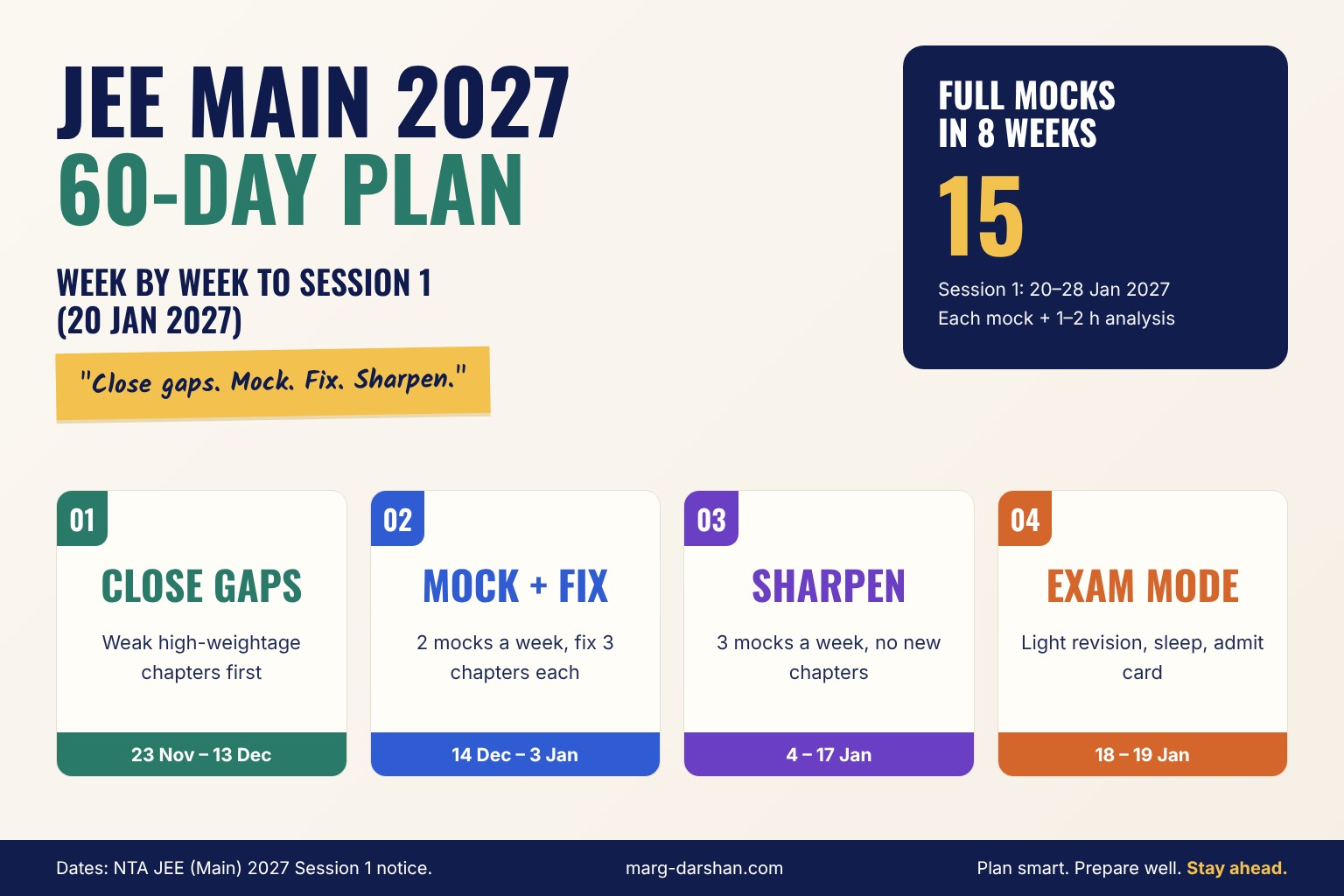
JEE Main 2027 Session 1 starts on Wednesday, 20 January 2027. From 23 November that is 58 days. Roughly 60 days, 8 weeks, and about 15 full-length mocks if you use them well.
This plan is for students who have finished most of the syllabus once (or most of it) and now need to convert it into marks. It is split into 3 phases: close the gaps, mock and fix, then sharpen. Each week has one job. If you are a Class 12 student with school and pre-boards, use the "school days" hours in the timetable; droppers use the full-day version.
- Missed the 22 Nov deadline? NTA's late window with a ₹500 late fee runs 23–26 Nov 2026, up to 11:50 PM on 26 Nov.
- Correction window: 27–29 Nov 2026. Check name, date of birth, category and photo once, then close the tab and study.
- City intimation slip around 30 Dec and admit card around 13 Jan are expected dates. Confirm on jeemain.nta.nic.in.
The 60-day plan at a glance
| Phase | Dates | Main job | Full mocks |
|---|---|---|---|
| 1. Close the gaps | 23 Nov – 13 Dec (3 weeks) | High-weightage chapters you are weak in, PYQs chapter by chapter | 1 a week (3) |
| 2. Mock and fix | 14 Dec – 3 Jan (3 weeks) | 2 mocks a week, fix what each mock shows | 2 a week (6) |
| 3. Sharpen | 4 Jan – 17 Jan (2 weeks) | Revise, don't start new chapters, mocks at your shift time | 3 a week (6) |
| Exam mode | 18 – 19 Jan | Light revision, formula sheet, sleep | 0 |
Why only 15 mocks and not 40? Because a mock without analysis is just a 3-hour practice of your old mistakes. Each mock in this plan comes with 1–2 hours of analysis the same day or the next morning. 15 analysed mocks beat 30 unanalysed ones. Mock dena easy hai, mock se seekhna asli kaam hai.
Phase 1: Close the gaps (23 Nov – 13 Dec)
You can't revise everything in 3 weeks, so pick by numbers. In our count of 35 JEE Main shifts (2024–2026, 2,895 questions), the top 5 chapters in each subject carried 28–35% of that subject's questions. Start there, and only with the ones you are weak in.
| Subject | Top 5 chapters (2024–26 count) | Share of subject |
|---|---|---|
| Physics | Ray Optics, Units & Measurements, Kinematics, Current Electricity, Moving Charges & Magnetism | 28.5% |
| Chemistry | Coordination Compounds, Hydrocarbons, GOC, d- & f-Block, Equilibrium | 30.5% |
| Maths | Conic Sections, 3D Geometry, Matrices & Determinants, Sets/Relations/Functions, Limits/Continuity/Differentiability | 34.9% |
These are counts of past papers, not predictions for 2027. Full list: JEE Main chapter-wise weightage 2024–2026: 35 papers counted.
- Take 1 full-length mock this week, 3 hours in one sitting, at 9 AM or 3 PM.
- From that mock, list your 6 weakest chapters (2 per subject) that are also in the top-10 list. This is your Phase 1 list.
- Finish the form tasks above (late fee window or corrections). Then forget about the form.
- One weak chapter per subject: NCERT read for theory (especially Chemistry), then 40–60 PYQs from that chapter.
- Make a one-page formula and trap sheet for each chapter. You will use these in January.
- Mock 2 on Sunday. Check: did the chapters you worked on cost fewer marks?
- The other 3 chapters from your list, same method.
- 15 of the 75 questions are numericals (60 marks, integer answers, −1 for wrong). Do 10 integer-type questions a day, mixed subjects.
- Mock 3 on Sunday.
Need your baseline mock this week? 3 full-length JEE Main mocks are free, no card needed.
Take a free mock →Phase 2: Mock and fix (14 Dec – 3 Jan)
Now the mock is the teacher. Two full mocks a week, and the days in between are for fixing what they showed.
| Day | What you do |
|---|---|
| Wed | Full-length mock (3 hours, shift time) |
| Thu | Analysis (1–2 hours) + fix chapter 1 from the mock |
| Fri | Fix chapter 2 + 10 numericals |
| Sat | Fix chapter 3 + revise your mistake notebook |
| Sun | Full-length mock |
| Mon | Analysis + fix |
| Tue | Weak-subject day: PYQs from one full shift of that subject |
How to analyse each mock in 60–90 minutes
- Tag every wrong or skipped question with a reason: concept gap, calculation slip, misread, or time pressure. Each needs a different fix.
- Check time per question. Any question where you spent more than 4 minutes is a time trap, even if you got it right.
- Pick 3 chapters to fix before the next mock. Not 10. Three.
- Redo every wrong question without looking at the solution first. Then read the solution.
Our step-by-step version: how to analyse a JEE Main mock test (the 4-bucket method).
- Taking a mock, checking the score, and moving on
- Starting a new coaching module in December
- Comparing your score with friends after every mock
- Same-day analysis, 3 chapters to fix, re-test in the next mock
- A mistake notebook you re-read every Saturday
- Tracking your own trend over 6 mocks
Phase 3: Sharpen (4 – 17 Jan)
- 3 full mocks this week (for example Mon, Wed, Sat), each at the shift time you are most likely to get.
- Between mocks: formula sheets, mistake notebook, and 1 PYQ shift paper of your weakest subject.
- If a chapter you never studied appears in a mock, leave it. 58 days is not the time to start Rotational Motion from zero.
- 3 full mocks, treated exactly like exam day: same wake-up time, same breakfast, same water break plan.
- Download the admit card when NTA releases it (expected around 13 Jan) and check your centre address.
- Fix your attempt order (which subject first) and your guessing rule. Don't change them after this week.
- No full mock. Light revision of formula sheets and the mistake notebook only.
- Pack the admit card, ID and anything NTA's instructions ask for the night before.
- Sleep 7–8 hours. A tired brain makes silly mistakes, and silly mistakes are −1 each.
Daily timetable: school days vs full days
| Block | Class 12 (school days) | Dropper / holidays |
|---|---|---|
| Morning | 45 min: formula sheet or mistake notebook before school | 9 AM–12 PM: mock, or a 3-hour PYQ / problem block at shift time |
| After school | 2 hours: weak chapter (theory + PYQs) | 1–4 PM: weak chapter, theory + PYQs |
| Evening | 1.5 hours: second subject, problems | 5–8 PM: second subject + 10 numericals |
| Night | 30 min: tomorrow's plan + 1 quick revision | 9–10 PM: mistake notebook, plan for tomorrow |
| Total | About 4.5–5 hours | About 9–10 hours |
On mock days, the mock replaces the morning (and for school students, Sunday is mock day). Board practicals and pre-boards will take some days in December and January. When they do, keep only the 45-minute morning block and the mistake notebook. Don't drop the mocks; move them.
Where 15 mocks come from
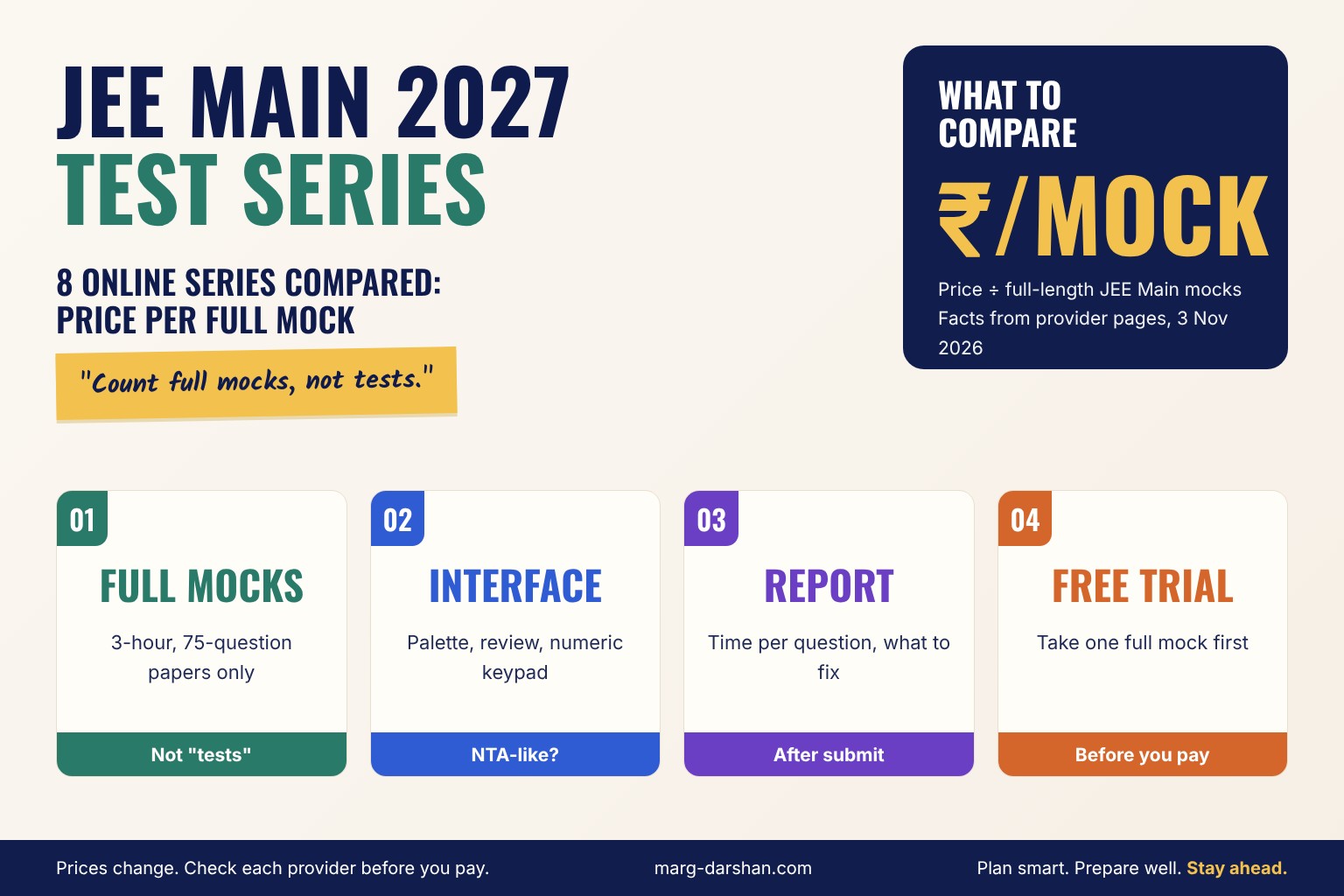
You need about 15 full-length mocks on an interface that looks like NTA's, with solutions you can learn from. Two good sources together:
- Past JEE Main shift papers (2024–2026, current syllabus). Treat at least 4 of them as timed mocks.
- A test series for the rest, so you also get questions you haven't seen and a report that shows where time went.
Note for parents
For the next 8 weeks, the most useful question is not "how many hours did you study?" but "what did the last mock show, and what are you fixing this week?" If your child can answer that in one line (for example "lost 20 marks in Current Electricity and 2 silly sign errors"), the plan is working. Protect the 3-hour mock slot on Sundays from family plans where you can, and expect a dip in scores in Phase 2. That dip is normal while weak chapters are being fixed.
Start week 1 with a full-length mock
Take a JEE Main mock on an NTA-like interface with step-by-step solutions. The report shows time per question vs ideal, a difficulty breakdown, your topic mastery grid, an estimated percentile, and says "Fix these 3 chapters first". You tag why each question went wrong and the report totals the reasons. Zeri AI then turns it into a 7-day plan.
3 full-length mocks are free, no card needed. The full series has 50+ full-length mocks and 10,000+ chapter and topic questions with unlimited re-attempts and 1-year access: ₹999, or ₹499 early bird till 31 Dec 2026, with a 7-day refund.
Take your free mock →Frequently asked questions
Enough to raise your score, yes, if most of the syllabus has been studied once. It is not enough to learn the whole syllabus from zero. Use the 60 days to close gaps in high-weightage chapters and to practise full papers.
About 15 full-length mocks, each followed by 1–2 hours of analysis. Fewer analysed mocks are better than many unanalysed ones.
Until about 13 December, yes, if the chapter is high-weightage and you can finish it in 3–4 days. After early January, no. Revise what you know.
Class 12 students with school: about 4.5–5 focused hours on school days and more on weekends. Droppers: 9–10 hours with breaks. Focus matters more than the number.
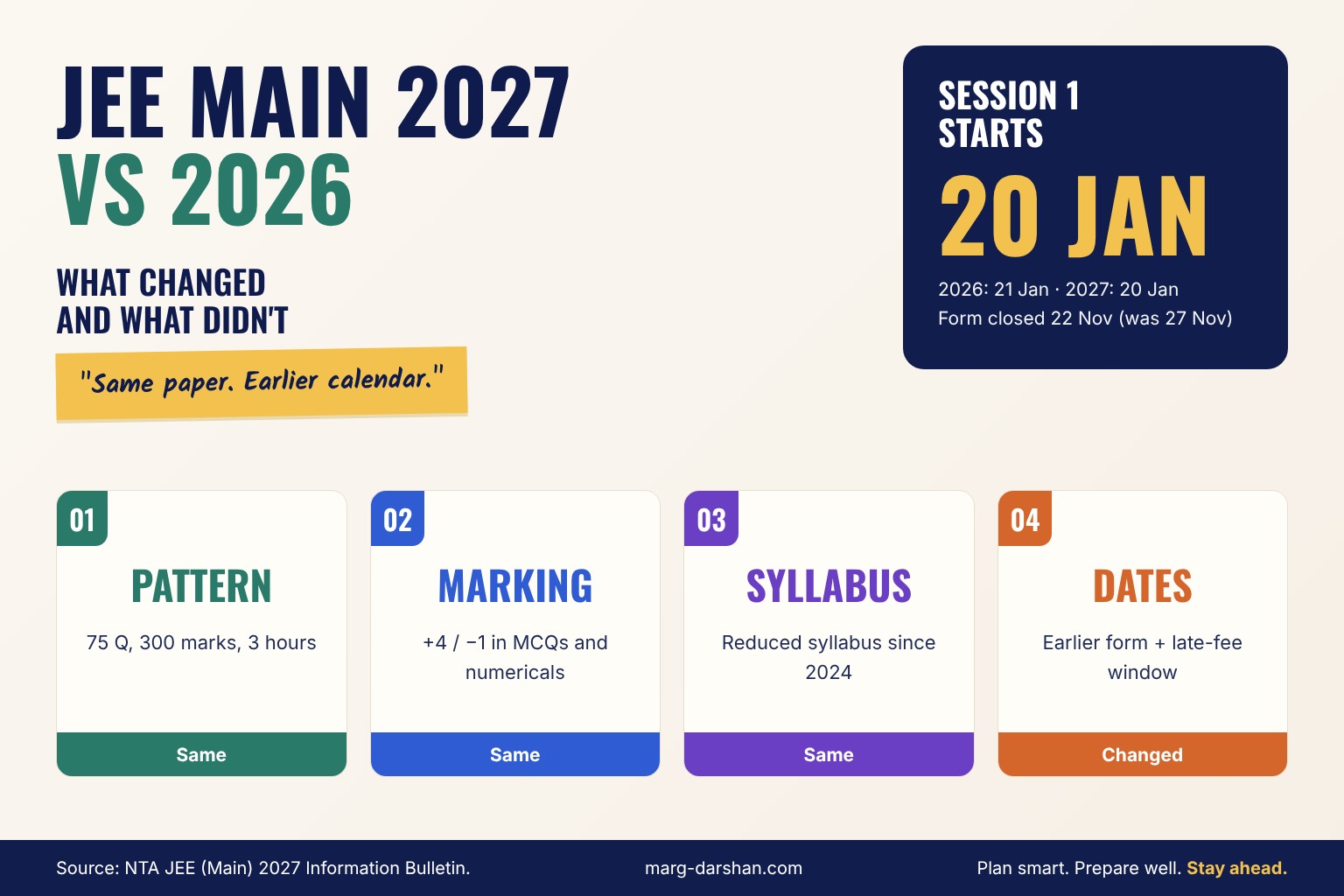
20, 21, 22, 23, 24 and 28 January 2027, with shifts at 9 AM–12 PM and 3–6 PM. See the JEE Main 2027 paper pattern and marking scheme.
Session 2 is on 2–7 April 2027, and the better of your two NTA scores counts. The same plan works again from February.
At the shift time you are most likely to get, and at the other one at least twice, so neither feels new on exam day.
JEE Main Test Series
50 full-length mocks on the exact NTA interface, with a worked solution for every question and a chapter-wise report. Start with free mocks.
Need Mentorship?
Want a personalised career roadmap? Book a 1-on-1 counselling session.
College Predictor
Confused which college to target? Use our JEE Main Predictor to see your college options by rank.
Comments
Leave a Comment
Please log in to leave a comment.
Newsletter
GET STARTED WITH MARGDARSHAN
Get weekly: JEE strategy, college cutoff updates, career paths after PCM, and insider tips from IITians. Free. Unsubscribe anytime.