JEE Main 2027 Preparation Strategy: A Phase-by-Phase Plan to Session 1 and Session 2
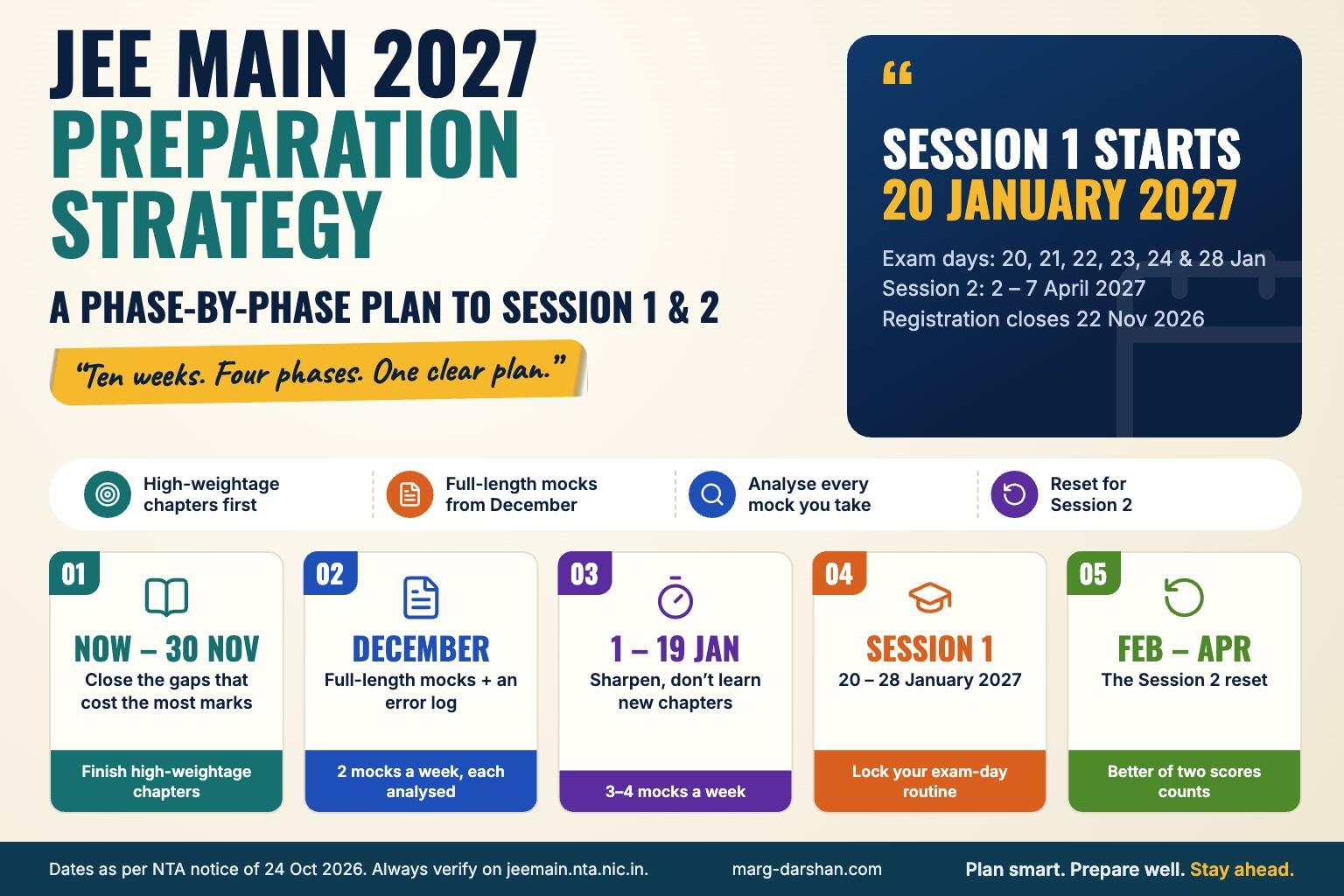
JEE Main 2027 Session 1 starts on 20 January 2027, so if you are reading this in November you have roughly ten weeks. That is enough time to move your score meaningfully, but not enough to learn everything again.
The plan below splits the time into four phases: close the high-weightage gaps, start full-length mocks, sharpen in January, then reset for Session 2 in April. Each phase says what to study, how many mocks to take and what to do with them.
JEE Main 2027 key dates
| JEE Main 2027 milestone | Date |
|---|---|
| Session 1 registration | 24 October – 22 November 2026 |
| Session 1 correction window | 27 – 29 November 2026 |
| Session 1 admit card | 13 January 2027 |
| Session 1 exam | 20, 21, 22, 23, 24 and 28 January 2027 |
| Session 2 registration | 5 January – 3 February 2027 |
| Session 2 exam | 2 – 7 April 2027 |
Dates are from the JEE Main 2027 Information Bulletin (NTA, 24 October 2026). NTA can revise them, so always confirm on jeemain.nta.nic.in. For eligibility, fees and the full syllabus, see the JEE Main 2027 complete guide.
The JEE Main 2027 exam in one table
Know exactly what you are training for. Paper 1 (B.E./B.Tech) is a three-hour computer-based test:
| Physics | Chemistry | Mathematics | |
|---|---|---|---|
| Section A (MCQ) | 20 | 20 | 20 |
| Section B (numerical, all compulsory) | 5 | 5 | 5 |
| Marks | 100 | 100 | 100 |
That is 75 questions for 300 marks. Every correct answer earns +4 and every wrong answer costs −1, in both sections. Since 2025 there is no choice inside Section B: all five numericals per subject count, and a wrong numerical loses a mark just like a wrong MCQ. Unattempted questions score zero.
Two consequences follow. First, blind guessing hurts, on numericals as much as on MCQs. Second, speed matters: 75 questions in 180 minutes is about 2 minutes 24 seconds per question, and some questions will need five.
Syllabus: NTA published the 2027 syllabus on 24 October 2026, and it keeps the reduced syllabus used since 2024. Topics such as Communication Systems (Physics), Mathematical Induction, Mathematical Reasoning and Linear Programming (Maths), and Surface Chemistry, s-Block Elements, Polymers and Chemistry in Everyday Life (Chemistry) are not in it. Do not spend December on them.
The four phases at a glance
Goal Finish or repair every high-weightage chapter before mocks begin.
Goal Two full-length mocks a week, each followed by a proper analysis.
Goal Three to four mocks a week, no new chapters, exam-day routine locked in.
Goal A ten-week cycle of its own, aimed at the chapters Session 1 exposed.
Phase 1 (now – 30 November): close the gaps that cost the most marks
You will not have time to perfect all three subjects, so rank chapters by two things: how many questions they usually carry, and how weak you are in them. Our JEE Main chapter-wise weightage for 2027 lists which chapters have carried the most questions in recent papers. Combine that with an honest self-rating (strong / shaky / not done) and work from the top of the "high weightage + shaky" list down.
A practical split for these weeks:
70%
High-weightage chapters you are shaky in.
20%
Questions from chapters you already know, so they stay warm.
10%
Formula sheets and NCERT lines for Chemistry, which reward revision more than any other subject.
Two tasks you must not forget in Phase 1:
- Register for Session 1 before 22 November 2026. Keep your photo, signature and Class 10 and 12 details ready.
- Take one full-length diagnostic mock this month, ideally on a computer and in one sitting. You are not chasing a score yet. You want a baseline: which subject leaks the most marks, and whether you run out of time. Margdarshan's JEE Main Test Series gives Class 12 students three complete mocks free, with full solutions and the analysis report, so your first diagnostic costs nothing.
If you are not sure whether your preparation is on track, run through the JEE Main 2027 readiness checklist at the end of this phase.
Phase 2 (1 – 31 December): start full-length mocks and an error log
December is when most students either take too few mocks or take too many without learning from them. Two a week is the right rhythm: enough to build stamina, with enough days between them to fix what each mock exposes.
How to take a mock so the score means something
- Sit for the full three hours, at the same time as your exam shift (9 AM or 3 PM).
- Use a laptop or desktop. The real exam is computer-based, and reading a long question on a phone trains the wrong habits.
- No pausing, no checking answers mid-way, no music.
- Treat your first attempt as the real score. Re-attempts are useful for learning, but they inflate your numbers if you count them.
How to analyse a mock (this is where the marks come from)
Spend at least as long analysing a mock as you spent taking it. Go through every question you got wrong, skipped or took more than four minutes on, and put each one in exactly one bucket:
| Bucket | What it looks like | What to do |
|---|---|---|
| Silly mistake | You knew the method; a sign, unit or calculation slipped | Write the exact slip in your error log; re-solve the question without looking |
| Concept gap | You did not know the idea or formula | Re-study that topic, then solve 15–20 questions on it before the next mock |
| Time trap | You could solve it, but it took too long | Practise that question type against a timer; learn when to skip it |
| Guess gone wrong | You marked an answer you were unsure of and lost a mark | Set a rule: attempt only when you can eliminate at least two options |
Add up the marks lost in each bucket. If silly mistakes cost you 20 or more marks, your next week is about accuracy, not new chapters. If concept gaps dominate, go back to Phase 1 for those chapters. Our guide on how to analyse a JEE Main mock test walks through a full example.
Keep all of this in one error log: a notebook or sheet with the question, the bucket, the correct idea in one line, and the date. Re-read it every Sunday. By January, that log is the most valuable revision material you own, because it is built from your own mistakes.
The Margdarshan test series report does the first part of this for you: it separates marks lost to silly mistakes from marks lost to gaps, shows time spent per question, and lists the chapters to fix next. You still need to do the re-solving yourself.
Phase 3 (1 – 19 January): sharpen, don't learn
The three weeks before Session 1 are for converting what you know into marks:
- Mocks: three or four full-length papers a week, still analysed, but faster: 60–90 minutes per mock.
- Revision: your error log, formula sheets, and NCERT Chemistry. Stop opening new chapters by about 10 January; a half-learned chapter usually costs more marks through confusion than it earns.
- Attempt order: decide your subject order and stick to it. Many students start with the subject they score most consistently in (often Chemistry), bank those marks, then move on. Try two or three orders in your mocks and keep the one that gives the highest first-attempt score, not the one that feels best.
- Time boxes: roughly 60 minutes per subject, with a firm rule to leave any question after three minutes and come back if time remains.
- Sleep and shift time: from mid-January, wake up and study at the hours of your exam shift.
For a day-by-day version of this stretch, see the last 30 days strategy for JEE Main 2027 and the daily timetable for JEE Main 2027.
Phase 4 (February – April): the Session 2 reset
Session 1 results come out within a few weeks of the exam. Whatever your percentile, Session 2 on 2–7 April 2027 is a second full attempt, and NTA uses your better score of the two. Treat the gap as a ten-week cycle of its own:
- Week 1 after the exam: rest for two or three days, then write down from memory where you lost time and marks.
- February: go back to Phase 1 for the chapters Session 1 exposed. Most students improve most in the subject they scored lowest in.
- March: two mocks a week, rising to three or four in the final fortnight, with the same analysis routine.
- Board exams: if you are in Class 12, your boards fall in this window. Plan mocks around board dates rather than skipping them altogether; one full mock a week keeps your exam speed.
Remember the board-marks rule for admission: you need 75% in Class 12 (65% for SC/ST) or a top-20-percentile result in your board for NITs, IIITs and IITs. Our 75% criteria explainer covers the details, and you can check yourself with the eligibility checker.
How many mocks should you take before JEE Main 2027?
Following the plan above, a Class 12 student takes about 15–20 full-length mocks before Session 1 and another 12–15 before Session 2. More than that rarely helps unless every mock is analysed. The number that matters is not how many papers you finish but how many mistakes from your error log stop repeating.
| Phase | Full-length mocks | Analysis per mock |
|---|---|---|
| Phase 1 (till 30 Nov) | 1 diagnostic | 3 hours |
| Phase 2 (December) | 8–9 (two a week) | 2–3 hours |
| Phase 3 (1–19 Jan) | 8–10 (three or four a week) | 60–90 minutes |
| Phase 4 (Feb–Apr) | 12–15 | 1–2 hours |
Subject-wise priorities in brief
Physics
Usually decides rank differences among well-prepared students. Mechanics, Electrostatics and Current Electricity, Modern Physics and Optics carry the most questions; numericals often come from these. Full strategy: Physics for JEE.
Chemistry
The fastest subject to improve in the last months. Inorganic rewards NCERT line-by-line revision; Physical rewards formula practice; Organic rewards reaction maps. Full strategy: Chemistry for JEE.
Mathematics
The longest paper for most students. Calculus, Coordinate Geometry, Vectors and 3D, and Algebra carry the bulk; the time trap is the main risk, so practise skipping.
Five mistakes that cost students the most marks
- Taking mocks without analysing them. A mock you do not analyse is three hours of practice in getting the same things wrong.
- Learning new chapters in January. Revise what you know instead.
- Counting re-attempt scores. Only your first attempt predicts exam day.
- Guessing numericals. They carry −1 now. Attempt only what you have worked out.
- Practising only on paper or phone. The exam is on a computer screen; your mocks should be too.
If you are in Class 11 or taking a drop year
Your JEE Main is in January 2028. Use this year to build chapter strength with chapter and topic tests, not full-length papers covering material you have not studied yet. Full mocks make sense once your syllabus can carry them, usually from mid-Class 12.
Your advantage is time and a full syllabus already seen once. Start full-length mocks from Phase 2 straight away and lean harder on the error log, because repeated mistakes are what usually separate a dropper's second attempt from their first. If you are still deciding, read our honest advice on dropping a year.
Practise on the real interface: Margdarshan JEE Main Test Series 2027
Everything above depends on full-length mocks that behave like the real paper. The Margdarshan JEE Main Test Series gives you:
- 50+ full-length mocks on the same layout, timer and question palette as the NTA computer-based test, built on the current 75-question, 300-mark pattern.
- A worked solution for every question, not just the answer key.
- An analysis report after every mock that separates marks lost to silly mistakes from marks lost to gaps, with time per question and the chapters to fix next.
- Your first attempt saved as your exam-condition score, with unlimited re-attempts for practice.
- 10,000+ questions as chapter and topic-wise tests for Phase 1 gap-filling.
Start with three full mocks free (Class 12, phone number only, no card). The full series is a single payment of ₹999 with a 7-day full refund. Once you have a score, the JEE Main college predictor shows which colleges fit it.
Start free: take Mock 1 →Frequently asked questions
Session 1 is on 20, 21, 22, 23, 24 and 28 January 2027, and Session 2 is on 2–7 April 2027, as per NTA's Information Bulletin of 24 October 2026. Registration for Session 1 closes on 22 November 2026.
No, but you need to prioritise. With about ten weeks to Session 1, focus on high-weightage chapters you are weak in, start full-length mocks in December, and use Session 2 in April as a second full attempt.
About 15–20 full-length mocks before Session 1 and 12–15 before Session 2 is enough, as long as you analyse each one. Analysing a mock matters more than taking extra ones.
Yes. In the current pattern, wrong answers lose one mark in both Section A (MCQs) and Section B (numericals), and all five numericals in each subject are compulsory.
Yes. If you appear in both sessions, your better NTA score is used for the merit list.
Yes. NTA offers mock tests on its website, and the Margdarshan JEE Main Test Series gives Class 12 students three complete full-length mocks free, with solutions and an analysis report. See free JEE Main mock tests 2027.
JEE Main Test Series
50 full-length mocks on the exact NTA interface, with a worked solution for every question and a chapter-wise report. Start with free mocks.
Need Mentorship?
Want a personalised career roadmap? Book a 1-on-1 counselling session.
College Predictor
Confused which college to target? Use our JEE Main Predictor to see your college options by rank.
Comments
Leave a Comment
Please log in to leave a comment.
Newsletter
GET STARTED WITH MARGDARSHAN
Get weekly: JEE strategy, college cutoff updates, career paths after PCM, and insider tips from IITians. Free. Unsubscribe anytime.