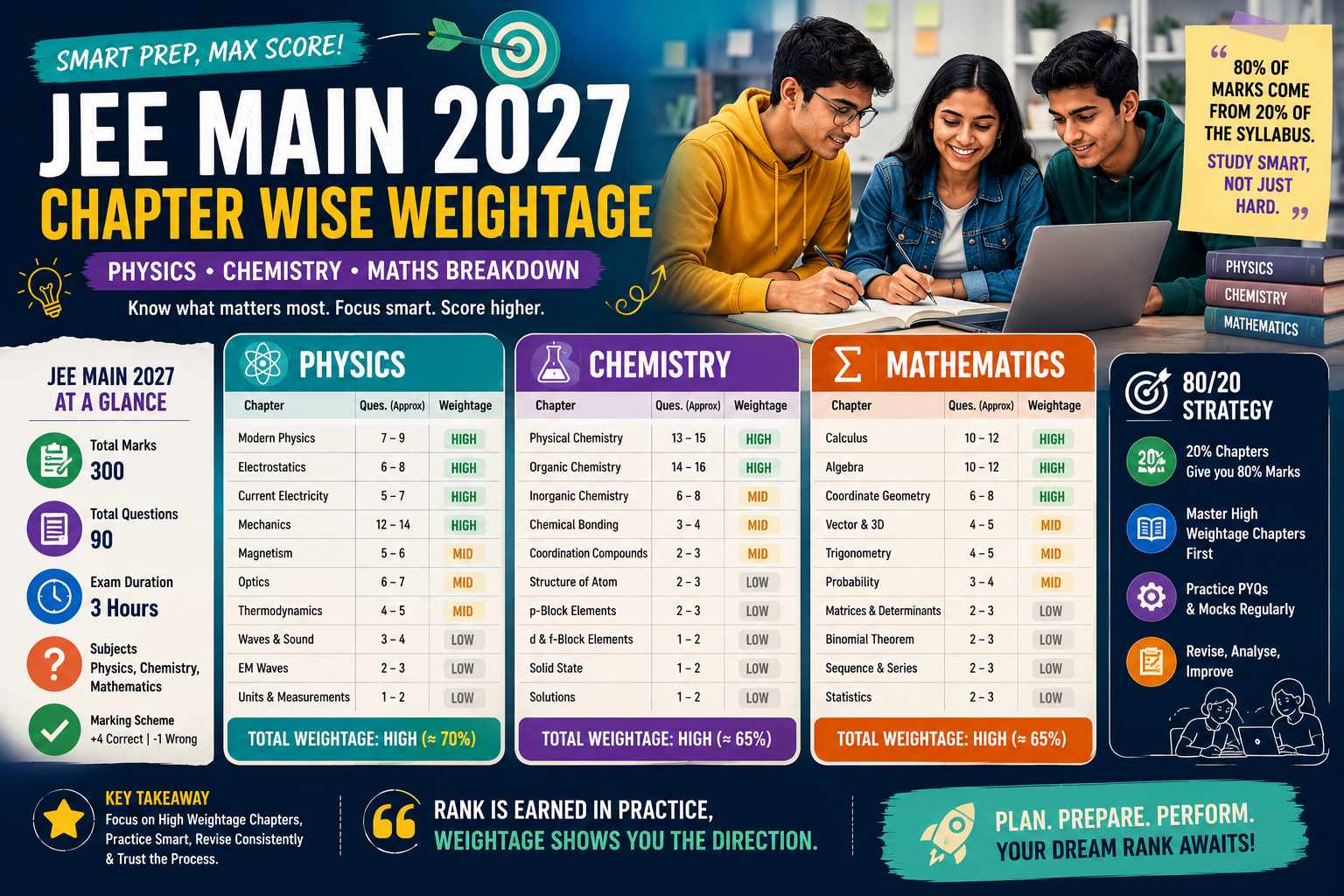
In JEE Main preparation, the 80/20 principle is very real. A minority of chapters often contributes a majority of the marks. That does not mean you ignore the full syllabus. It means you stop treating every chapter with the same urgency.
For JEE Main 2027 and 2028 aspirants, the smart question is not "Which chapter should I study?" The smart question is: "Which chapters carry the most weight, and where am I personally losing marks?" This JEE Main chapter wise weightage 2027 guide gives you a complete subject-wise breakdown of the syllabus, organised from higher to lower trend weightage.
Before you use this list, remember one thing. NTA does not promise fixed chapter-wise weightage. The figures below are approximate, trend-based estimates from recent JEE Main paper patterns and the current official syllabus direction. Use them as a priority map, not as a guarantee.
Physics: JEE Main Syllabus Weightage Breakdown
Physics in JEE Main is usually more formula-and-concept application oriented than JEE Advanced. The JEE Main high weightage chapters in Physics repeatedly include Modern Physics, Current Electricity, Electrostatics, Ray Optics, Magnetism, EMI/AC, Thermodynamics, SHM/Waves, and Mechanics. But the safer approach is to cover every major chapter because Physics questions are often interlinked.
| Rank | Physics Chapter / Topic | Approx Questions | Approx Marks | Priority Note |
|---|---|---|---|---|
| 1 | Modern Physics: atoms, nuclei, photoelectric effect, dual nature High | 3-4 | 12-16 | Very scoring if formulas and NCERT facts are clear. |
| 2 | Current Electricity High | 2-3 | 8-12 | Circuits, meters, resistance combinations and drift concepts repeat often. |
| 3 | Electrostatics and Capacitors High | 2-3 | 8-12 | Strong overlap with potential, field and energy concepts. |
| 4 | Magnetism and Magnetic Effects of Current High | 2 | 8 | Biot-Savart, Ampere, force on charge/current, moving coil galvanometer. |
| 5 | Ray Optics and Wave Optics High | 2-3 | 8-12 | Ray optics is usually more direct; wave optics needs concept clarity. |
| 6 | EMI and Alternating Current High | 2 | 8 | Induction, LCR, resonance and power factor are frequent. |
| 7 | Thermodynamics and Kinetic Theory High | 2 | 8 | Often formula-driven; overlaps with Chemistry basics. |
| 8 | Rotational Motion Medium | 1-2 | 4-8 | Can be tricky, but high-value for serious rank improvement. |
| 9 | Laws of Motion, Friction and Circular Motion Medium | 1-2 | 4-8 | Foundation for mechanics and mixed problems. |
| 10 | Work, Energy and Power Medium | 1-2 | 4-8 | Scoring if conservation methods are strong. |
| 11 | Centre of Mass, Momentum and Collisions Medium | 1 | 4 | Frequently appears as single-concept questions. |
| 12 | Gravitation Medium | 1 | 4 | Formula-heavy and usually manageable. |
| 13 | Simple Harmonic Motion and Waves Medium | 1-2 | 4-8 | Important for oscillations, sound, strings and wave equations. |
| 14 | Semiconductors and Electronic Devices Medium | 1 | 4 | Often direct and NCERT-style; do not skip. |
| 15 | Units, Dimensions, Errors and Measurements Medium | 1 | 4 | Easy marks if practised. |
| 16 | Kinematics and Vectors Maintain | 0-1 | 0-4 | Low direct weightage but essential for mechanics. |
| 17 | Properties of Solids and Fluids Maintain | 0-1 | 0-4 | Surface tension, viscosity and elasticity appear shift-wise. |
| 18 | Experimental Skills Medium | 1 | 4 | Recent papers include practical/measurement-based questions. |
Chemistry: JEE Main Chapter Wise Weightage 2027
Chemistry is often the most scoring subject in JEE Main because many questions are direct if NCERT, formulas and reaction logic are strong. The most important chapters JEE Main students should not ignore include Chemical Bonding, Coordination Compounds, General Organic Chemistry, Hydrocarbons, Biomolecules, Thermodynamics, Equilibrium, Electrochemistry, Mole Concept and Periodic Trends.
| Rank | Chemistry Chapter / Topic | Approx Questions | Approx Marks | Priority Note |
|---|---|---|---|---|
| 1 | Chemical Bonding and Molecular Structure High | 2-3 | 8-12 | VSEPR, hybridisation, MOT and bond properties are must-do. |
| 2 | Coordination Compounds High | 2 | 8 | High scoring: nomenclature, isomerism, CFT and magnetic properties. |
| 3 | General Organic Chemistry and Isomerism High | 2 | 8 | The base for the full organic section. |
| 4 | Hydrocarbons and Aromatic Compounds Medium | 1-2 | 4-8 | Reaction mechanisms and aromatic stability matter. |
| 5 | Aldehydes, Ketones, Carboxylic Acids and Derivatives Medium | 1-2 | 4-8 | Regularly tested through reactions and conversions. |
| 6 | Amines and Organic Compounds Containing Nitrogen Medium | 1 | 4 | Direct reactions, basicity and tests are common. |
| 7 | Biomolecules and Chemistry in Everyday Life type topics Medium | 1-2 | 4-8 | NCERT-based, quick scoring if revised often. |
| 8 | Mole Concept and Stoichiometry Medium | 1-2 | 4-8 | Foundation for Physical Chemistry numericals. |
| 9 | Atomic Structure Medium | 1 | 4 | Quantum numbers, spectra and Bohr model appear often. |
| 10 | Chemical Thermodynamics Medium | 1-2 | 4-8 | Formula clarity gives quick marks. |
| 11 | Chemical and Ionic Equilibrium Medium | 1-2 | 4-8 | Can be calculation-heavy; very important for rankers. |
| 12 | Electrochemistry Medium | 1 | 4 | Nernst equation, conductance and cells are common. |
| 13 | Chemical Kinetics Medium | 1 | 4 | Usually direct if rate law and half-life are clear. |
| 14 | Solutions Medium | 1 | 4 | Colligative properties and concentration terms are key. |
| 15 | Periodic Table and Periodic Properties Medium | 1 | 4 | Supports inorganic reasoning across chapters. |
| 16 | p-Block Elements Medium | 1-2 | 4-8 | NCERT lines, trends and compounds matter. |
| 17 | d- and f-Block Elements Medium | 1 | 4 | Oxidation states, colour, magnetism and lanthanoid contraction. |
| 18 | Purification and Characterisation of Organic Compounds Maintain | 0-1 | 0-4 | Basic methods and qualitative analysis can appear. |
| 19 | Some Basic Principles of Practical Chemistry Maintain | 0-1 | 0-4 | Practical and lab-based questions are increasingly useful. |
Mathematics: JEE Main High Weightage Chapters
Mathematics is usually the lengthiest subject in JEE Main. The questions may not always be impossible, but they are time-consuming. Your 80/20 JEE preparation strategy in Maths should focus on chapters that repeatedly give multiple questions: Vectors and 3D, Matrices and Determinants, Calculus, Coordinate Geometry, Probability, Complex Numbers and Algebra.
| Rank | Maths Chapter / Topic | Approx Questions | Approx Marks | Priority Note |
|---|---|---|---|---|
| 1 | Vectors and 3D Geometry High | 3-4 | 12-16 | One of the most reliable high-weightage clusters. |
| 2 | Matrices and Determinants High | 2-3 | 8-12 | Often direct and scoring with enough practice. |
| 3 | Limits, Continuity and Differentiability High | 2 | 8 | Foundation for calculus and mixed questions. |
| 4 | Application of Derivatives Medium | 1-2 | 4-8 | Monotonicity, maxima-minima and tangents/normals repeat. |
| 5 | Indefinite and Definite Integration High | 2 | 8 | Needs formula memory plus pattern recognition. |
| 6 | Area Under Curve and Differential Equations Medium | 1-2 | 4-8 | Generally more manageable than heavy integration. |
| 7 | Circle, Parabola, Ellipse and Hyperbola High | 2-3 | 8-12 | Coordinate geometry is a consistent scoring zone. |
| 8 | Straight Lines and Pair of Lines Medium | 1 | 4 | Basic but used across conics. |
| 9 | Complex Numbers Medium | 1-2 | 4-8 | Geometry of complex numbers is important. |
| 10 | Quadratic Equations and Expressions Medium | 1 | 4 | Foundational for algebra and inequalities. |
| 11 | Sequences and Series Medium | 1-2 | 4-8 | AP, GP, HP and special series are common. |
| 12 | Binomial Theorem Medium | 1 | 4 | Easy to revise, often scoring. |
| 13 | Permutation and Combination Medium | 1 | 4 | Can be tricky; practise cases carefully. |
| 14 | Probability Medium | 1-2 | 4-8 | Repeatedly useful, especially with P&C basics. |
| 15 | Statistics Medium | 1 | 4 | Usually direct and high ROI. |
| 16 | Trigonometry and Inverse Trigonometric Functions Medium | 1-2 | 4-8 | Low direct weightage but used everywhere. |
| 17 | Sets, Relations and Functions Medium | 1 | 4 | Basic definitions and graph sense matter. |
| 18 | Mathematical Reasoning Maintain | 0-1 | 0-4 | Often quick marks if included in latest syllabus. |
How to Actually Use This Weightage List
Knowing the JEE Main syllabus weightage is useful, but it is not enough. Every student reads the same "important chapters" list. The students who improve faster do something extra: they track their own per-chapter accuracy after every mock test.
For example, suppose Current Electricity is high weightage and you attempted four questions across recent mocks. If you got only one correct, that chapter is not just high weightage; it is personally weak. That becomes your priority. But if you are already getting 90% accuracy in Modern Physics, spending another full week there may give less improvement than fixing Electrostatics or Matrices.
Make three buckets after every mock. Bucket A: high-weightage chapters where accuracy is below 60%. These are urgent. Bucket B: high-weightage chapters where accuracy is 60-80%. These need revision and mixed practice. Bucket C: low-weightage or already-strong chapters. These should be maintained through short revision, not ignored completely.
This method prevents the common JEE mistake: revising what feels comfortable. Many students keep solving chapters they already know because it gives confidence. Rank improves when you fix uncomfortable chapters that also carry marks. That is where the 80/20 approach becomes practical.
- After every mock, tag each wrong question by chapter.
- Calculate chapter-wise attempts, correct answers and accuracy.
- Separate "I didn't know the concept" from "I made a silly mistake."
- Fix high-weightage chapters with low accuracy first.
- Revise low-weightage chapters through short formula and NCERT sprints.
This is the real 80/20. Not just "study important chapters." It is "find the 20% of high-weightage chapters that are currently damaging my score, then fix them before the next mock."
FAQs on JEE Main Chapter Wise Weightage 2027
Can I crack JEE Main by doing only high-weightage chapters?
You can improve your score quickly, but relying only on high-weightage chapters is risky because NTA changes distribution across shifts. Use high-weightage chapters for priority, not for skipping the full syllabus.
How often should I update my chapter-wise priority list?
Update it after every full mock and every major part test. Your weak chapters in August may not be your weak chapters in December. A good test series should make this movement visible.
Which subject gives the fastest score improvement?
For many students, Chemistry improves fastest because NCERT and repeated patterns help. But the real answer depends on your chapter-wise accuracy, not general advice.
Join the Margdarshan JEE Main Test Series 2027-28 Waitlist
The waitlist is open now. Margdarshan's JEE Main Test Series is built to track your accuracy on exactly these high-weightage chapters after every mock, so you always know which 20% to fix next.
EARLYBIRD price: ₹499 for the first 100 students. Standard price: ₹999. Launching soon.
Weightage varies and outcomes depend on the individual student, effort, consistency and exam-day performance.
Join the Waitlist