JEE Main Chapter-wise Weightage 2024–2026: 35 Papers Counted
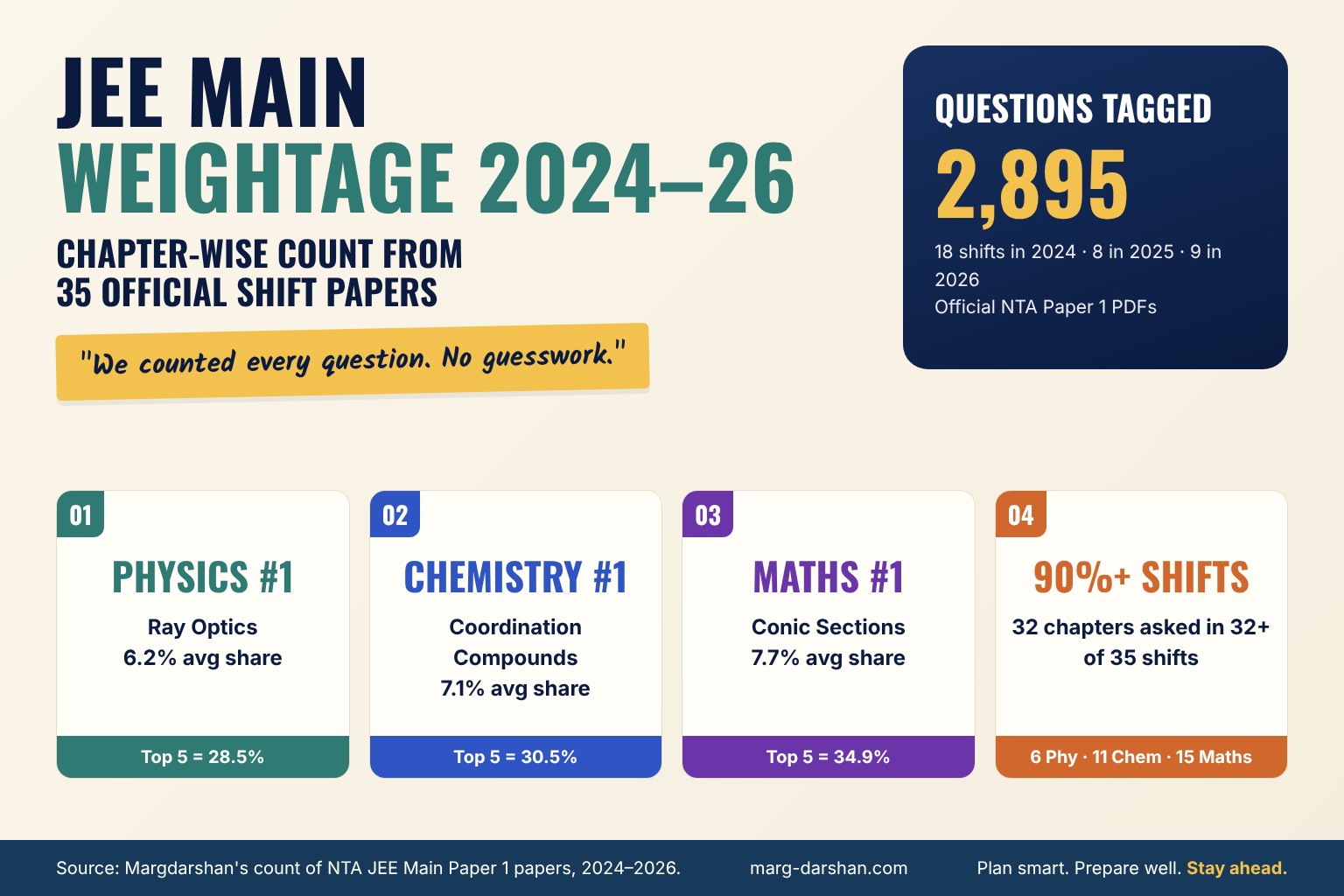
Most weightage lists online are copied from each other. We counted ours. We tagged every question in 35 official JEE Main Paper 1 shift papers from 2024, 2025 and 2026: 2,895 questions, each one assigned to a chapter and checked against the paper images.
Below: the top 5 chapters per subject, the chapters that appeared in 90%+ of shifts, the numerical-heavy chapters, and the caveats you should know before you use any of it. We do not predict 2027 here. This is what the last three years actually asked.
What we counted
Only B.Tech Paper 1, only years on the current syllabus. Pre-2024 papers are left out because the syllabus changed.
| Year | Shifts | Questions | Per subject per shift |
|---|---|---|---|
| 2024 | 18 (8 Jan/Feb + 10 Apr) | 1,620 | 20 MCQ + 10 numerical (attempt 5) = 30 |
| 2025 | 8 (April only) | 600 | 20 MCQ + 5 numerical = 25 |
| 2026 | 9 (April only) | 675 | 25 |
| Total | 35 | 2,895 |
Each chapter's share of questions is worked out for each year separately, and then the three yearly shares are averaged. That way 2024's bigger sample (18 shifts) does not drown out 2025 and 2026.
Top 5 chapters per subject (2024–2026)
| # | Physics | Avg % | Chemistry | Avg % | Maths | Avg % |
|---|---|---|---|---|---|---|
| 1 | Ray Optics | 6.2 | Coordination Compounds | 7.1 | Conic Sections | 7.7 |
| 2 | Units & Measurements | 5.9 | Hydrocarbons* | 6.2 | 3D Geometry | 7.5 |
| 3 | Kinematics | 5.6 | GOC (Basic Principles)* | 6.2 | Matrices & Determinants | 7.0 |
| 4 | Current Electricity | 5.5 | d- & f-Block | 5.6 | Sets, Relations & Functions | 6.5 |
| 5 | Moving Charges & Magnetism | 5.3 | Equilibrium | 5.3 | Limits, Continuity & Differentiability | 6.2 |
| Top 5 share | 28.5 | 30.5 | 34.9 | |||
| Top 10 share | 51.6 | 54.9 | 60.8 |
* Hydrocarbons has the most borderline tags in Chemistry (22 of its 55 questions could fit two chapters). GOC sits at #3 mostly because of 2024 (8.1%); it was only 4.0% in 2026.
Highest 3-year average, and at least 6.1% every single year (2024: 6.1, 2025: 9.0, 2026: 6.2).
The top 10 Maths chapters carried 60.8% of Maths questions, against 51.6% in Physics. Finishing the big Maths chapters properly pays more than spreading thin.
Chapters asked in 90%+ of the 35 shifts
Weightage tells you how many questions a chapter gets on average. Consistency tells you how often it shows up at all. These chapters appeared in at least 32 of the 35 shifts (number of shifts in brackets).
| Subject | Chapters (shifts out of 35) |
|---|---|
| Physics (6) | Units & Measurements (34), Moving Charges & Magnetism (34), Semiconductors (34), Ray Optics (33), Kinematics (32), Wave Optics (32) |
| Chemistry (11) | Coordination Compounds (35), Atomic Structure (35), Chemical Kinetics (35), Chemical Bonding (34), Solutions (33), Equilibrium (33), Biomolecules (33), d- & f-Block (32), p-Block (32), Hydrocarbons (32), Purification & Characterisation (32) |
| Maths (15) | Matrices (35), Binomial Theorem (35), Sequences & Series (35), Conic Sections (35), 3D Geometry (35), Vectors (35), Sets/Relations/Functions (34), Limits & Continuity (34), Differential Equations (34), Area under Curves (33), Probability (33), Permutations & Combinations (33), Complex Numbers (32), Definite Integration (32), Quadratic Equations (32) |
Thermal Properties of Matter (8 shifts) and Magnetism & Matter (10 shifts). Next lowest: Redox Reactions and Indefinite Integration, 12 shifts each. Rare does not mean skip: it means do these after the consistent chapters, not before.
Weightage is the average student's map. Your mock report is yours. 3 full-length mocks free, no card.
Take a free mock →Numerical-heavy chapters
Across the 35 shifts, each subject offered 265 numerical (integer-answer) questions. These chapters supplied the most. If numericals are your weak spot, practise these chapters in integer format, not just MCQs.
| Physics | Num Q | Chemistry | Num Q | Maths | Num Q |
|---|---|---|---|---|---|
| Current Electricity | 24 | Chemical Kinetics | 25 (60% of its Q) | Limits & Continuity | 20 |
| Moving Charges & Magnetism | 23 | Chemical Thermodynamics | 23 (59%) | Sets/Relations/Functions | 19 |
| Rotational Motion | 23 (50%) | Hydrocarbons | 20 | Conic Sections | 19 |
| Kinematics | 20 | Chemical Bonding | 19 | Differential Equations | 18 |
| Wave Optics | 19 | Solutions | 19 | 3D Geometry | 16 |
Year-to-year changes (and why we don't call them trends)
| Rose (2024 → 2026) | pp | Fell (2024 → 2026) | pp |
|---|---|---|---|
| Equilibrium | +3.4 | GOC (Basic Principles) | −4.1 |
| Ray Optics | +3.1 | Chemical Bonding | −3.6 |
| Hydrocarbons | +2.9 | Current Electricity | −3.5 |
| Mechanical Properties of Solids | +2.7 | Limits/Continuity | −2.4 |
| Conic Sections | +2.6 | Aldehydes, Ketones & Acids | −2.4 |
| Chemical Kinetics | +2.4 | Laws of Motion | −2.3 |
2025 and 2026 cover April shifts only, and the 2026 papers were tagged from images while 2024 was tagged from text extraction. A change under about 2 percentage points may be noise or a tagging difference. Do not drop a chapter because it "fell".
How to use this list (without over-using it)
These show up in almost every shift. A gap here costs you marks in every paper.
The top 10 chapters carried 51.6% (Physics), 54.9% (Chemistry) and 60.8% (Maths) of questions across the three years.
After each full-length mock, the Margdarshan report puts "Fix these 3 chapters first" at the top: the chapters that cost you the most marks. Cross-check that with this list, and spend the week there.
Note for parents
A weightage list helps your child decide what to revise first; it does not tell them what to skip. Every chapter in the syllabus can be asked, and the last three years show that even "rare" chapters turned up in 8–12 shifts. The better question to ask at home is: "Which chapters did your last mock say to fix, and are they on this list?"
Find your own top 3 chapters
Take a full-length JEE Main mock on an NTA-like interface. The report shows "Fix these 3 chapters first", a topic mastery grid, time per question vs ideal, and a difficulty breakdown. 3 full-length mocks free, no card. Full series ₹999, early bird ₹499 till 31 Dec 2026.
Take a free mock →Frequently asked questions
In our count of 35 shift papers (2024–2026): Ray Optics in Physics, Coordination Compounds in Chemistry and Conic Sections in Maths had the highest average share. The full top 5 per subject is in the table above.
We tagged all 2,895 questions in 35 official NTA Paper 1 shift papers to a chapter, checked a random sample and all unclear tags against the paper images, then averaged each chapter's yearly share across 2024, 2025 and 2026.
The JEE Main syllabus changed for 2024. Older papers include topics that are no longer in the syllabus, so they would distort the count.
NTA's January 2025 question-paper PDFs were corrupt on its site, one April 2025 shift was partly blank, and NTA has not published the January 2026 papers. We counted only what we could read from official files.
No. It is a count of what was asked in 2024–2026. Use it to order your revision, not to guess the 2027 paper.
Chemical Kinetics (25) and Chemical Thermodynamics (23) in Chemistry, Current Electricity (24) in Physics, and Limits & Continuity (20) in Maths, out of 265 numericals per subject across the 35 shifts.
Not safely. Even the rarest chapters in our count appeared in 8–12 of the 35 shifts. Do them later, not never.
JEE Main Test Series
50 full-length mocks on the exact NTA interface, with a worked solution for every question and a chapter-wise report. Start with free mocks.
Need Mentorship?
Want a personalised career roadmap? Book a 1-on-1 counselling session.
College Predictor
Confused which college to target? Use our JEE Main Predictor to see your college options by rank.
Comments
Leave a Comment
Please log in to leave a comment.
Newsletter
GET STARTED WITH MARGDARSHAN
Get weekly: JEE strategy, college cutoff updates, career paths after PCM, and insider tips from IITians. Free. Unsubscribe anytime.