JEE Main Physics PYQs: 14 Patterns That Repeat (2024–26)
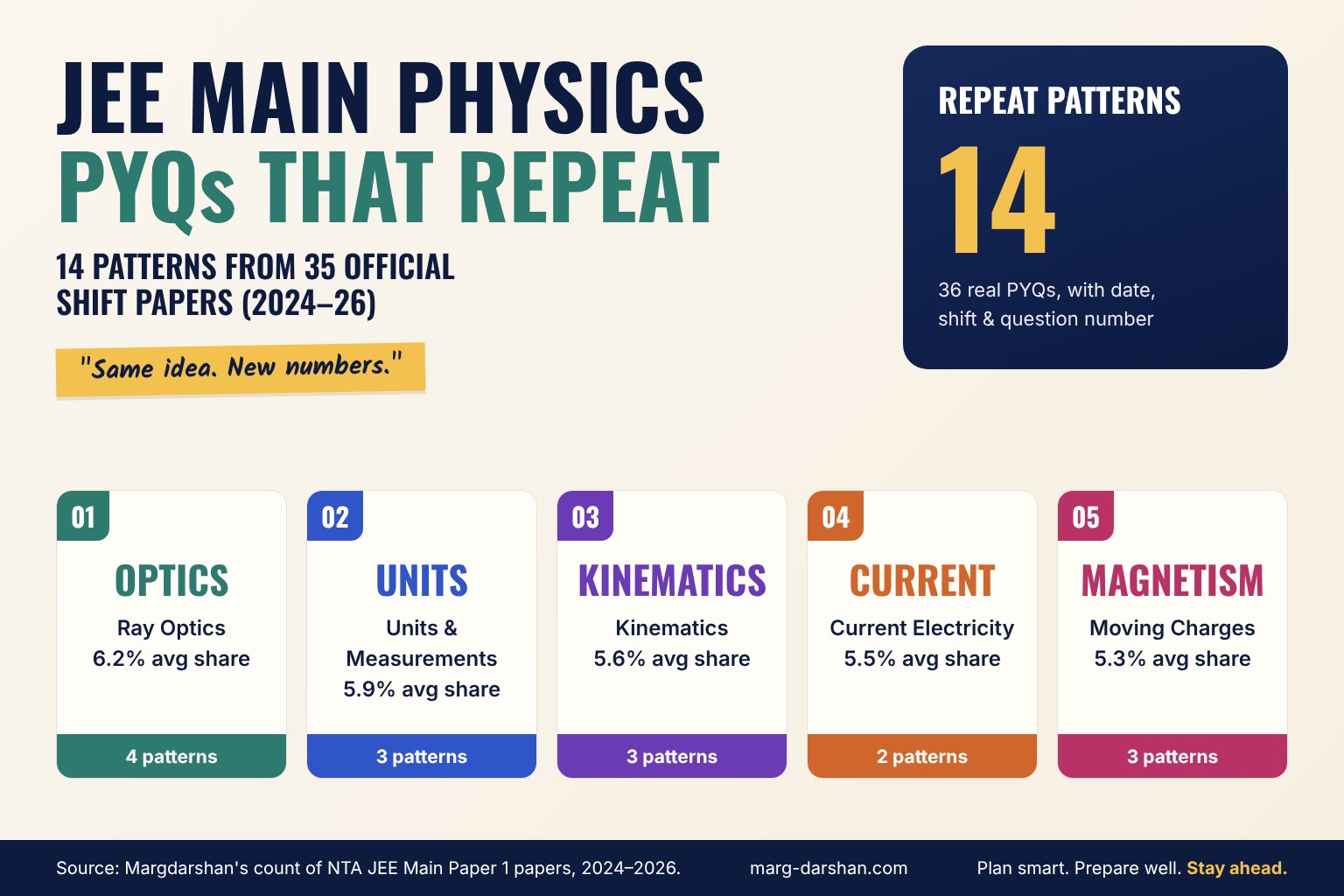
JEE Main keeps asking the same Physics ideas with new numbers. We went through 35 official JEE Main Paper 1 shift papers from 2024, 2025 and 2026 and pulled out the patterns that came back again and again in the 5 Physics chapters with the highest weightage.
Below are 14 repeat patterns. Each one has the real question it came from (date, shift and question number), a short worked solution, and one line to remember. This is not a list of what will come in 2027. It shows what the last three years kept asking, so you can practise it on purpose.
Why these 5 chapters
These are the 5 Physics chapters with the highest average share of questions in our 35-paper chapter-wise weightage count. Together they made up about 28.5% of all Physics questions from 2024 to 2026, which is roughly 7 of the 25 Physics questions in a shift.
| # | Chapter | Avg % of Physics (2024–2026) | Patterns below |
|---|---|---|---|
| 1 | Ray Optics | 6.2 | 4 |
| 2 | Units & Measurements | 5.9 | 3 |
| 3 | Kinematics | 5.6 | 3 |
| 4 | Current Electricity | 5.5 | 2 |
| 5 | Moving Charges & Magnetism | 5.3 | 3 |
"27 Jan 2024 S1 Q45" means the paper held on 27 January 2024, Shift 1, question number 45 in the official NTA paper. "S1" is the morning shift, "S2" the afternoon shift.
1. Ray Optics: 4 patterns
The question (27 Jan 2024 S1 Q45): the refractive index of a prism is cot(A/2), where A is the angle of the prism. Find the angle of minimum deviation. The same question came back four days later on 31 Jan 2024 S1, again as Q45.
Solution: μ = sin((A + δ)/2) / sin(A/2). Put μ = cos(A/2)/sin(A/2). So sin((A + δ)/2) = cos(A/2) = sin(90° − A/2). Then (A + δ)/2 = 90° − A/2, which gives δmin = 180° − 2A (π − 2A).
Related (2 Apr 2025 S2 Q49): prism angle 60°, μ = √2, ray at minimum deviation. Find the angle of incidence. sin((60° + δ)/2) = √2 × sin 30° = 1/√2, so (60° + δ)/2 = 45°. At minimum deviation, i = (A + δ)/2, so i = 45°.
At minimum deviation, i = (A + δ)/2 and r = A/2. If μ is given as cot(A/2), the answer is always δ = 180° − 2A.
30 Jan 2024 S1 Q59: a convex lens forms a real image 2 times the object's size. The object–image distance is 45 cm. Find f. For a real image, the object and image are on opposite sides: |u| + v = 45 with v = 2|u|. So |u| = 15 cm, v = 30 cm, and 1/f = 1/30 + 1/15. That gives f = 10 cm.
1 Feb 2024 S1 Q59 (same question number, two days later): the image is virtual and 3 times the size, and the distance is 20 cm. A virtual image is on the same side, so |v| − |u| = 20 with |v| = 3|u|. So |u| = 10 cm, v = −30 cm, and 1/f = 1/v − 1/u = −1/30 + 1/10. That gives f = 15 cm.
6 Apr 2026 S2 Q50: a concave mirror with f = 10 cm forms an image twice the object's size at two different object positions. Find the distance between the positions. Real image (m = −2): u = −15 cm. Virtual image (m = +2): u = −5 cm. Distance = 10 cm.
Write v in terms of u using m first. Then use the given distance (add for a real image, subtract for a virtual one). Magnification ±m always gives two object positions.
29 Jan 2024 S1 Q45: a biconvex lens with μ = 1.5 has f = 20 cm in air. Find f in a liquid with μ = 1.6. The ratio is fliquid/fair = (1.5 − 1) / (1.5/1.6 − 1) = 0.5 / (−0.0625) = −8. So f = −160 cm. The lens now diverges, because the liquid is optically denser than the glass.
7 Apr 2025 S1 Q42: μ = 1.6, f = 12 cm in air, placed in water with μ = 1.28. The ratio is 0.6 / (1.6/1.28 − 1) = 0.6/0.25 = 2.4. So f = 28.8 cm = 288 mm.
fmedium/fair = (μlens − 1) / (μlens/μmedium − 1). If μmedium > μlens, the sign flips.
6 Apr 2024 S2 Q46: thin convex lens, radii 15 cm and 30 cm, f = 20 cm. 1/20 = (μ − 1)(1/15 + 1/30) = (μ − 1)(1/10). That gives μ = 1.5.
3 Apr 2025 S1 Q42: radii 10 cm and 15 cm, f = 12 cm. 1/12 = (μ − 1)(1/10 + 1/15) = (μ − 1)(1/6). The answer is again μ = 1.5.
For a biconvex lens, 1/f = (μ − 1)(1/R1 + 1/R2), using magnitudes. If your answer is not a clean value like 1.5, recheck the signs.
Can you solve these in under 2 minutes each? A full-length mock shows your time per question against the ideal time.
Take a free mock →2. Units & Measurements: 3 patterns
27 Jan 2024 S1 Q31 (two statements). Statement I: Planck's constant and angular momentum have the same dimensions. Statement II: linear momentum and moment of force have the same dimensions. h = E/ν = [ML²T⁻¹], and L = mvr = [ML²T⁻¹], so Statement I is true. Momentum is [MLT⁻¹] and torque is [ML²T⁻²], so Statement II is false.
4 Apr 2025 S2 Q41 used the same Statement I. This time Statement II said that in Bohr's model, angular momentum is an integral multiple of Planck's constant. That is false: it is an integral multiple of h/2π. So again I is correct and II is incorrect.
3 Apr 2025 S2 Q26 asked for Planck's constant again, this time in a match-the-list question with the Boltzmann constant [ML²T⁻²K⁻¹], the coefficient of viscosity [ML⁻¹T⁻¹] and thermal conductivity [MLT⁻³K⁻¹].
h = [ML²T⁻¹] = angular momentum. In Bohr's model, L = nh/2π, not nh. NTA often hides a trap in the second statement.
8 Apr 2024 S2 Q31: find the dimensions of ε₀E². The energy density of an electric field is ½ε₀E², so ε₀E² = energy/volume = [ML²T⁻²]/[L³] = [ML⁻¹T⁻²], the same as pressure.
2 Apr 2026 S1 Q26: the same idea, two years later. ½ε₀E² = MaLbTc, find 2a − b + c. With a = 1, b = −1 and c = −2: 2(1) − (−1) + (−2) = 1.
½ε₀E², B²/2μ₀, pressure and energy density all have the dimensions [ML⁻¹T⁻²]. Don't derive it in the exam. Just recognise it.
31 Jan 2024 S1 Q50: the percentage errors in the length and the diameter of a wire are 0.1% each. Find the % error in its resistance. R = ρl/(πd²/4), so %R = %l + 2 × %d = 0.1 + 0.2 = 0.3%.
The 2026 papers asked the same thing for the density of a cylinder and the volume from the diameter. Each time, the error is multiplied by the power of the quantity.
If Q = aᵖbᵠ/cʳ, then %Q = p·%a + q·%b + r·%c. Errors always add, even for the quantity you divide by.
3. Kinematics: 3 patterns
7 Apr 2025 S1 Q31: two projectiles are fired with the same speed at (45° + α) and (45° − α). Find the ratio of their times of flight. T = 2u sinθ/g, so T₁/T₂ = sin(45° + α)/sin(45° − α). Divide the top and bottom by cos 45° cos α: (1 + tan α)/(1 − tan α). Their ranges are equal, because sin 2θ is the same for both angles.
Complementary angles give the same range. Time of flight and maximum height still differ, by the ratio of sines and the ratio of sin² respectively.
8 Apr 2024 S2 Q32: at what angle are the horizontal range and the maximum height equal? R/H = (u² sin 2θ/g) / (u² sin²θ/2g) = 4/tan θ. If R = H, then tan θ = 4, so θ = tan⁻¹(4).
3 Apr 2025 S2 Q27 used the same relation: the range is 3 times the maximum height. So 4/tan θ = 3, which gives tan θ = 4/3 (θ ≈ 53°).
R = 4H/tan θ. Whenever range and height are compared, use this formula and the rest follows.
9 Apr 2024 S1 Q32: the particle covers half the distance at 6 m/s. It covers the other half in two equal time intervals, at 9 m/s and then 15 m/s. Equal times means the second half is covered at (9 + 15)/2 = 12 m/s. Equal distances means the overall average is 2 × 6 × 12/(6 + 12) = 8 m/s.
For equal times, take the simple average. For equal distances, take the harmonic mean, 2v₁v₂/(v₁ + v₂). Most mistakes come from mixing up the two.
4. Current Electricity: 2 patterns
27 Jan 2024 S1 Q41: a wire of resistance R is cut into 5 equal parts, and the parts are joined in parallel. Each part has resistance R/5, and 5 of them in parallel give R/25.
6 Apr 2024 S1 Q58: a wire is stretched until its radius becomes r/2. Find x if the new resistance is xR. The volume stays the same, so the area becomes A/4 and the length becomes 4l. R ∝ l/A rises by 4 × 4, so x = 16.
4 Apr 2024 S2 Q55: two wires of the same material and same mass have radii 2 mm and 4 mm. Same mass means l ∝ 1/A, so R ∝ 1/A² ∝ 1/r⁴. The thinner wire has (4/2)⁴ = 16 times the resistance.
Fixed volume: R ∝ l² ∝ 1/r⁴. Cut into n parts and join in parallel: R/n².
8 Apr 2024 S1 Q56: R = 10 Ω at 0 °C, 10.2 Ω at 100 °C and 10.95 Ω at t °C. Find t in kelvin. α = 0.2/(10 × 100) = 2 × 10⁻⁴ per °C. Then 10.95 = 10(1 + αt), so t = 475 °C, which is about 748 K.
29 Jan 2024 S1 Q41: I = I₀ + βt with I₀ = 20 A and β = 3 A/s. Find the charge in 20 s. q = ∫I dt = 20(20) + 3(20²)/2 = 400 + 600 = 1000 C.
Rt = R₀(1 + αt): find α from the first pair of readings, then use it for the third. When I depends on t, q is the area under the I–t graph, so integrate.
5. Moving Charges & Magnetism: 3 patterns
We found this in at least 7 of the 35 papers, in all three years. Here are four of them.
- 29 Jan 2024 S1 Q42: G = 10 Ω, Ig = 3 mA, to read 8 A. Shunt S = IgG/(I − Ig) = 0.03/7.997 ≈ 3.75 × 10⁻³ Ω.
- 9 Apr 2024 S1 Q50: G = 200 Ω, Ig = 20 μA, to read 0–20 mA. S = (20 × 10⁻⁶ × 200)/(0.02 − 0.00002) ≈ 0.20 Ω.
- 1 Feb 2024 S1 Q42: G = 50 Ω, Ig = 5 mA, to make a voltmeter for 100 V. Series R = V/Ig − G = 20,000 − 50 = 19,950 Ω.
- 6 Apr 2026 S2 Q48: a 2 Ω shunt gives a 500 mA full-scale reading, and a 470 Ω series resistor gives a 10 V full-scale reading. Find G. From the shunt, Ig(G + 2) = 1. From the series resistor, Ig(G + 470) = 10. Dividing: G + 470 = 10(G + 2), so G = 50 Ω.
To make an ammeter, add a small shunt in parallel: S = IgG/(I − Ig). To make a voltmeter, add a big resistor in series: R = V/Ig − G.
9 Apr 2024 S2 Q44: a proton and a deuteron with the same kinetic energy move perpendicular to B. r = mv/qB = √(2mK)/qB. Same q and same K means r ∝ √m, so rd : rp = √2 : 1.
7 Apr 2025 S1 Q37 asked for the graph of r against kinetic energy E. Since r ∝ √E, it is a rising curve that bends down (concave).
6 Apr 2024 S1 Q57: a coil with 200 turns, area 2.5 × 10⁻⁴ m² and current 100 μA sits in B = 1 T with M along B. Find the work to turn it by 90°. W = MB(cos 0° − cos 90°) = NIAB = 200 × 10⁻⁴ × 2.5 × 10⁻⁴ × 1 = 5 μJ.
6 Apr 2024 S2 Q58 came the same day, in the other shift. 100 turns, area 5 × 10⁻³ m², current 1 mA, B = 0.20 T, plane of the coil perpendicular to B (so M is along B). W = NIAB = 100 × 10⁻³ × 5 × 10⁻³ × 0.2 = 100 μJ.
r = √(2mK)/qB. For work done in rotating a coil, W = MB(cos θ₁ − cos θ₂). Watch the wording: "plane perpendicular to B" means M is parallel to B.
You will see posts that say "these questions will come in 2027". Nobody knows that. What the data shows is that NTA reuses ideas, sometimes within the same week (P1, P2 and P14). So if you can solve each pattern above in under 2 minutes, you are covered for a chapter that makes up about 5–6% of the Physics paper.
How to use this list (7-day plan)
| Day | Do this | Time |
|---|---|---|
| 1 | Ray Optics P1–P4: solve each referenced PYQ without looking at the solution | 60 min |
| 2 | Units & Measurements P5–P7, plus 10 dimension questions | 45 min |
| 3 | Kinematics P8–P10, plus 10 projectile questions | 60 min |
| 4 | Current Electricity P11–P12, plus 5 circuit questions with a capacitor | 60 min |
| 5 | Moving Charges P13–P14 | 45 min |
| 6 | One full-length mock at your shift time (9 AM or 3 PM) | 3 hrs |
| 7 | Analyse the mock: which of these 14 patterns did you still get wrong, and why? | 90 min |
Session 1 of JEE Main 2027 is on 20, 21, 22, 23, 24 and 28 January 2027. If you start this week, you can go through this list about 9 times before the exam. Once is not enough. Thoda boring hai, par kaam karta hai.
Note for parents
If your child says "I've done this chapter", ask them to solve one pattern from this page in front of you, against a 2-minute timer. That tells you more than hours of study. Repeat patterns reward regular practice, not last-minute cramming. A mock test once a week, followed by an honest look at the mistakes, is the simplest way to see whether the practice is working.
Check these patterns under exam pressure
Take a full-length JEE Main mock on an NTA-like interface. You get step-by-step solutions, time per question vs ideal, a topic mastery grid and a report that says "Fix these 3 chapters first". 3 full-length mocks are free, no card needed. The full series (50+ full-length mocks, 10,000+ chapter and topic questions, 1-year access) costs ₹999, or ₹499 early bird till 31 Dec 2026.
Start your free mock →Frequently asked questions
The exact question rarely repeats, but the idea often does. In our 35-paper check, the prism μ = cot(A/2) question appeared twice in January 2024 (27 Jan S1 Q45 and 31 Jan S1 Q45), and Planck's constant vs angular momentum appeared in both 2024 and 2025.
In our count, Ray Optics, Units & Measurements, Kinematics, Current Electricity and Moving Charges & Magnetism have the highest weightage from 2024 to 2026. Those are the chapters covered on this page.
No one can promise that. Treat these as patterns to practise, not predictions.
From the official NTA JEE Main Paper 1 (B.Tech) shift papers for 2024, 2025 (April) and 2026 (April). Each reference gives the date, shift and question number so you can find the original.
Most of these are 1–2 minute questions once you know the pattern. If one takes you more than 3 minutes, practise it again.
No change has been announced. Check the JEE Main 2027 paper pattern and marking scheme for the current format: 25 Physics questions per shift, +4/−1.
Start with these patterns, because they are where the marks have been concentrated. Then do full shift papers as timed mocks, so you practise choosing which questions to attempt as well as solving them.
JEE Main Test Series
50 full-length mocks on the exact NTA interface, with a worked solution for every question and a chapter-wise report. Start with free mocks.
Need Mentorship?
Want a personalised career roadmap? Book a 1-on-1 counselling session.
College Predictor
Confused which college to target? Use our JEE Main Predictor to see your college options by rank.
Comments
Leave a Comment
Please log in to leave a comment.
Newsletter
GET STARTED WITH MARGDARSHAN
Get weekly: JEE strategy, college cutoff updates, career paths after PCM, and insider tips from IITians. Free. Unsubscribe anytime.