How to Join ISRO After 12th: IIST, IIT & Research Paths | Margdarshan
Ask a Class 11 student who wants to work at ISRO how they plan to get there, and you will usually get one of two answers. Either "I'll crack JEE and get into IIT" — or a shrug, because they assume it is not realistically possible for someone like them.
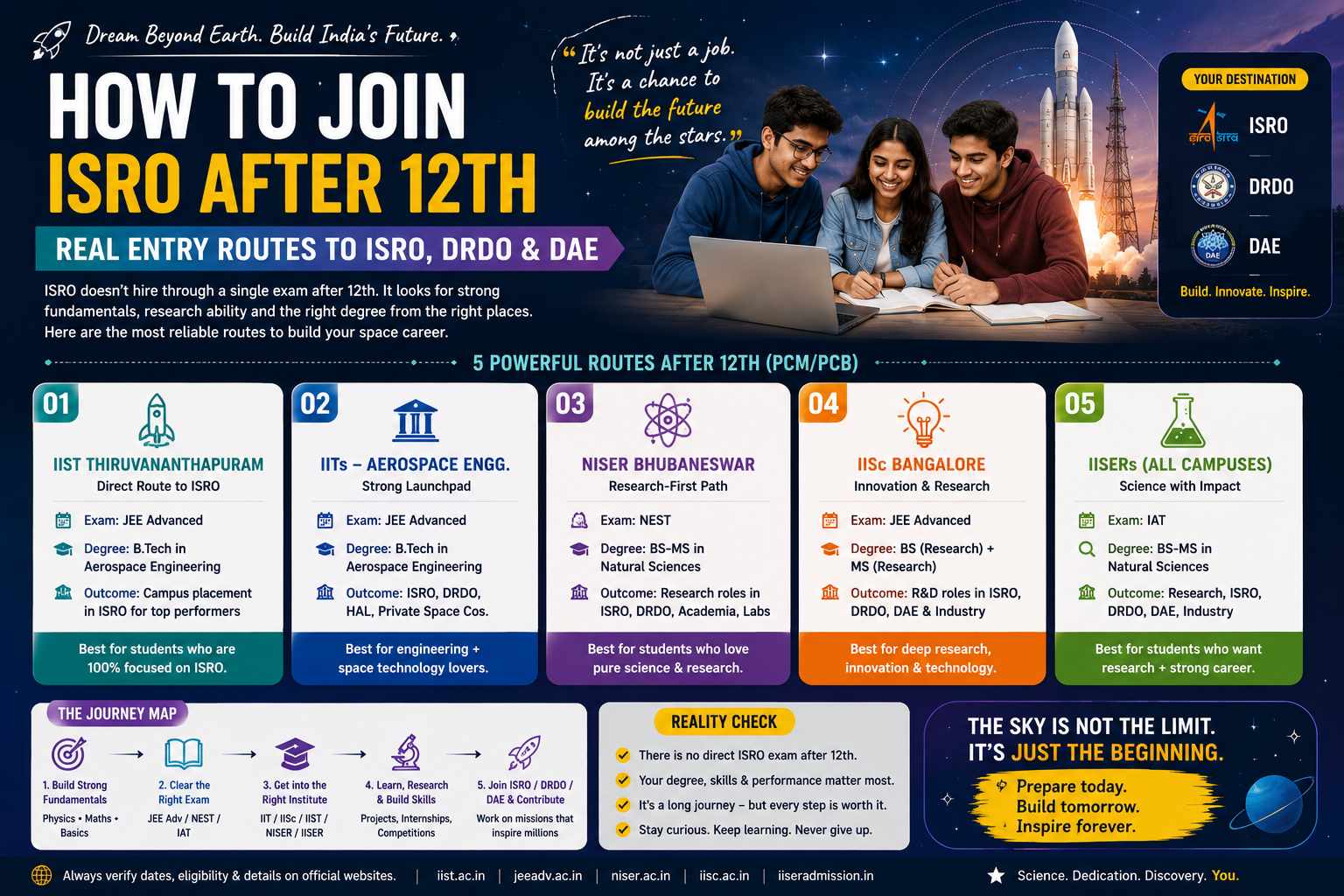
Both responses come from the same misunderstanding. ISRO is not an IIT-only organisation, and it is not unreachable. But it also does not work the way most students imagine. There is no single entrance exam that admits you to ISRO after Class 12. What exists instead are several distinct educational routes — each leading to space, defence or atomic research through a different door, with a different timeline and a different set of requirements.
Understanding those routes properly is what separates students who eventually work at these organisations from students who simply hoped to. This guide covers five of them honestly — what you study, how you enter, and how the path to the organisation actually works.
1. IIST Thiruvananthapuram — The Most Direct Route to ISRO
What you study
The Indian Institute of Space Science and Technology offers B.Tech programs in Aerospace Engineering and Avionics. Aerospace covers propulsion systems, flight mechanics, structural design and orbital dynamics. Avionics covers the electronic systems that control spacecraft — navigation, communication, control systems and onboard computing.
The curriculum is built specifically around space technology rather than general engineering. That focus is what makes IIST distinct from any other engineering institution in India.
How the path to ISRO actually works
- Appear for JEE Advanced after Class 12 and secure a rank that qualifies you for IIST admission.
- Complete the four-year B.Tech in Aerospace Engineering or Avionics.
- Maintain strong academic performance throughout — this is the deciding factor.
- Top-performing students have historically been absorbed directly into ISRO on graduation.
The phrase "IIST ISRO placement" gets repeated online in a way that suggests every IIST graduate walks into ISRO. That is not accurate. Direct absorption has historically applied to top performers only — a limited number of students who meet the required academic standard. Students who do not make that cut follow the same route as everyone else: further study, competitive recruitment, or careers in the wider aerospace and technology sector. IIST gives you the shortest possible path, but it does not remove the competition. It concentrates it into your four years of coursework.
2. IIT Aerospace Engineering — The ICRB Route
What you study
Aerospace Engineering at IIT Bombay, IIT Madras and IIT Kanpur covers aerodynamics, propulsion, flight dynamics, aerospace structures, control systems and computational fluid dynamics. These departments have deep research programs, well-equipped laboratories and faculty working on projects that intersect directly with national space and defence priorities.
How the path to ISRO actually works
- Clear JEE Advanced and secure Aerospace Engineering at IIT Bombay, Madras or Kanpur.
- Complete your four-year B.Tech with strong fundamentals in your core subjects.
- After graduation, apply through ICRB — ISRO's Centralised Recruitment Board — which conducts recruitment for scientist and engineer positions.
- Clear the ICRB written examination and interview process.
ICRB is the standard recruitment channel through which most engineers enter ISRO. It is a genuine competitive examination, open to eligible graduates, and it is how the majority of ISRO's engineering workforce is recruited.
An IIT Aerospace degree does not create any automatic entitlement to an ISRO position. You compete in ICRB alongside graduates from NITs, IIST, state engineering colleges and other institutions. What the IIT degree gives you is depth of preparation and access to research opportunities — real advantages in a competitive examination, but advantages you still have to convert. Many IIT Aerospace graduates also pursue an M.Tech or PhD first, which opens additional research-track entry routes.
3. NISER Bhubaneswar — The Atomic Energy Route
What you study
The National Institute of Science Education and Research offers a five-year Integrated MSc across Physics, Chemistry, Mathematics and Biological Sciences. The first years build a broad scientific foundation before you specialise, and research work is embedded into the program well before the final year.
NISER's institutional relationship matters here: it operates under the Department of Atomic Energy, which is precisely why its graduates have a natural pathway into DAE research institutions.
How the path to DAE actually works
- Appear for NEST — the National Entrance Screening Test — after Class 12.
- Complete the five-year Integrated MSc in your chosen science discipline.
- Build genuine research experience through projects and laboratory work during the program.
- Move into DAE laboratories and research positions, typically via research pathways or further doctoral study.
This is a research career, not an engineering placement. Entry into DAE laboratories typically follows a research trajectory rather than a campus-placement model, and many students pursue a PhD as part of that path. The timeline is longer than an engineering route. What you get in return is the chance to work on nuclear science, materials research and fundamental physics at national laboratories — work that very few people in India get to do. Choose this if the science itself is what draws you.
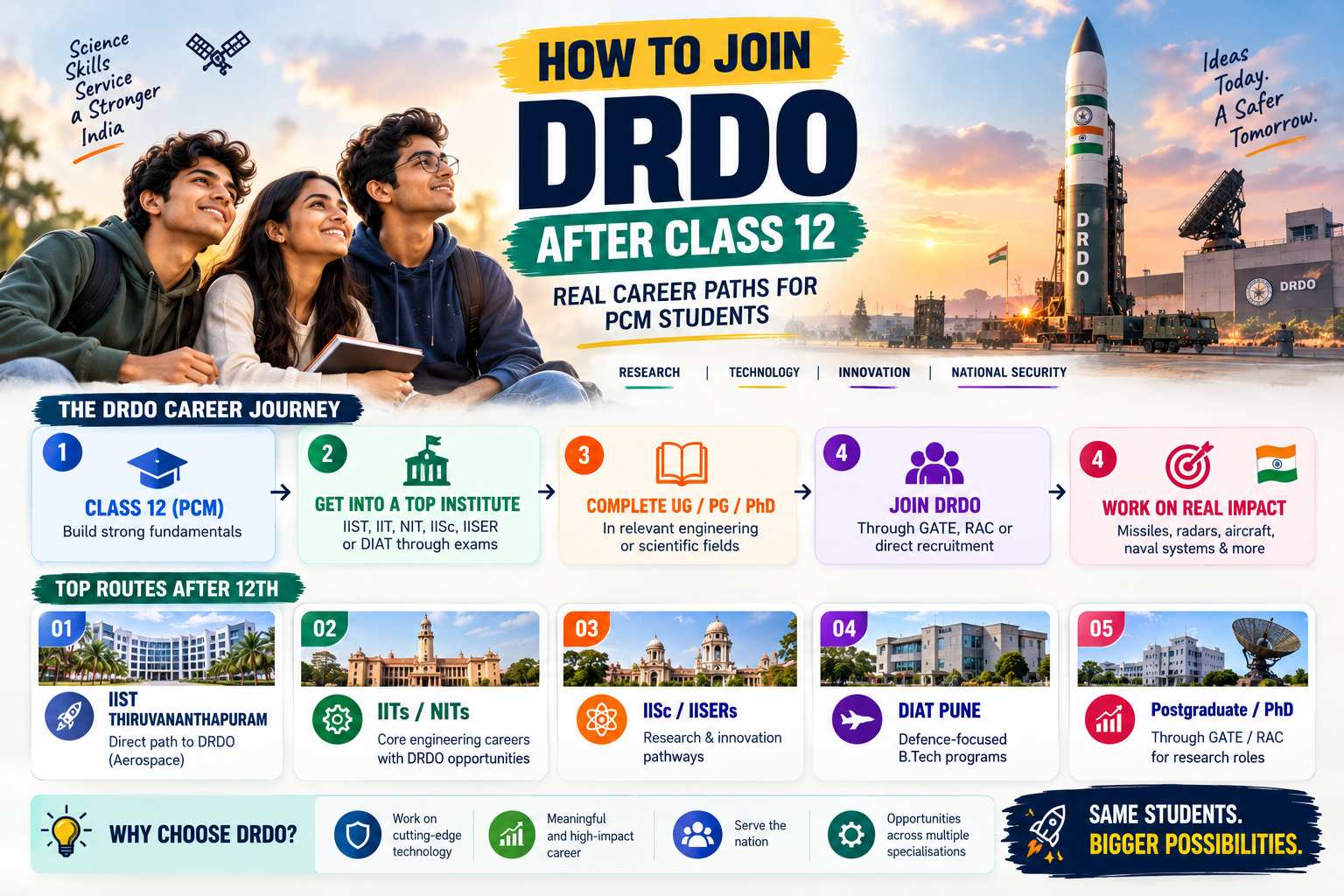
4. IISc Bangalore — Multiple Entry Routes, Research Pipeline to DRDO
What you study
The Indian Institute of Science offers a four-year BS and a BS-MS program with a strong research orientation from early on. IISc is consistently India's highest-ranked research institution, and undergraduate students there have access to laboratories and faculty working at the frontier of their fields.
How the path to DRDO actually works
- Enter through any of three routes — JEE Advanced, NEET or IAT — which makes IISc unusually accessible across student profiles.
- Complete the four-year BS or the BS-MS program with substantial research involvement.
- Continue into postgraduate or doctoral research, building specialisation relevant to defence technology.
- Enter DRDO or national laboratories through research recruitment pathways.
The three-route entry is worth emphasising. A student who prepared for NEET, or one who took the IISER Aptitude Test, can reach IISc without JEE Advanced at all — something many families do not realise.
DRDO recruitment is competitive and generally favours candidates with postgraduate qualifications and demonstrated research capability. A BS from IISc alone is a foundation, not a finished credential for a DRDO scientist position — most successful candidates continue into MSc or PhD research first. Recruitment processes also change periodically, so check current notifications directly rather than relying on what was true a few years ago.
5. IISER BS-MS — The Research Route to National Laboratories
What you study
The IISER Integrated BS-MS is a five-year program covering Physics, Chemistry, Mathematics and Biology in the early years before specialisation. It was designed explicitly to train research scientists, and the curriculum reflects that — laboratory work, independent projects and exposure to active research groups are built into the degree rather than added at the end.
How the path to national laboratories actually works
- Appear for the IISER Aptitude Test (IAT) after Class 12.
- Complete the five-year Integrated BS-MS, specialising in a discipline relevant to your target research area.
- Build research credentials through projects, publications and laboratory experience during the program.
- Enter research roles at national laboratories, typically via doctoral research or research recruitment.
Like NISER and IISc, this is a research trajectory. You will not graduate at 22 into a scientist position at a national laboratory. What you will have is a genuine research training and a master's degree at the five-year mark, which puts you well ahead when applying for PhD programs in India or abroad. Students on this path who are consistent in building research experience have strong outcomes. Students who treat it as a generic science degree do not.
Comparing the Five Routes
| Institution | Degree | Entry Exam | Target Organisation | Path Type |
|---|---|---|---|---|
| IIST Thiruvananthapuram | B.Tech Aerospace / Avionics | JEE Advanced | ISRO | Direct absorption (top performers) |
| IIT Bombay / Madras / Kanpur | B.Tech Aerospace | JEE Advanced | ISRO | ICRB recruitment after graduation |
| NISER Bhubaneswar | 5-yr Integrated MSc | NEST | DAE Laboratories | Research pathway |
| IISc Bangalore | 4-yr BS / BS-MS | JEE Advanced · NEET · IAT | DRDO · National Labs | Research pipeline |
| IISERs | 5-yr Integrated BS-MS | IAT | National Laboratories | Research pathway |
What This Means for Your Preparation
Two of these five routes run through JEE Advanced, which means JEE preparation remains directly relevant if IIST or IIT Aerospace is your target. But three of them — NISER via NEST, IISER via IAT, and IISc via IAT or NEET — do not require JEE Advanced at all.
That is the practical takeaway for families. A student determined to work in space, defence or atomic research has more than one examination through which to reach that goal. If JEE does not go the way you hoped, NEST and IAT are genuine alternative doors into institutions with real pathways to DAE, DRDO and national laboratories.
The other takeaway is about timelines. Engineering routes get you to a recruitment examination in four years. Research routes take longer and usually involve doctoral study. Neither is better — they lead to different kinds of work. What matters is choosing the one that matches how you actually want to spend your working life, and then preparing for the specific examination that opens it.
Targeting IIST or IIT Aerospace? Your JEE Preparation Needs Direction.
The Margdarshan JEE Main Test Series 2027–28 is live now — chapter-level percentile tracking, error-type analysis and a weekly roadmap showing exactly where your marks are going and what to fix next.
Early-bird pricing is limited to the first 100 enrolments.
Enrol in the JEE Main Test Series →Need Mentorship?
Want a personalised career roadmap? Book a 1-on-1 counselling session.
College Predictor
Confused which college to target? Use our JEE Main Predictor to see your college options by rank.
Comments
Leave a Comment
Please log in to leave a comment.
Newsletter
GET STARTED WITH MARGDARSHAN
Get weekly: JEE strategy, college cutoff updates, career paths after PCM, and insider tips from IITians. Free. Unsubscribe anytime.