Every year, thousands of students burn two full years preparing for JEE without even knowing one simple fact: some of Delhi University's top courses do not need JEE at all. They need CUET UG performance, Class 12 eligibility, smart subject selection, and a clear preference strategy.
This is not an anti-JEE argument. Engineering is a great route for the right student. But if a student is forcing PCM only because "good careers need JEE," the family is missing the bigger picture. DU courses without JEE can lead to finance, consulting, banking, analytics, management, policy, entrepreneurship, technology-plus-innovation, and high-quality postgraduate options.
For Class 11-12 students from Science, Commerce, Humanities, and parents who are trying to understand options, CUET has changed the game. Class 12 marks still matter for eligibility, subject choices, and tie-related rules, but the main admission race for these DU programs happens through CUET and the DU CSAS process.
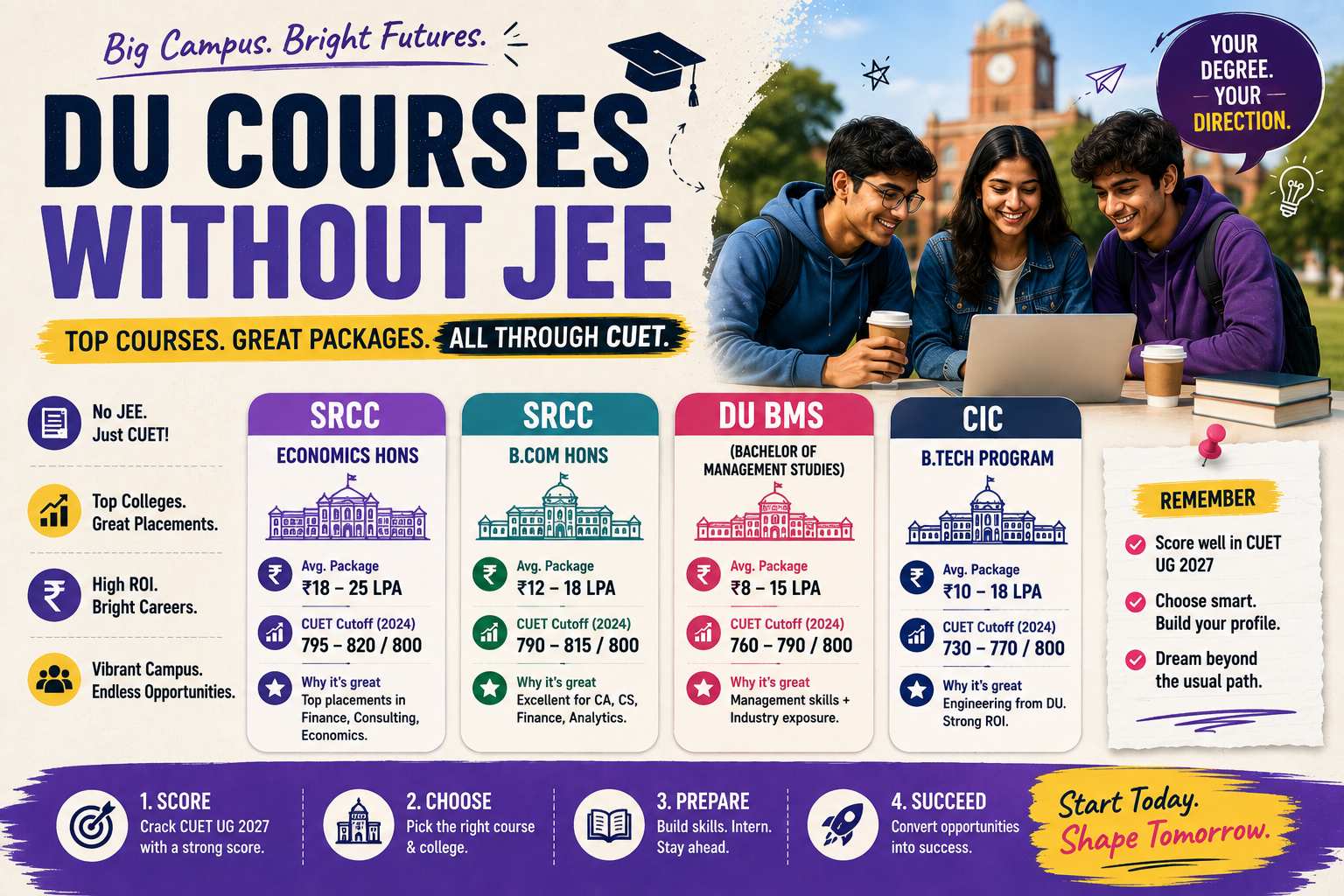
| Course | Entry Route | Approx CUET Cutoff | Career Direction | Approx Placement Figure |
|---|---|---|---|---|
| BA (Hons) Economics at SRCC | CUET UG + DU CSAS | ~897+ UR, 2026 Round 1 | Finance, consulting, banking | Average ~₹13.79 LPA |
| B.Com (Hons) at SRCC | CUET UG + DU CSAS | ~924, 2026 | Big 4, banking, analytics | Strong commerce placements; verify official report |
| BMS | CUET UG + DU CSAS | College/category dependent | Consulting, marketing, finance | Varies sharply by college |
| Economics Hons at Hansraj / Hindu / LSR | CUET UG + DU CSAS | ~880-910 | Finance, consulting, policy, analytics | Hansraj avg ~₹9.6 LPA, median ~₹8.4 LPA |
| B.Tech at Cluster Innovation Centre | CUET UG | DU/CIC admission dependent | IT, mathematical innovation, startups, interdisciplinary tech | Project and skill dependent |
BA (Hons) Economics at SRCC
SRCC Economics is one of the most respected undergraduate programs in India for students who like maths, markets, policy, finance, data, business and analytical thinking. The entry route is CUET UG, followed by DU's Common Seat Allocation System.
What do you study? Microeconomics, macroeconomics, statistics, econometrics, mathematics for economics, development, public finance, Indian economy and policy. It is not "arts lite." A good Economics student needs comfort with graphs, numbers, logic, data and writing.
Career outcomes can include finance analyst roles, consulting analyst roles, banking, research, policy, analytics, startups, and later MBA, economics master's, public policy or actuarial paths. SRCC placements are one reason this course is discussed among the highest paying courses in DU, but students should verify the latest official placement report before making claims.
B.Com (Hons) at SRCC
B.Com (Hons) at SRCC is the dream DU course for many Commerce students, and also a serious option for students from other streams who have the right CUET subject combination and eligibility. It is a route into commerce, finance, accounting, audit, taxation, business analytics and management roles.
The course covers financial accounting, corporate accounting, business law, economics, taxation, cost accounting, management, statistics, auditing and related areas. Students who combine B.Com (Hons) with Excel, financial modelling, internships, case competitions, analytics tools and communication skills become much stronger by final year.
Career outcomes often include Big 4 roles, banking, risk, audit, consulting support, equity research support, analytics and corporate finance. It can also combine well with CA, CFA, MBA, FRM and entrepreneurship. Again, the CUET cutoff DU number is not fixed forever; check DU CSAS every admission cycle.
BMS (Bachelor of Management Studies)
BMS is for students who want management early rather than waiting for an MBA. It is one of the most practical career after 12th without JEE options for students who enjoy business, people, presentations, markets, strategy, finance and execution.
In BMS, students study management principles, finance, marketing, human resources, economics, business research, organisational behaviour, strategy, entrepreneurship and quantitative methods. The course becomes powerful when students do live projects, internships, case competitions and society work.
Career outcomes include consulting analyst roles, marketing, sales strategy, finance, business development, product operations, startup roles and later MBA pathways. BMS is not automatically high-paying just because it says "management." The college, internships, student profile, communication and practical exposure decide the outcome.
Economics Hons at Hansraj / Hindu / LSR
If SRCC Economics is not available, Economics Hons at Hansraj, Hindu and LSR remains extremely strong. These colleges offer brand value, peer group, active societies, alumni networks, and access to internships in finance, consulting, research, policy and analytics.
The curriculum is similar in academic direction: micro, macro, statistics, econometrics, maths, development, policy and electives. Students who are strong in quantitative thinking can later move into data analytics, economics research, finance, consulting, public policy, development sector, or global master's programs.
The Hansraj numbers mentioned above should be verified through the official placement cell report. For Hindu and LSR, students should also check official college placement reports instead of relying on social media screenshots. In DU, college brand helps, but your CV, internships and interview skills matter heavily.
B.Tech at Cluster Innovation Centre
Cluster Innovation Centre, University of Delhi, is a lesser-known but interesting route for students who want technology, mathematics and interdisciplinary innovation without the usual JEE engineering track. CIC's B.Tech program is known for Information Technology and Mathematical Innovations, project-based learning and an innovation-focused environment.
Students can study computing, mathematical thinking, innovation, problem-solving, projects and interdisciplinary applications. It is not the same as a standard B.Tech CSE at an engineering college, so students should read the latest DU/CIC admission bulletin and curriculum carefully.
Career outcomes depend strongly on coding skill, projects, internships, portfolio, problem-solving and how well the student uses Delhi's startup and institutional ecosystem. For a student who wants a tech-flavoured DU route, CIC deserves attention.
How to Choose Between JEE and CUET Routes
The decision should not be emotional. A student who genuinely likes engineering, physics, machines, coding or technical depth may still be better served by JEE. But a student who likes finance, economics, management, policy, consulting, business, analytics or commerce should not blindly burn two years on JEE just because society says PCM equals engineering.
- Choose JEE if your target is engineering, NITs, IIITs, IITs or technical branches.
- Choose CUET seriously if DU economics, commerce, management or CIC fits your strengths.
- Track CUET subject requirements early; wrong subject choices can block admission.
- Compare fees, placements, location, internships and postgraduate goals together.
- Do not judge a course only by highest package. Look at average, median and role quality.
The best students do not ask, "Which exam is more famous?" They ask, "Which route fits my aptitude and gives me the strongest career options?"
FAQs on DU Courses Without JEE
Can I get high-paying DU courses without JEE?
Yes. Courses like SRCC Economics, SRCC B.Com (Hons), BMS, top DU Economics programs and CIC B.Tech can open strong career routes through CUET UG and DU CSAS, depending on eligibility and score.
Are CUET cutoffs fixed every year?
No. Cutoffs change every year and vary by category, course, college and round. Treat numbers like ~897+, ~924 or ~880-910 as recent reference points, not guarantees.
Confused Between JEE and CUET?
Margdarshan helps students and parents compare JEE and CUET routes based on aptitude, stream, marks, target colleges, career outcomes and long-term fit.
Explore Margdarshan career guidance before you commit two years to the wrong exam strategy.
Explore Career Guidance