Most PCM students hear only one story: JEE, college, coding job, corporate package. But not every talented student wants a cubicle, startup hustle, or private-sector race. Some want uniform, discipline, ships, aircraft, research labs, national service, or a life that feels bigger than a desk.
This blog is for students and parents who are unaware of serious non-corporate paths after Class 12 PCM. These routes are not "lesser" options. They can offer free or subsidized education, officer training, stable pay, high responsibility, travel, technical exposure, and strong long-term respect.
But they are also not fantasy careers. Defence careers after 12th PCM demand physical fitness, medical standards, discipline, service commitments, postings, time away from home, and a willingness to accept institutional life. Choose them with pride, but also with full information.
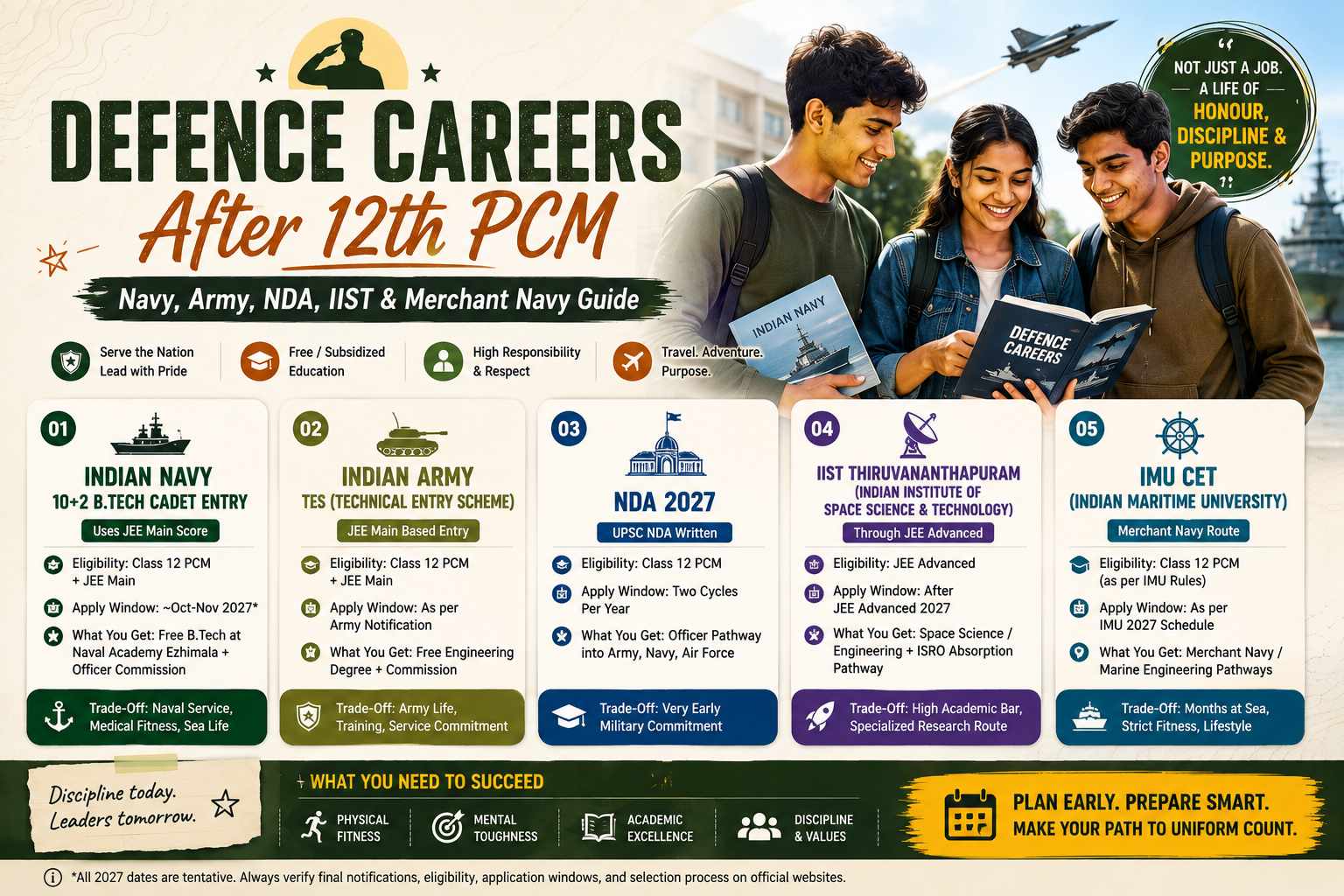
| Path | Entry Basis | Tentative 2027 Window | What You Get | Trade-Off |
|---|---|---|---|---|
| Indian Navy 10+2 B.Tech Cadet Entry | JEE Main score + SSB + medicals | Apply ~Oct-Nov 2027 | Free B.Tech at Naval Academy Ezhimala + officer commission | Naval service, medical fitness, sea life |
| Indian Army TES | JEE Main based + SSB + medicals | As per Army notification | Free engineering degree + commission | Army life, training, service commitment |
| NDA 2027 | UPSC NDA written + SSB + medicals | Two cycles per year | Officer pathway into Army, Navy, Air Force | Very early military commitment |
| IIST Thiruvananthapuram | JEE Advanced | After JEE Advanced 2027 | Space science/engineering route + ISRO absorption pathway | High academic bar, specialized route |
| IMU CET | IMU CET + medical/eyesight standards | As per IMU 2027 schedule | Merchant navy / marine engineering routes | Months at sea, strict fitness, lifestyle trade-offs |
1. Indian Navy After 12th: 10+2 B.Tech Cadet Entry
The Indian Navy after 12th route that many PCM students miss is the 10+2 B.Tech Cadet Entry. Selected candidates join the Indian Naval Academy at Ezhimala, complete a four-year B.Tech, and are commissioned as officers in the Indian Navy after successful training.
The selection is not only marks-based. JEE Main score helps with shortlisting, but students must clear SSB interviews, medical standards, document checks, and final merit. The lifestyle is disciplined: uniforms, training, chain of command, postings, and possible sea assignments.
For many families, the biggest attraction is that the education cost is taken care of and the student is trained directly for a respected officer role. But that benefit comes with responsibility. Naval officers may work on ships, submarines, technical systems, communication networks, aviation-linked platforms, and shore establishments depending on branch and posting.
Students who enjoy physics, machines, electronics, discipline, water, travel, and national service may love this path. Students who want a flexible college life, private-sector internships, and freedom to switch jobs quickly should think carefully. The Navy is not just a degree provider; it is a life of service.
For a student who wants technology plus service, this is a powerful route. But parents should understand the commitment. This is not a normal college degree where you freely switch careers after four years. You are preparing to become a naval officer.
2. Army TES JEE Main: Technical Entry Scheme
Army TES JEE Main is another route that PCM students often discover late. TES stands for Technical Entry Scheme. It is meant for candidates who have completed Class 12 with PCM and qualify through the required JEE Main-linked shortlisting process as per the official notification.
Selected candidates undergo military and technical training, earn an engineering degree, and move toward a commission in the Indian Army. The attraction is clear: technical education, officer status, structured career growth, and national service.
The trade-off is equally real. Army life means postings, physical standards, institutional discipline, family separation at times, and service requirements. If a student wants comfort-first life, TES may not suit them. If they want responsibility early, it can be life-changing.
Unlike a normal B.Tech, TES trains a student inside the Army ecosystem. That means academics, military training, leadership development, physical conditioning, and character building happen together. Parents should not evaluate it only by comparing "package" with private engineering colleges. The value is in commission, career stability, allowances, leadership, and technical responsibility.
At the same time, the student must be mentally ready for SSB. SSB is not a coaching-style written exam. It evaluates officer-like qualities, communication, teamwork, psychology, decision-making, and confidence. A high JEE Main score can open the gate, but personality and medical fitness decide whether the journey continues.
3. NDA 2027: The Classic Officer Route After Class 12
NDA 2027 is the National Defence Academy route conducted by UPSC. It is one of the most respected officer-entry paths after Class 12. The exam is usually held twice a year, followed by SSB interviews and medical examination.
NDA is not just an exam; it is a lifestyle decision at a young age. Cadets train academically, physically, mentally, and militarily. Later, they move to service academies and become officers in the Army, Navy, or Air Force depending on merit, preference, eligibility, and vacancies.
Pay is stable and structured through government scales, allowances, accommodation support, medical benefits, pension-related rules as applicable, and long-term career progression. But the emotional cost can include postings away from home, field areas, risk, strict hierarchy, and high accountability.
If a student wants uniformed service and leadership from a young age, NDA is unmatched. If they are only choosing it because relatives said "government job secure hai," they should pause and understand the life first.
For PCM students, NDA can open Army, Navy, and Air Force options depending on eligibility and merit. The written paper includes Mathematics and General Ability, so JEE preparation can help with mathematical discipline, but NDA also needs current awareness, English, history, geography, science basics, and personality preparation.
The best NDA candidates do not prepare only to clear an exam. They build stamina, confidence, communication, discipline, and awareness. They can lead a group, take pressure, and stay calm when plans change. That is why NDA is a great fit for some students and a poor fit for others.
4. IIST ISRO Route: Space Science Through JEE Advanced
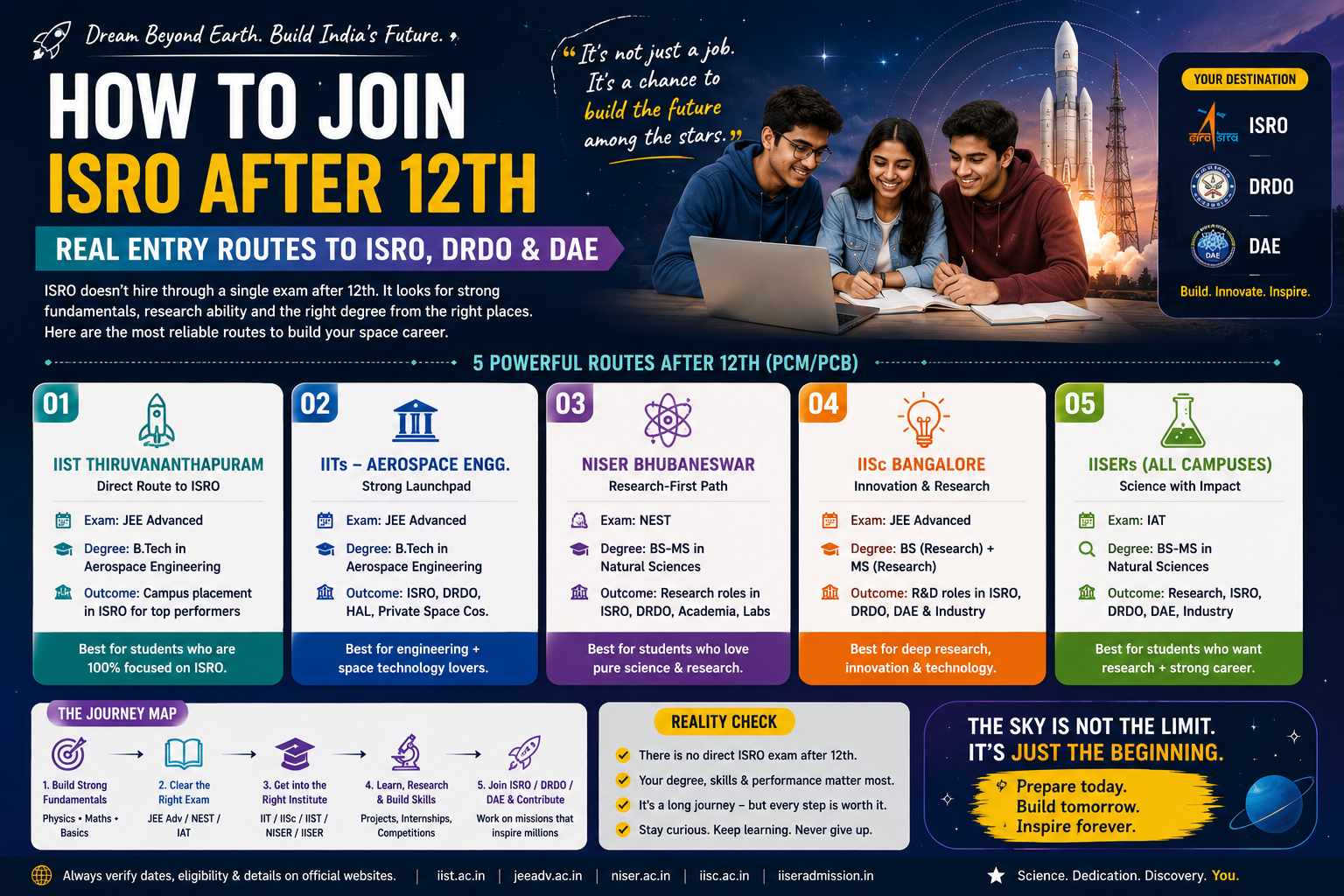
IIST ISRO is a dream route for students fascinated by rockets, satellites, aerospace, avionics, propulsion, space science, and national missions. IIST Thiruvananthapuram admits undergraduate students through JEE Advanced as per the official admission rules.
The attraction is the connection with India's space ecosystem. IIST has historically been associated with an ISRO absorption pathway for eligible students, subject to academic performance, vacancies, policies, and official rules. Students should read the latest bond, fee, and absorption conditions carefully before admission.
This path is more academic and specialized than defence entries. It suits students who enjoy physics, maths, engineering, research, and long-term technical work. The career may not feel like a typical corporate job, but it can offer mission-driven scientific satisfaction.
IIST is especially suitable for students who are fascinated by space but also strong enough for the JEE Advanced route. The academic environment is technical and demanding. Students may study aerospace engineering, avionics, engineering physics, space science, or allied areas depending on the program and current structure.
Parents should understand that the IIST ISRO pathway is not the same as choosing a generic engineering college. It is specialized. That is its strength and its limitation. If the student genuinely wants space technology or research-led engineering, it can be extraordinary. If the student is unsure and wants maximum branch flexibility, they should compare it carefully with IITs, NITs, and other options.
5. IMU CET Merchant Navy: Marine Engineering and Life at Sea
IMU CET merchant navy routes are for students interested in ships, engines, navigation, ports, marine engineering, and international maritime careers. Indian Maritime University conducts admissions for maritime programs, including routes connected to marine engineering and merchant navy careers.
At-sea earnings can be attractive compared with many early corporate roles, especially after experience and certifications. But this is not "easy money." Merchant navy life can mean months away from home, shipboard discipline, isolation, irregular communication, strict medical and eyesight standards, and tough working conditions.
Students should compare programs carefully: B.Tech Marine Engineering, nautical science routes, naval architecture, and other IMU-linked options have different career outcomes. Parents should also check institute approval, placement history, onboard training, medical rules, and total fees.
Realistic at-sea earnings can become strong after a candidate gets the right training, sea time, exams, and rank progression. However, income can vary widely by company, vessel type, contract, rank, nationality of employer, and global shipping cycles. There may also be waiting periods between contracts, so families should not treat the highest salary screenshot as the average career.
The lifestyle is the real filter. Some students enjoy ships, machinery, international routes, and independence. Others struggle with isolation, missing festivals, being away from family, and strict onboard routines. Before choosing IMU CET, speak to real merchant navy professionals if possible. Glamour videos rarely show the full picture.
How to Decide If These Paths Fit You
These careers are not for everyone, and that is okay. A student who wants flexible city life may not enjoy defence or merchant navy. A student who wants command, structure, travel, and mission-driven work may feel suffocated in a normal corporate job.
- Check physical and medical standards before emotional attachment begins.
- Understand service commitments, bonds, postings, and training life.
- Talk to real officers, cadets, alumni, or maritime professionals if possible.
- Compare "free education" with the responsibility that comes after it.
- Do not choose a uniformed career only for salary, status, or family pressure.
The right question is not "which option sounds most prestigious?" The right question is "which life can I actually live with pride for many years?"
Also remember that these paths often have age limits, marital-status rules, height/weight standards, eyesight requirements, and nationality conditions. Small details can decide eligibility. A student may be academically brilliant but medically unfit for a particular route. That is painful if discovered late, so check official notices early.
For PCM students, the smart strategy is to keep JEE preparation strong while also tracking these special entries. Navy Cadet Entry and Army TES use JEE Main. IIST needs JEE Advanced. NDA runs separately through UPSC. IMU CET has its own maritime route. One preparation plan can support multiple doors, but only if you track deadlines.
FAQs on Defence and Maritime Careers After 12th PCM
Can I join Indian Navy after 12th through JEE Main?
Yes, the Navy 10+2 B.Tech Cadet Entry uses JEE Main score for shortlisting, followed by SSB and medical standards, as per official notifications.
Is Army TES the same as normal engineering?
No. TES includes engineering education inside an Army officer pathway. It brings a commission and service commitment, not just a degree.
Is merchant navy good for PCM students?
It can be excellent for students comfortable with ships, technical work, travel, fitness standards, and time away from home. It is rewarding, but the lifestyle is demanding.
Need Help Choosing Between JEE, Defence, IIST and Merchant Navy?
Margdarshan helps students and parents compare career paths based on aptitude, marks, medical fit, family priorities, lifestyle expectations, and long-term goals.
Book a career guidance session before applications and exam forms start creating confusion.
Book Career Guidance