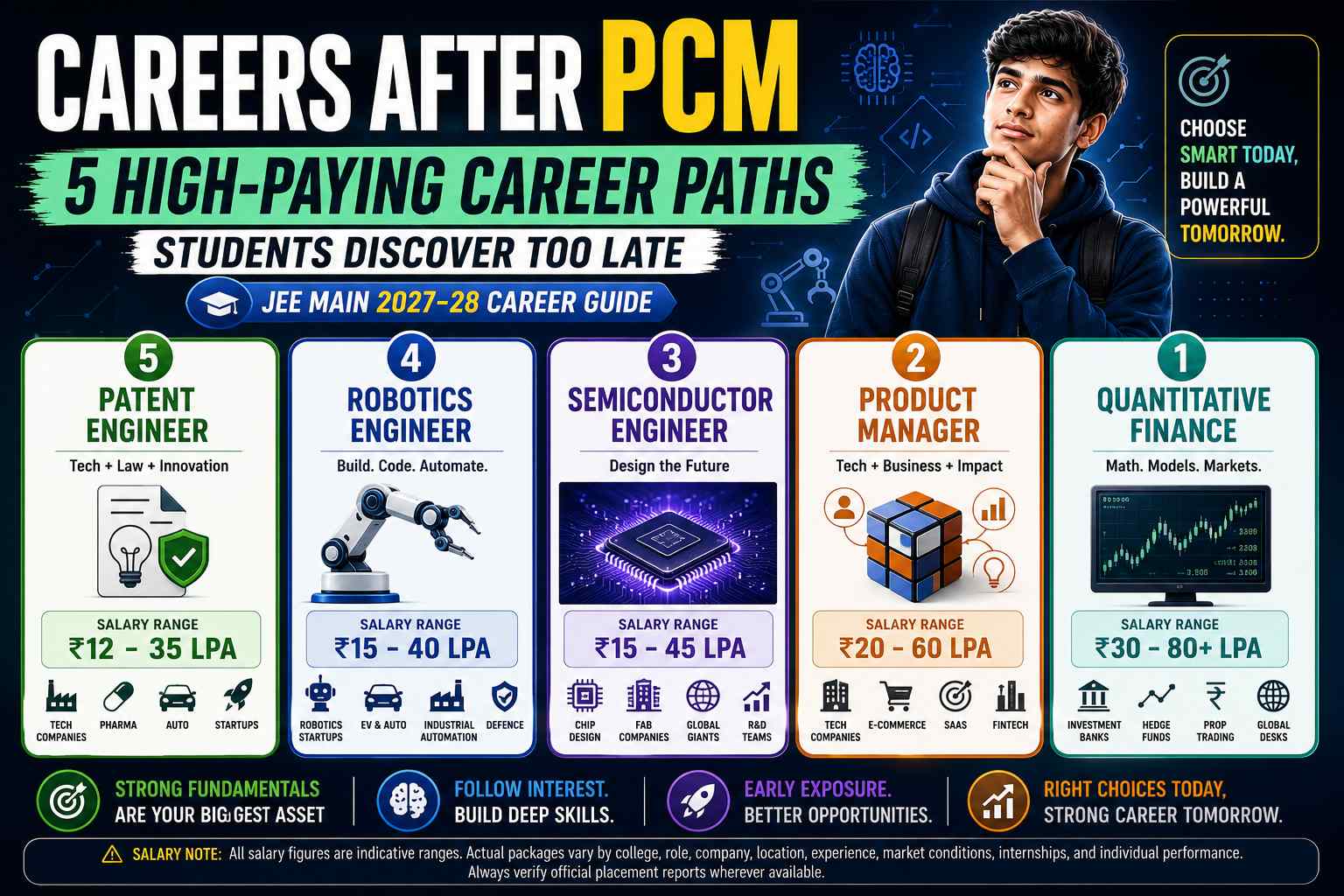
Careers After PCM: 5 High-Paying Career Paths Students Discover Too Late
Most PCM students spend two years preparing for JEE, but only discover these careers in their third or fourth year of college. By then, internships are gone, projects are random, and the best students have already started building the right skills.
Here is the first mindset shift: choosing PCM is not choosing one career. It is choosing possibilities. The real question is not "Engineering or nothing?" It is "Which Careers After PCM should I know before choosing a college and branch?"
Engineering is one path, but even inside engineering, the career map is much bigger than Software, Mechanical, Civil, and Electronics.
Today, some of the highest paying careers after PCM are coming from AI, semiconductor design, quant finance, robotics, product management, and intellectual property. These are serious career options after PCM, especially for JEE aspirants who want strong colleges, useful skills, and high-growth industries.
This guide is written for Class 11 and 12 students, droppers, and parents who are asking a practical question: "If my child takes PCM and prepares for JEE Main, what careers can actually open up?" Let us look at five future careers for PCM students that are often discovered too late.
| Career Path | Best-Fit Students | Suitable Branches/Degrees | Indicative Salary Range |
|---|---|---|---|
| Patent Engineer | Tech + writing + legal curiosity | ECE, CSE, Mechanical, Chemical, Biotech | ₹12-35 LPA |
| Robotics Engineer | Students who like building systems | Mechatronics, Mechanical, ECE, EE, CSE | ₹15-40 LPA |
| Semiconductor Engineer | Physics, electronics, device-level thinking | ECE, EE, Engineering Physics, Materials | ₹15-45 LPA |
| Product Manager | Tech + communication + business thinking | Any strong engineering branch, MBA optional | ₹20-60 LPA |
| Quantitative Finance | Strong maths and coding students | CSE, MnC, Statistics, Maths, Engineering Physics | ₹30-80 LPA+ |
5. Patent Engineer
A patent engineer works at the intersection of technology, law, and innovation. When a company invents a new chip design, medical device, AI system, manufacturing process, or electronic product, it needs to protect that invention. Patent engineers help understand the technical idea, search whether similar inventions already exist, and support patent drafting or analysis.
Companies need this role because intellectual property is a business asset. In technology, pharma, manufacturing, electronics, automotive, and deep-tech startups, patents can decide who owns an idea and who can commercialize it.
Skills and pathways
Law degree is not always required to start as a patent analyst or patent engineer, but certifications in intellectual property, patent drafting, or later legal study can help. Students who like technology but do not want a pure coding job should consider this path seriously.
4. Robotics Engineer
A robotics engineer designs machines that can sense, move, decide, and perform tasks. This can include factory robots, warehouse automation, drones, surgical robots, autonomous vehicles, defence systems, and robots used in agriculture or logistics.
Robotics demand is increasing because companies want speed, precision, safety, and automation. As labour-intensive work becomes expensive or risky, robots are entering factories, hospitals, farms, warehouses, and even homes.
Skills and recruiters
Hiring can happen in robotics startups, EV companies, industrial automation firms, aerospace teams, research labs, and global tech companies. If you like building things physically and digitally, robotics is one of the most exciting engineering career options.
3. Semiconductor Engineer
A semiconductor engineer works on chips, electronic devices, circuits, fabrication, verification, testing, packaging, or embedded hardware. This career is growing because every major technology depends on chips: phones, cars, laptops, satellites, AI servers, medical devices, telecom, and defence systems.
India is pushing hard to build a semiconductor and display ecosystem. The India Semiconductor Mission describes its goal as positioning India as a global hub for electronics manufacturing and design, with schemes for fabs, display fabs, compound semiconductors, ATMP/OSAT, and design-linked incentives. That creates long-term demand for skilled electronics talent.
Skills and recruiters
Representative recruiters include NVIDIA, Qualcomm, Intel, AMD, Texas Instruments, Micron, Samsung, and semiconductor design or verification companies. For students who enjoy physics and electronics, this is one of the strongest high salary careers after PCM.
2. Product Manager
A Product Manager decides what a product should become. They understand users, define features, work with engineering and design teams, study data, prioritize decisions, and make sure the product solves a real problem. In simple words, a PM connects technology, business, and customer needs.
A product management career is growing fast because every company is becoming a product company: fintech apps, edtech platforms, food delivery, SaaS tools, e-commerce, AI products, and enterprise software. Engineers often make strong PMs because they understand how products are built.
Skills and recruiters
Companies hiring for PM roles include Google, Microsoft, Amazon, Flipkart, Razorpay, Swiggy, Zomato, and many high-growth startups. This is one of the top alternative careers after engineering for students who do not want to remain in only coding or core engineering roles.
1. Quantitative Finance
Quant finance career roles use mathematics, probability, statistics, programming, and market understanding to build trading strategies, pricing models, risk systems, and financial algorithms. This is why strong maths students often thrive here.
Quant is competitive, but the upside is high. The best pathways usually come through IITs, ISI, CMI, top engineering colleges, strong maths/statistics programs, and serious self-preparation in coding and probability. Students from Mathematics & Computing, CSE, Statistics, Engineering Physics, and related quantitative programs often have an advantage.
Skills and recruiters
Representative recruiters include Tower Research, Quadeye, Graviton, WorldQuant, Goldman Sachs, and global firms such as Jane Street where relevant. Among careers for JEE aspirants, quant finance is one of the most rewarding for students who are genuinely strong in mathematics.
Careers After PCM: How Students Can Prepare Early
You do not need to decide your exact career in Class 11. But you should prepare in a way that keeps more doors open. The student who builds strong PCM fundamentals, earns a good JEE Main percentile, chooses the right college and branch, and starts projects early will always have more options.
During college, focus on four things: coding, communication, internships, and domain projects. A robotics student should build robots. A semiconductor student should learn circuits and VLSI basics. A quant student should sharpen probability and Python. A future PM should learn analytics, user research, and product case studies.
Most importantly, do not blindly follow placements. Follow industries. If an industry is growing, hiring, and becoming important to India and the world, students who prepare early will benefit.
FAQs on Career Options After PCM
Is engineering the only good career after PCM?
No. Engineering is a strong pathway, but PCM can also lead to research, data science, finance, design, product management, defence technology, intellectual property, and entrepreneurship.
Which career has the highest salary after PCM?
Quant finance, product management, semiconductor roles, AI/data science, and some specialized software roles can offer high salaries. The outcome depends heavily on college, skill, internships, and company.
Can JEE Main help with these careers?
Yes. A strong JEE Main percentile can unlock better colleges and branches, which improves access to internships, peer groups, alumni networks, and recruiters.
Choosing PCM Means Choosing Possibilities
Choosing PCM is not choosing Engineering. It is choosing hundreds of career possibilities. The smartest Careers After PCM open up when you combine the right percentile, the right branch strategy, and early awareness.
Join the Margdarshan JEE Main Test Series 2027-28 Waitlist to improve your JEE Main percentile and unlock access to better colleges, branches, and future career options.
Early Bird Price: ₹499 for the first 100 students. Standard Launch Price: ₹999.
Secure Your Waitlist Seat Book 1:1 Mentorship