If you are in Class 11 or 12 right now, you need a smarter branch strategy. CSE is excellent, no doubt. But blindly chasing it can push students into weaker colleges, higher fees, or branches they do not understand. A strong branch in a good institute can beat a fashionable branch in a weak environment.
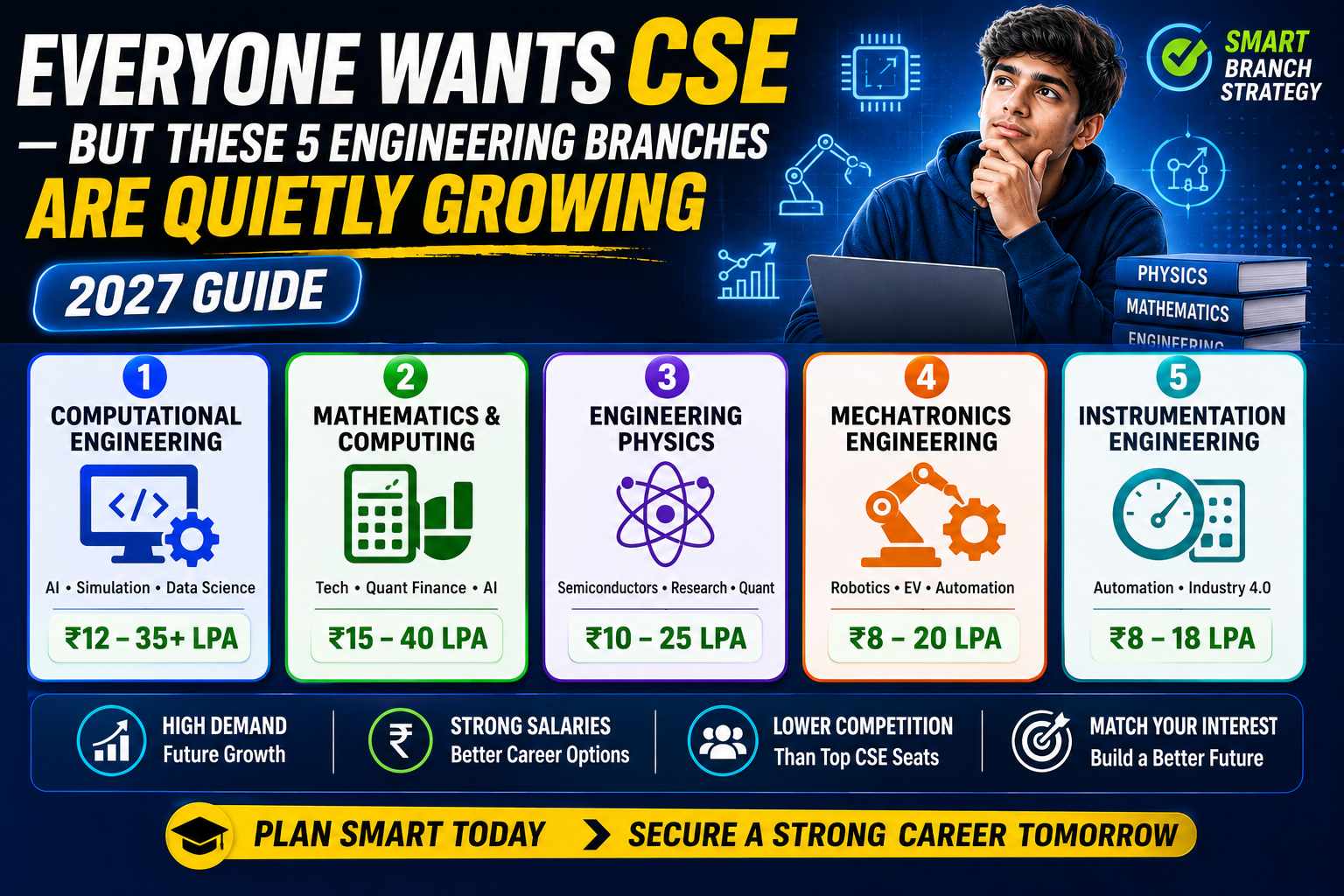
This guide covers the best engineering branches other than CSE that are gaining demand through automation, AI, semiconductor growth, robotics, simulation, analytics, and quant careers. These are not random backups. These are serious alternatives to CSE for students who want future scope, strong salaries, and lower competition than top CSE seats.
5. Instrumentation Engineering — Core + Automation + Industry 4.0
Instrumentation Engineering deals with sensors, measurement systems, control systems, process automation, and industrial electronics. In simple words, it teaches you how machines, plants, factories, refineries, energy systems, and automated production lines are monitored and controlled.
Demand is rising because every serious industry is moving toward automation. Manufacturing, oil and gas, pharma, energy, aerospace, EV plants, and smart factories need engineers who understand both hardware and control logic. This is where Instrumentation quietly becomes powerful.
Roles and recruiters
Recruiters can include core manufacturing firms, energy companies, automation companies, consulting firms, and industrial technology teams. For students who like physics, circuits, and real-world machines, this branch has much better future scope than many people assume.
4. Mechatronics Engineering — Mechanical + Electronics + AI/Robotics
Mechatronics is the meeting point of mechanical engineering, electronics, control systems, programming, and robotics. Think drones, robots, automated warehouses, EV systems, medical devices, smart machines, and self-operating industrial equipment.
Why is demand rising? Because the world is not becoming only software-driven. It is becoming software plus hardware plus intelligence. Companies building robots, EVs, manufacturing automation, aerospace systems, and consumer hardware need engineers who can work across domains.
Roles and recruiters
Top opportunities come from robotics startups, automotive and EV companies, automation firms, aerospace teams, and advanced manufacturing companies. If you want one of the engineering branches with future scope, Mechatronics deserves serious attention.
3. Engineering Physics — Semiconductors + Research + Quant
Engineering Physics is not a traditional core branch. It is a high-concept branch for students who enjoy physics, mathematics, electronics, materials, computation, and research. It opens paths into semiconductors, photonics, quantum technologies, data science, finance, and higher studies.
The biggest reason this branch is growing is the semiconductor wave. India and the world need talent in chip design, materials, sensors, optics, and advanced electronics. Students with strong fundamentals can also move into quant roles, analytics, research labs, and AI-adjacent technical work.
Roles and recruiters
This branch rewards depth. It may not be as instantly understood as CSE, but for strong students it can become a gateway to some of the most technical and high paying engineering branches, especially when paired with coding and strong projects.
2. Mathematics & Computing — Tech + Quant Finance + AI
Mathematics & Computing is one of the strongest JEE Main branches for students who like problem-solving, algorithms, probability, statistics, optimization, and coding. It is close to CSE in placement outcomes, but with a stronger mathematical foundation.
Demand is rising because AI, machine learning, data science, trading, risk modelling, cybersecurity, and optimization all need mathematics. In many high-end roles, companies do not just want someone who can code. They want someone who can model uncertainty, design algorithms, and think from first principles.
Roles and recruiters
Recruiters may include software companies, fintech firms, analytics teams, banks, trading firms, AI startups, and research-driven product companies. For students searching for alternatives to CSE without leaving the tech salary track, Mathematics & Computing is one of the cleanest choices.
1. Computational Engineering — AI + Simulation + Data Science
Computational Engineering is the most future-proof branch on this list because it sits between engineering, computer science, simulation, AI, and data science. It teaches students to solve real engineering problems using computation: climate models, aircraft design, drug discovery, EV battery simulation, fluid flow, structural design, and digital twins.
As industries become more complex, companies cannot test everything physically. They simulate, model, optimize, and predict. That creates demand for engineers who understand both the physical system and the computational tools. This is where Computational Engineering can quietly outperform many traditional branches.
Roles and recruiters
Opportunities can come from automotive, aerospace, energy, climate tech, biotech, defence, AI labs, and product companies. If you are looking for high paying engineering branches with long-term relevance, this branch deserves to be on your radar before counselling begins.
Best engineering branches other than CSE: How to Compare Them
Do not compare branches only by today's popularity. Compare them by four things: the college offering the branch, the curriculum, placement ecosystem, and your own aptitude. A student who likes maths and coding may do brilliantly in Mathematics & Computing. A student who enjoys physics and research may grow faster in Engineering Physics. A student who likes machines, electronics, and coding may fit Mechatronics beautifully.
The mistake is thinking CSE is the only safe option. The better strategy is to build a branch preference list before JoSAA or counselling pressure starts. That list should include CSE, but it should also include realistic high-growth branches that match your percentile range.
How to Actually Get Into These Branches
Most of these branches are accessible through JEE Main counselling routes, depending on the institute. But the word "accessible" does not mean easy. You still need a strong JEE Main percentile, especially if you want these branches in respected NITs, IIITs, GFTIs, or strong private/state institutions.
The students who reach these branches do one thing early: they track their percentile trajectory chapter by chapter. Not just marks. Not just rank prediction after full syllabus tests. They know which chapters are giving them percentile lift, where they are losing accuracy, and how their performance is moving month by month.
That is the difference between "I studied a lot" and "I know exactly what percentile I am building toward." For JEE Main 2027 and 2028 aspirants, this tracking should start now, while there is still time to correct weak chapters.
Join the Margdarshan JEE Main Test Series 2027-28 Waitlist
Margdarshan is launching a JEE Main Test Series designed around percentile tracking, chapter-wise trajectory, and a full roadmap for students targeting strong branches beyond only CSE.
Early-bird pricing: ₹499 for the first 100 students. Standard price: ₹999. Launching soon.
Join the Waitlist