JEE Main 2027 Readiness Checklist — Are You Preparing Right or Just Preparing Hard?
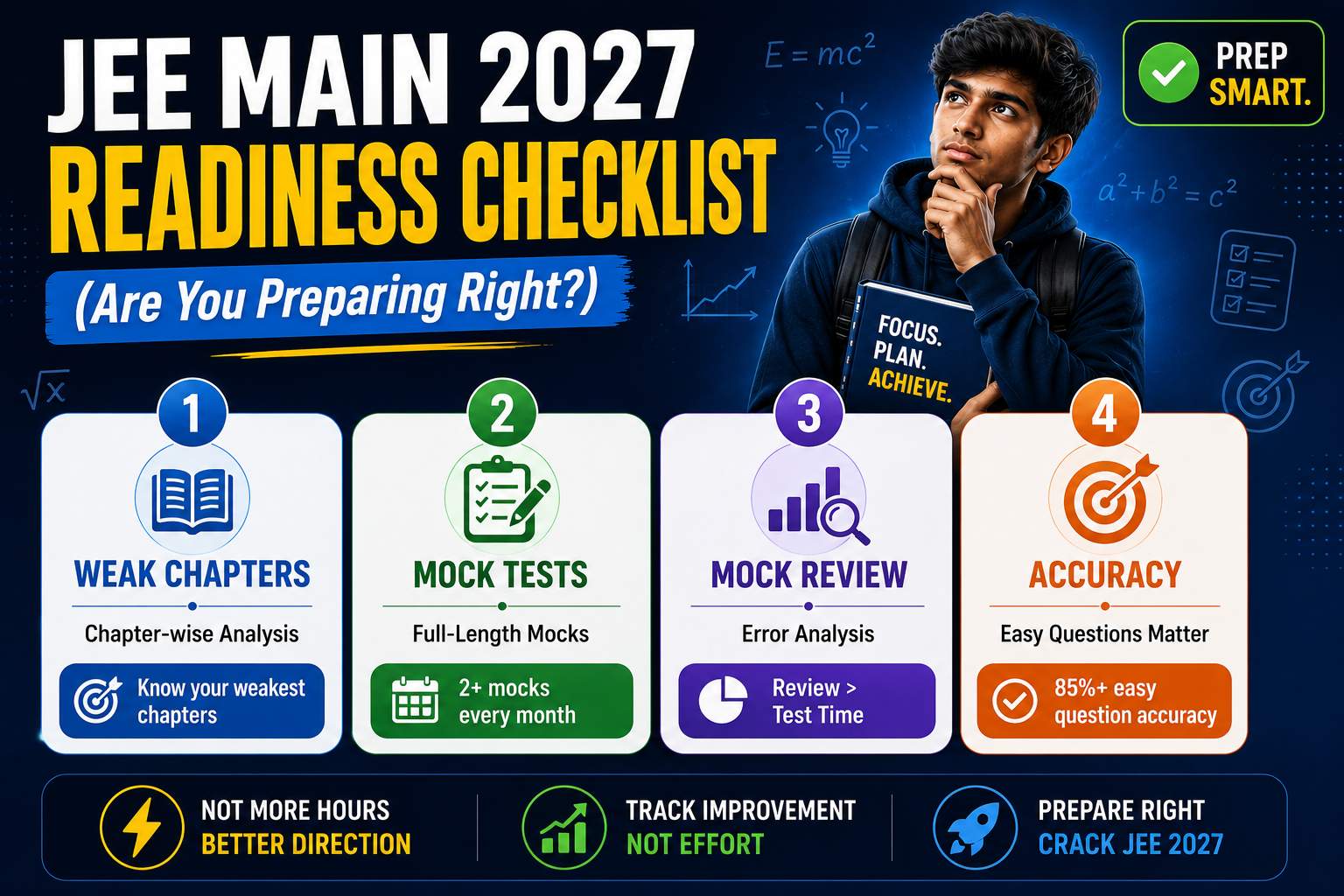
You have been studying for JEE 2027 for months. You are putting in 6, 8, maybe 10 hours a day. Your DPPs are done. Your coaching attendance is perfect. You feel like you are working hard.
But here is the question nobody asks you: Is it working?
Not "are you working." Working is easy to measure — hours, pages, videos watched. The harder question is whether those hours are translating into rank improvement. Because for 90% of JEE aspirants, they are not. And the reason is almost never effort. It is direction.
The Most Common Year 1 Mistake
Most students in Class 11 and early Class 12 build a preparation habit that feels productive but does not actually improve their score. It looks like this: attend class, complete DPP, watch a YouTube lecture, solve some questions, repeat. Every day. Every week. For months.
At the end of it, they take a mock test and score roughly what they would have scored anyway — because they were never tracking whether their effort was producing improvement. They were tracking effort itself.
- 10 hours studied today
- All DPPs submitted
- Notes are detailed and colour-coded
- Syllabus coverage feels good
- Mock score: unchanged for 6 weeks
- Knows exactly which chapters are weak
- Mock scores rising 8–12 marks per month
- Error type tracked and reducing
- Accuracy on easy questions above 90%
- Time per question improving
The student who scores 180 does not always study more than the student at 120. They study differently. They know what is working and what is not. They course-correct every week, not every year.
The JEE 2027 Readiness Checklist
Answer each of these honestly. Not what you plan to do. Not what you did last week. What is actually true right now.
Most students say "I am weak in Physical Chemistry" or "Mechanics needs work." That is not specific enough to act on. Physical Chemistry has 12 chapters. Mechanics has 8. Saying you are weak in a subject tells you nothing about what to revise tomorrow.
A student who knows they are specifically losing marks in Electrochemical Cells, Rotational Dynamics and Probability can build a targeted 3-week sprint. A student who says "Chemistry and Maths need work" will revise broadly, cover material they already know, and make no meaningful progress on the chapters that are actually costing them rank.
How to find your answer: Go back to your last 3 mocks. List every wrong answer by chapter. The chapters that appear 3+ times across mocks are your actual weak chapters — not the ones you feel uncomfortable about, the ones the data shows.
Not sectional tests. Not untimed practice. Full 3-hour papers, exactly as the actual exam runs, with no pausing, no phone, no open books.
Untimed practice creates a specific kind of false confidence. You solve a problem in 8 minutes, get it right, and feel good about the chapter. But in the actual exam that question needs to be solved in 3 minutes — or skipped intelligently. You have practised the concept. You have not practised the exam.
- Builds concept familiarity
- Feels smooth and productive
- No time pressure decisions
- Cannot reveal stamina issues
- Does not build paper instinct
- Reveals how you perform under pressure
- Builds real exam stamina
- Forces skip-or-attempt decisions
- Shows time distribution errors
- The only real dress rehearsal
Two mocks per month is a minimum for Year 1 of preparation. By Class 12, this increases. But if you are not hitting two right now, you are going into a 3-hour high-stakes exam without ever having practised finishing one.
This is the checklist item most students fail — and the one that separates good students from improving ones.
The average student finishes a mock, checks their score, quickly glances at the solutions for the questions they got wrong, and moves on. Total review time: 30–45 minutes. They feel like they have done the work.
The topper's post-mock ritual looks completely different.
| Activity | Average Student | Topper |
|---|---|---|
| Check score and rank | ✅ Yes | ✅ Yes |
| Review wrong answers | Quickly — 30 min | Deeply — why was it wrong? |
| Classify error type | Never | Every question |
| Review skipped questions | Rarely | Always — fear or strategy? |
| Time audit | Never | Which questions wasted time? |
| Chapter heatmap update | Never | After every mock |
| Total review time | 30–45 minutes | 2–3 hours |
A mock you do not analyse properly is 3 hours of exam practice followed by zero improvement in your preparation direction. You got the data — you just did not read it.
Most students assume they lose rank on the hard questions. The data says otherwise.
In JEE Main, easy and medium questions make up roughly 60–70% of the paper. Students who crack IIT are not necessarily solving all the hard questions — they are almost never dropping marks on the easy ones. That is the actual difference.
If you do not know your split accuracy, you are probably studying hard problems when you should be eliminating errors on questions you already know how to solve. That is a very expensive use of your time.
How to find your answer: In your next mock review, label each question Easy / Medium / Hard based on difficulty. Then calculate your accuracy separately for each tier. If your Easy accuracy is below 85%, that is your most urgent fix — not hard problem practice.
Not Sure If Your JEE 2027 Preparation Is on Track?
Margdarshan helps JEE aspirants build a targeted preparation plan — chapter prioritisation, mock strategy, error analysis and a week-by-week roadmap built around your specific gaps.
Book Career Counselling SessionHow to Use This Checklist
Go back through the four questions and answer each one honestly. Not aspirationally — actually.
Your preparation has direction, not just volume. Keep building on this. Your job now is consistency and increasing the depth of your analysis as the exam approaches.
You have the right instincts but gaps in execution. Pick the checklist item you scored lowest on and fix it in the next two weeks before anything else. One change made deeply is better than four changes made weakly.
You are preparing hard, not right. The effort is there — the direction is not. This is not a judgement; it is common. But if you do not change the system, the next 12 months of effort will produce the same result. The earlier you reset, the more time you have to rebuild correctly.
What to Do Next
You now have a clear picture of where your preparation stands. The next step is not to study more — it is to study differently, starting with whichever checklist item you scored lowest on. Name your weakest chapter in each subject today. Schedule your next full timed mock this week. Run a proper 2-hour review after it. That is the first week of actually preparing right.
Frequently Asked Questions — JEE Main 2027
JEE Main 2027 is expected to be conducted in two sessions — January 2027 and April 2027 — following the same pattern as previous years. NTA typically announces the official schedule 3–4 months in advance. Keep checking jeemain.nta.ac.in for official dates.
To qualify for JEE Advanced 2027 and be eligible for IIT admission, you typically need to be in the top 2.5 lakh rank in JEE Main. This usually corresponds to roughly 97–98+ percentile in the general category, though the exact cutoff varies by year and category.
Students get a maximum of 6 attempts across 3 years (2 attempts per year). If you are appearing in Class 12 in 2027 for the first time, you are eligible. If you appeared in 2025 or 2026, check NTA's eligibility criteria as the rules depend on your year of Class 12 completion.
Both are equally weighted in the paper. However, Class 11 topics like Mechanics, Thermodynamics, Organic Chemistry basics and Algebra form the foundation for Class 12 chapters. Students who ignore Class 11 in Class 12 always regret it. Start revising Class 11 alongside Class 12 from Day 1.
A minimum of 2 full-length mocks per month in Class 11, increasing to 1 per week in Class 12. The number matters less than what you do after — analysis quality determines improvement, not mock quantity. Ten unanalysed mocks produce less improvement than four deeply reviewed ones.
Yes. You need a minimum of 75% aggregate in Class 12 (65% for SC/ST) to be eligible for IIT/NIT admission through JEE Main. Board marks do not affect your JEE percentile, but they determine whether you can convert a good rank into an actual seat.
Focus on three things: fix your chapter-level weak spots identified from mock data, improve accuracy on easy and medium questions above 85%, and run full timed mocks every week with a 2-hour post-mock analysis. Score improvement in the last 6 months almost always comes from fixing mistakes, not learning new concepts.
For Chemistry, NCERT is essential and sufficient for most theory-based questions. For Physics and Maths, NCERT builds the foundation but is not enough — you need HC Verma or DC Pandey for Physics and NCERT + standard problem sets for Maths. Do not skip NCERT, but do not stop there either.
Quality matters far more than quantity. A student studying 6 focused hours with proper analysis and targeted revision will outperform a student doing 10 hours of unfocused DPP submission. That said, a realistic target for serious aspirants is 6–8 hours of productive study daily, excluding coaching time.
High-weightage chapters that appear consistently include — Physics: Mechanics, Electrostatics, Current Electricity, Optics. Chemistry: Organic Chemistry (named reactions, mechanisms), Coordination Compounds, Chemical Bonding, Electrochemistry. Maths: Calculus (Limits, Derivatives, Integration), Coordinate Geometry, Algebra (Matrices, Probability, Sequences). These chapters alone can account for 50–60% of your score.
Yes — many do every year. Coaching quality matters, but it is not the deciding factor. What determines your result is how you use your study time, how well you analyse your mocks, and how consistently you target your weak chapters. A student with average coaching and excellent self-analysis will outperform a student at a top coaching centre who never reviews their tests.
JEE Main tests breadth — you need to know the full syllabus at a solid level and execute accurately under time pressure. JEE Advanced tests depth — it requires deeper conceptual understanding and multi-concept problem solving. If your target is JEE Advanced 2027, you need to build both. If your target is NIT/IIIT via JEE Main, speed and accuracy on standard problems matters most.
Need Mentorship?
Want a personalised career roadmap? Book a 1-on-1 counselling session.
College Predictor
Confused which college to target? Use our JEE Main Predictor to see your college options by rank.
Comments
Leave a Comment
Please log in to leave a comment.



Newsletter
GET STARTED WITH MARGDARSHAN
Get weekly: JEE strategy, college cutoff updates, career paths after PCM, and insider tips from IITians. Free. Unsubscribe anytime.