How to Join DRDO After 12th: Real Career Path for PCM | Margdarshan
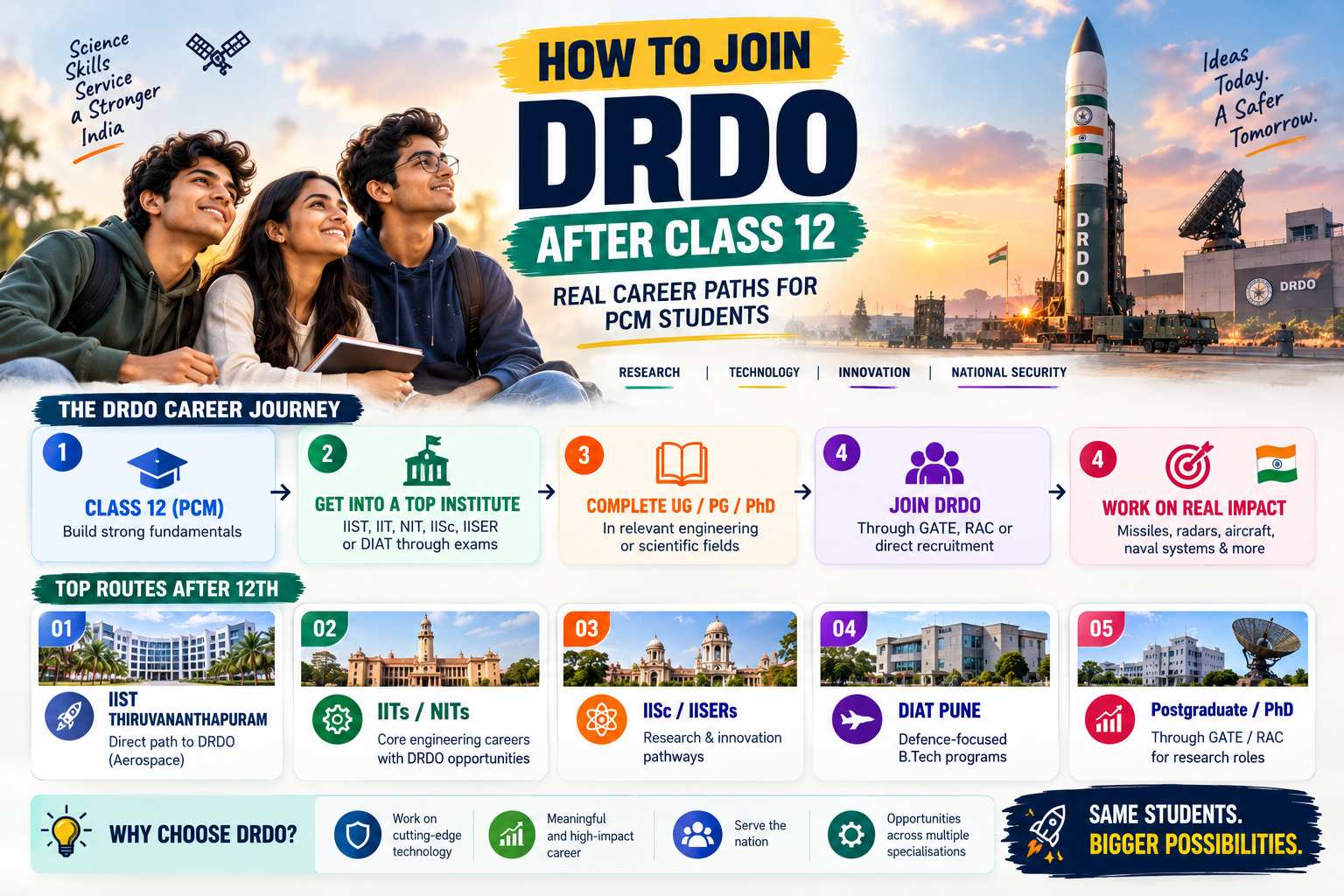
Ask a Class 11 student who is fascinated by missiles, radar systems or fighter aircraft whether they plan to work at DRDO, and most will hesitate. The common belief is that DRDO is either unreachable for an ordinary student or reserved for IIT graduates. Both assumptions are wrong, and both cost students years of clear planning.
Here is what is actually true. There is no "DRDO entrance exam" you can write after Class 12. DRDO recruits graduates and researchers, not school-leavers. So the real question behind how to join DRDO after 12th is this: which ladder do you start climbing after boards, and what is the step at the top of it?
Several distinct ladders lead to defence research. This guide maps five of them honestly, covering the Class 12 entry point, the degree, and the step that actually gets you into a DRDO laboratory.
The one-line reality: Almost every DRDO career path passes through a second filter after your degree. That filter is GATE, DRDO's Recruitment and Assessment Centre (RAC), or postgraduate research. Direct absorption straight after an undergraduate degree applies only to a small number of IIST top performers, and that absorption is into ISRO. Plan for the second exam from day one.
1. IIST Thiruvananthapuram: Space and Defence-Focused Engineering
IIST is the only Indian institute whose undergraduate engineering is built entirely around space and defence-relevant technology. Aerospace Engineering and Avionics cover propulsion, flight dynamics, guidance and onboard electronic systems. That is the same technical foundation that defence research depends on.
How the ladder works
- Clear JEE Advanced with a rank that qualifies for IIST.
- Complete the B.Tech in Aerospace Engineering or Avionics.
- Top performers have historically been absorbed into ISRO on graduation.
- Everyone else, including those targeting DRDO, moves on through GATE, RAC or postgraduate study.
Not every IIST graduate walks into ISRO, and none walk into DRDO automatically. Absorption is limited to a small group of top performers, so the competition doesn't disappear at IIST. It moves into your four years of coursework. For a DRDO goal specifically, IIST gives you an excellent foundation, but you will still face the same recruitment step as everyone else.
2. IIT Aerospace or Mechanical: The GATE / RAC Route
Aerospace and Mechanical Engineering at IIT Bombay, IIT Madras and IIT Kanpur give you deep grounding in aerodynamics, structures, thermal systems and propulsion. These are core disciplines for defence hardware. These departments also expose you to serious research early, which matters later.
How the ladder works
- Clear JEE Advanced and secure Aerospace or Mechanical at one of these IITs.
- Complete the B.Tech with strong core fundamentals, because GATE tests exactly these.
- After graduation, enter DRDO's recruitment process through GATE or through DRDO's Recruitment and Assessment Centre (RAC).
An IIT degree gives you no automatic entitlement to a DRDO post. In GATE and RAC, you compete with graduates from NITs, IIST and state colleges on the same paper. IIT gives you better preparation and research exposure, but you still have to convert that advantage on exam day.
3. NIT Core Branches: The Most Underrated DRDO Career Path
This is the route most families overlook. DRDO recruits from NIT core branches through GATE. Mechanical, Electronics & Communication and Metallurgy map directly onto the kind of work defence labs do, including systems design, radar and communications, and advanced materials.
Agar JEE Advanced ka rank expected nahi aaya, toh yeh mat socho ki DRDO ka darwaza band ho gaya. A strong JEE Main percentile into an NIT core branch keeps this path fully open.
How the ladder works
- Clear JEE Main and choose a core branch at an NIT, not just the highest-ranked branch available.
- Treat your four years as GATE preparation. Core subjects are the exam.
- Use your GATE score to enter DRDO's recruitment process.
On this route, your college name matters less than your GATE score, and GATE is highly competitive. Branch choice also matters more than students realise. If DRDO is the goal, a core branch you are genuinely good at beats a "prestigious" branch that pulls you away from defence-relevant subjects.
Not Sure Which Ladder Fits Your Rank?
IIST, IIT core, NIT core or a research route: the right choice depends on your expected rank, your strongest subjects and how long you are willing to study before your first job. Margdarshan helps students map rank → college → branch → career, built around a goal like defence research.
Book Career Counselling Session4. IISc / IISER: The Research Route to Defence Laboratories
This route suits students drawn to the science behind defence technology, such as materials, physics, chemistry and computation, rather than to engineering design. Three possible entry exams make it unusually accessible. You can reach it without JEE Advanced at all.
How the ladder works
- Enter through JEE Advanced, NEET or IAT.
- Complete a 4-year BS or 5-year BS-MS, building real research experience along the way.
- Pursue a PhD, which leads into research roles at national defence laboratories.
This is the longest ladder on this list. You will not graduate into a defence scientist role. The PhD is the step that opens the door. Choose it only if research itself excites you, not as a backup.
5. DIAT Pune: DRDO's Own University (Postgraduate Only)
Myth-bust: You cannot join DIAT after Class 12. The Defence Institute of Advanced Technology offers only postgraduate programmes: M.Tech, PhD and PG Diplomas. It is the step you take after a B.Tech, not instead of one.
DIAT fits at Step 3 of the ladder. A student who finishes a B.Tech at IIST, an IIT or an NIT can pursue an M.Tech or PhD at DIAT and train inside DRDO's own academic ecosystem. For anyone already sure about defence research, it is one of the most relevant postgraduate options in the country.
For DIAT Pune admission, eligibility and selection criteria vary by programme and are revised periodically. Always check the current admission notice instead of relying on forum posts.
The Five Routes Side by Side
| Route | Class 12 Entry | Undergraduate Degree | Step Into Defence Research |
|---|---|---|---|
| IIST Thiruvananthapuram | JEE Advanced | B.Tech Aerospace / Avionics | ISRO absorption for top performers; otherwise GATE / RAC / PG |
| IIT Aerospace / Mechanical | JEE Advanced | B.Tech (IIT Bombay, Madras, Kanpur) | GATE or DRDO RAC |
| NIT Core Branches | JEE Main | B.Tech Mechanical / ECE / Metallurgy | GATE |
| IISc / IISER | JEE Advanced · NEET · IAT | 4-yr BS / 5-yr BS-MS | PhD research → national defence labs |
| DIAT Pune | Not applicable (PG only) | Requires a completed UG degree | M.Tech / PhD / PG Diploma |
How to Choose Your Defence Research Career Path
- Start with your realistic exam outcome. A strong JEE Advanced rank opens IIST and IIT. A strong JEE Main percentile opens NIT core branches. NEET or IAT open IISc and IISER.
- Decide between engineering and science. If you want to build systems, take an engineering route. If you want to understand the materials and physics underneath, take the research route.
- Pick branch over brand. For a defence research career in India, a core branch aligned with DRDO's work matters more than a college name.
- Plan Step 3 early. Whether it is GATE, RAC, DIAT or a PhD, the second filter decides the outcome. Start building for it in your second year, not your final semester.
A note for parents: This is a longer road than a campus placement. Most students on it face one more competitive exam or two to five more years of postgraduate study after their degree. Please don't judge a core branch only by its placement statistics if your child's goal is defence research. Those numbers measure a different outcome. What helps most is patience with the timeline and support for the second exam.
Every Ladder Above Starts With One Exam
Four of these five routes begin with JEE Main or JEE Advanced. The Margdarshan JEE Main Test Series 2027–28 is live now, and it is free to start. It goes beyond mock tests with chapter-level percentile tracking, error-type analysis, time audits and a weekly roadmap that shows exactly where your marks are going and what to fix next.
Free to start. Early-bird pricing is limited to the first 100 enrolments.
Enrol in the JEE Main Test Series →Need Mentorship?
Want a personalised career roadmap? Book a 1-on-1 counselling session.
College Predictor
Confused which college to target? Use our JEE Main Predictor to see your college options by rank.
Comments
Leave a Comment
Please log in to leave a comment.


Newsletter
GET STARTED WITH MARGDARSHAN
Get weekly: JEE strategy, college cutoff updates, career paths after PCM, and insider tips from IITians. Free. Unsubscribe anytime.