How to Prepare Chemistry for JEE 2026 & 2027 | Complete Syllabus, Strategy & Toppers’ Tips
Chemistry is a high-scoring section in both JEE Main and JEE Advanced. With the right balance of concept clarity, smart practice, and NCERT mastery, you can turn Chemistry into your strongest subject and boost your JEE rank for 2026 or 2027.
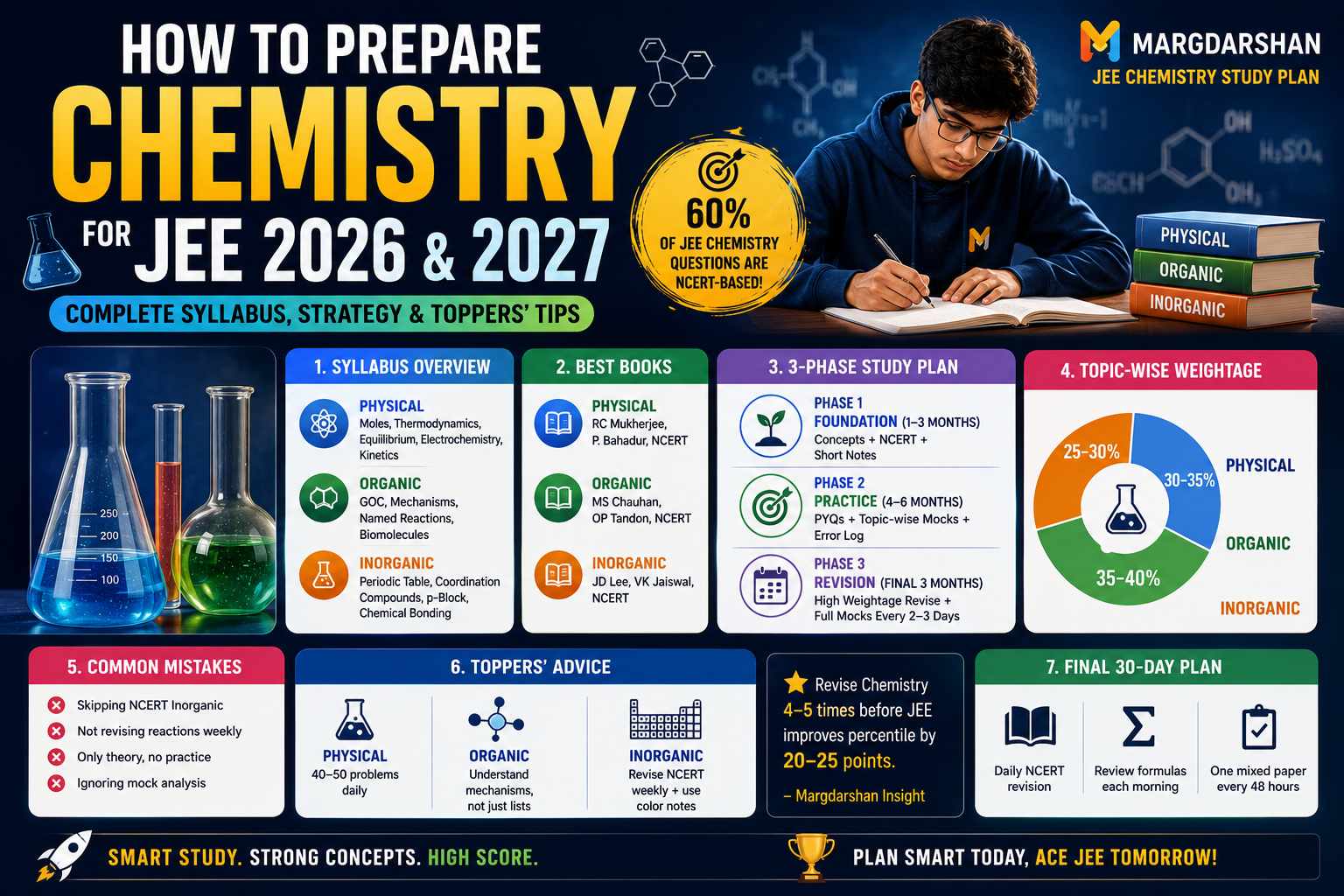
1. JEE Chemistry Syllabus Overview
- Physical Chemistry: Moles, Thermodynamics, Equilibrium, Electrochemistry, Kinetics
- Organic Chemistry: GOC, Reaction Mechanisms, Named Reactions, Biomolecules
- Inorganic Chemistry: Periodic Table, Coordination Compounds, p-Block, Chemical Bonding
2. Best Books for JEE Chemistry
- Physical Chemistry: RC Mukherjee, P. Bahadur, NCERT
- Organic Chemistry: MS Chauhan, OP Tandon, NCERT
- Inorganic Chemistry: JD Lee, VK Jaiswal, NCERT
3. Margdarshan’s 3-Phase Chemistry Study Plan
Phase 1: Foundation (Months 1–3)
- Build conceptual clarity from NCERT and Margdarshan modules.
- Summarize reactions and formulas after every chapter.
Phase 2: Practice & Application (Months 4–6)
- Solve previous year JEE Chemistry papers.
- Take topic-wise mock tests and track improvement.
Phase 3: Revision & Testing (Final 3 Months)
- Revise high-weightage topics and mechanisms daily.
- Attempt full mock tests every 2–3 days.
4. Topic-Wise Weightage for JEE Chemistry
| Section | Approx. Weightage |
|---|---|
| Physical Chemistry | 30–35% |
| Organic Chemistry | 35–40% |
| Inorganic Chemistry | 25–30% |
5. Common Student Mistakes
- Skipping NCERT Inorganic content
- Not revising reactions weekly
- Focusing only on theory without problem practice
- Ignoring mock test analysis
6. Margdarshan Insights & Toppers’ Advice
- Physical: Practice 40–50 problems daily.
- Organic: Learn mechanism logic, not reaction lists.
- Inorganic: Revise NCERT weekly and use color-coded notes.
7. Final 30-Day Chemistry Revision Plan
- Daily NCERT revision (especially Inorganic)
- Review Physical formulas each morning
- Attempt one mixed paper every 48 hours
Frequently Asked Questions (FAQs)
1. How should I start Chemistry preparation for JEE 2026 & 2027?
Begin with NCERT and Margdarshan’s conceptual videos. Once confident, move to standard books like MS Chauhan, RC Mukherjee, and JD Lee.
2. Which chapters are most important for JEE Chemistry?
Focus on Thermodynamics, Electrochemistry, GOC, Alcohols, Chemical Bonding, and Coordination Compounds.
3. Is NCERT enough for JEE Main Chemistry?
Yes, 70% of JEE Main Chemistry questions are NCERT-based. For JEE Advanced, supplement with reference books for problem depth.
4. How much time should I give to Chemistry daily?
2–3 focused hours daily split into learning, solving, and revision sessions work best.
5. How can I retain long reaction mechanisms?
Use flashcards, flowcharts, and visual reaction maps. Rewriting reactions boosts memory retention by 60%.
Also read: Mastering Physics for JEE 2026 & 2027
Need Mentorship?
Want a personalised career roadmap? Book a 1-on-1 counselling session.
College Predictor
Confused which college to target? Use our JEE Main Predictor to see your college options by rank.
Comments
Leave a Comment
Please log in to leave a comment.

Newsletter
GET STARTED WITH MARGDARSHAN
Get weekly: JEE strategy, college cutoff updates, career paths after PCM, and insider tips from IITians. Free. Unsubscribe anytime.