Highest Paying Tech Careers For PCM Students In 2026 (Beyond IIT & CSE)
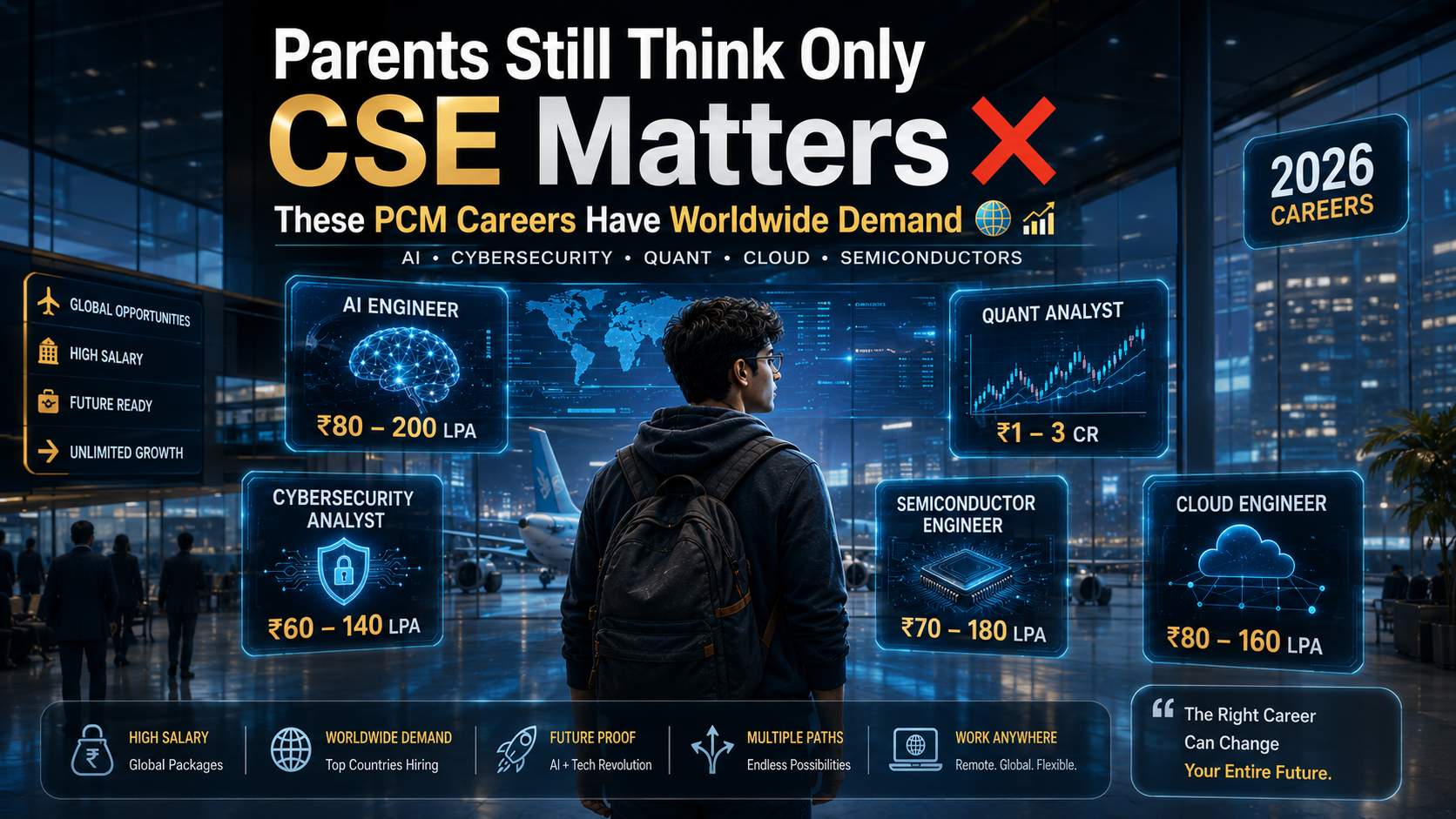
Everyone is chasing IIT + CSE. Meanwhile, some of the highest-paying careers in tech are quietly exploding outside the traditional path.
Every year, nearly 15 Lakh students in India set their sights on a singular, hyper-saturated goal: securing a Computer Science Engineering (CSE) seat at a top-tier Indian Institute of Technology (IIT). This tunnel vision is perpetuated by legacy coaching centers, societal inertia, and outdated placement brochures. The collective narrative suggests that if you do not land this specific combination, your engineering career is compromised.
But look closely at the global technology landscape of 2026. The structure of the tech economy has fundamentally fractured and rebuilt itself. The rise of generative AI, the urgent necessity of cloud infrastructure, the integration of advanced mathematics in quantitative finance, and a borderless, remote startup economy have created highly lucrative domains that do not care about traditional college tags.
We are seeing a profound divergence:
- Student A: Grinds for a traditional Civil Engineering seat at an older IIT, struggles to transition into software, and enters a generic IT services firm at a modest salary.
- Student B: Misses the IIT cutoff, studies Mathematics & Computing or Electronics at a premier state or private university, masters specialized high-value tech skills, and secures a remote global role paying in USD.
Same PCM background. Completely different futures. This guide is a McKinsey-style strategic blueprint designed to show PCM students, JEE aspirants, and parents how to bypass the traditional bottleneck and target the highest-paying tech options.
Why PCM Students Have a Massive Structural Advantage
To succeed in the modern tech economy, you must understand that coding is no longer a standalone superpower. Generative AI can write basic syntax in seconds. The developers who will be replaced by AI are those who only know "how to code." The professionals who are irreplaceable are those who understand the underlying logic of systems—the mathematics of neural networks, the physics of hardware-software integration, and the statistical models of risk.
This is where a background in Physics, Chemistry, and Mathematics (PCM) becomes a massive structural advantage:
- The Mathematical Foundation: Advanced machine learning, cryptography, and quantitative finance are essentially pure mathematics. Your comfort with multi-variable calculus, linear algebra, and probability is the exact vocabulary of high-end tech.
- Systematic Analytical Thinking: Physics trains your brain to break down complex, chaotic real-world systems into solvable, fundamental equations. This is the exact mental model needed to design scalable cloud architectures or debug distributed databases.
- Cross-Domain Adaptability: Because PCM focuses on "first principles" rather than temporary software tools, you can easily pivot into any emerging tech stack. A student who understands vector mathematics can master 3D game engines, robotics, or spatial computing much faster than a generic IT student.
In short, PCM students are uniquely positioned to lead future engineering careers because they don't just use technology—they understand the math and science that governs it.
The 7 Highest-Paying Tech Careers in 2026 (Beyond B.Tech CSE)
Below is an exhaustive, data-backed analysis of the elite tech domains that represent the highest paying jobs after pcm in 2026.
1. AI Engineer (Generative AI & LLM Specialist)
The AI revolution has graduated from experimental chatbots to core enterprise infrastructure. Companies are spending billions to integrate Large Language Models (LLMs) and custom AI pipelines into their operations. This has created a historic shortage of specialized AI Engineers.
- What They Do: Fine-tuning LLMs, designing retrieval-augmented generation (RAG) pipelines, managing vector databases, and deploying neural networks for specific commercial tasks.
- Is Coding Required? Yes, heavily. However, the focus is on Python, deep learning frameworks, and data structures rather than traditional web development.
- Best Skills to Learn: Python, PyTorch, TensorFlow, Hugging Face transformers, vector databases (Pinecone, Milvus), API integration, and prompt engineering.
- Best Degrees/Branches: B.Tech/B.S. in Artificial Intelligence, Mathematics & Computing, Computer Science, or Data Science.
- Who Should Choose It: Students who love mathematics, pattern recognition, and want to be at the absolute forefront of technology.
- Remote/Global Opportunities: Exceptional. Global AI startups actively hire Indian talent for remote roles because the talent deficit in the US and Europe is massive.
2. Cybersecurity Architect & Ethical Hacker
As systems become more connected and AI-driven, the threat landscape has grown exponentially. Companies are no longer just protecting websites; they are protecting autonomous vehicle networks, national smart grids, and AI pipelines.
- What They Do: Finding vulnerabilities (Ethical Hacking), designing zero-trust corporate security architectures, performing digital forensics after data breaches, and securing cloud environments.
- Is Coding Required? Yes, but focused on automation scripts, exploit payloads, and code vulnerability analysis.
- Best Skills to Learn: Network protocols, Linux system administration, penetration testing (Burp Suite, Metasploit), Python scripting, and cloud security architectures.
- Best Degrees/Branches: B.Tech/B.Sc in Cybersecurity, Computer Science, Information Technology, or Forensic Science (Digital).
- Who Should Choose It: Problem solvers who love puzzle-solving, mystery, and are highly logical. There is a documented global shortage of over 3.5 Million cybersecurity experts.
3. Quantitative Analyst (Quant)
Quants are the elite mathematicians of the financial world. They work for hedge funds, investment banks, and High-Frequency Trading (HFT) firms, using mathematical models to trade securities and manage financial risk.
- What They Do: Designing algorithmic trading strategies, building statistical arbitrage models, and optimizing execution algorithms that process trades in microseconds.
- Is Coding Required? Yes. You need to write ultra-fast, optimized code (primarily in C++ or Python) to execute mathematical models.
- Best Skills to Learn: Advanced probability, stochastic calculus, linear algebra, C++, Python, quantitative finance theory, and machine learning.
- Best Degrees/Branches: B.Math or B.Stat from ISI, B.Tech in Mathematics & Computing, or B.Sc (Hons) in Mathematics/Statistics.
- Who Should Choose It: Absolute mathematics prodigies who thrive under intense, high-stress, highly competitive environments.
4. Cloud Architect & DevOps Specialist
Every modern company is a digital company, and every digital company runs on the Cloud. Cloud Architects design the virtual infrastructure that keeps massive applications running without a millisecond of downtime.
- What They Do: Designing secure, scalable, and cost-effective cloud networks, managing containerized applications, and automating deployment pipelines (CI/CD).
- Is Coding Required? Yes, but focused on "Infrastructure as Code" (IaC) and script automation rather than building software applications.
- Best Skills to Learn: AWS, Microsoft Azure, Google Cloud Platform (GCP), Kubernetes, Docker, Terraform, CI/CD tools (Jenkins, GitHub Actions), and Linux.
- Best Degrees/Branches: B.Tech (CSE/IT/ECE), BCA, or B.Sc (Computer Science).
5. Autonomous Systems & Robotics Engineer
The robotics industry has evolved from stationary factory arms to autonomous drones, warehouse robots, self-driving cars, and humanoid systems. This requires a complex blend of mechanical design, sensors, and machine learning.
- What They Do: Designing control algorithms, integrating LiDAR/camera sensors, building robotic vision models, and testing hardware-software compatibility.
- Is Coding Required? Yes. You write control loops and vision processing algorithms (primarily in C++ and Python) that run directly on microcontrollers.
- Best Skills to Learn: ROS (Robotic Operating System), C++, Python, Control Systems theory, Embedded systems, and Computer Vision.
- Best Degrees/Branches: B.Tech in Mechatronics, Robotics Engineering, Electronics & Communication, or Mechanical Engineering.
6. Tech Product Manager (PM)
Product Managers do not write code. Instead, they act as the "Mini-CEOs" of a product, deciding what should be built and why. They sit at the intersection of Engineering, Design, and Business.
- What They Do: Writing product requirement documents, conducting user research, prioritizing features for the engineering team, and tracking product success metrics.
- Is Coding Required? No. However, you must be "tech-literate" (understanding how APIs, databases, and system architectures work).
- Best Skills to Learn: Product strategy, market analysis, user empathy, wireframing, data analytics (SQL, Mixpanel), and agile methodologies.
- Best Degrees/Branches: B.Tech (Any Branch) + MBA, or Integrated MBA (IPM) from top IIMs.
7. Advanced Data Scientist
Data is the currency of the digital age. Advanced Data Scientists do not just create simple bar charts; they build predictive models that forecast consumer behavior, market fluctuations, and logistics bottlenecks.
- What They Do: Building predictive pipelines, cleaning massive scale industrial datasets, conducting A/B testing experiments, and applying statistical models to solve complex business queries.
- Is Coding Required? Yes, Python, R, and SQL are mandatory tools of the trade.
- Best Skills to Learn: Statistics, Probability, SQL, Python, machine learning models, and data visualization tools (Tableau, PowerBI).
Master Comparison Matrix: Tech Careers 2026
| Career Path | Math Difficulty | Coding Intensity | Starting Salary (IN) | Global Potential | Best Academic Branch |
|---|---|---|---|---|---|
| AI Engineer | High | High | ₹18 - ₹25 LPA | Exceptional | B.Tech AI / CSE |
| Cybersecurity Architect | Moderate | Moderate | ₹15 - ₹20 LPA | High | B.Tech Cybersecurity / IT |
| Quant Analyst | Extreme | Extremely High | ₹25 - ₹40 LPA | Exceptional | B.Stat / B.Math / MnC |
| Cloud Architect | Moderate | Low-Moderate | ₹12 - ₹15 LPA | High | B.Tech CSE / IT / ECE |
| Robotics Engineer | High | High | ₹10 - ₹14 LPA | Moderate-High | B.Tech Mechatronics |
| Product Manager | Low-Moderate | None (Tech Lit) | ₹25 - ₹35 LPA | High | B.Tech (Any) + MBA / IPM |
| Data Scientist | High | High | ₹15 - ₹18 LPA | High | B.Sc Stats / B.Tech Data Sci |
The Degree Myth: Why Branch Specialty Matters More Than Rankings
A common trap for students during best careers after JEE planning is prioritizing a college's NIRF rank over the specific academic branch. In 2026, the corporate world has moved away from evaluating degrees based on raw prestige. Instead, they look for Domain Expertise.
If you are choosing between Chemical Engineering at a top-10 NIT vs. Computer Science / Artificial Intelligence / Mathematics & Computing at a mid-tier state university (like PEC, UIET, or Thapar), our strategic recommendation is to choose the tech branch.
- Syllabus Relevance: Traditional branches like Mechanical require you to spend 80% of your time studying thermodynamics and manufacturing science, leaving little bandwidth to build a high-end coding or data portfolio.
- The "Core" Fallacy: Tech companies recruiting on campus often restrict non-CS/IT students from sitting for their placement tests, regardless of how prestigious the college is.
Best Colleges for Future Tech Careers
When shortlisting colleges, do not evaluate them solely based on infrastructure or general rankings. Instead, analyze their Coding Culture and Placement Ecosystem.
- IIIT Hyderabad: The absolute gold standard for pure computer science and AI research. Their coding culture (ACM-ICPC) is legendary.
- IIIT Bangalore & IIIT Delhi: These coupling institutes offer an integrated, tech-heavy focus from day one, skipping traditional first-year physics/chemistry fluff.
- BITS Pilani (Pilani, Goa, Hyderabad): Known for its "Zero Attendance" policy, BITS allows students the intellectual freedom to build startups and scale technical portfolios.
- Strategic Tier-2 Options: Private giants like VIT Vellore, MIT Manipal, and Thapar Institute have massive placement portals. If you rank in the top 5% of these institutes and participate actively in their coding clubs, your salary outcome will easily match that of an average NIT graduate.
Skills That Matter More Than College: "Google Hires Skills, Not Degrees"
The most significant change in the 2026 hiring landscape is the decline of the resume as a static document. Global tech pools and startups now evaluate candidates based on their Digital Footprint.
If you want an elite starting package from a non-IIT college, you must build these five pillars during your engineering years:
- GitHub Portfolio: Your code must be public. Build and host real web apps, AI models, or open-source contributions.
- Competitive Programming & Kaggle: For AI/ML and Data Science aspirants, your Kaggle ranking is your real-world credential. For software engineers, active profiles on LeetCode or Codeforces show recruiters that your logic is sharp.
- Mandatory Internships: Do not wait for 4th-year placements. Start applying for remote internships or startup roles from your 2nd year.
- Industry Certifications: AWS Certified Solutions Architect (Cloud), Certified Ethical Hacker (Cybersecurity), or Google Data Analytics Professional Certificate (Data Science).
- Active LinkedIn Networking: Share your learning journey publicly. Write articles on product teardowns, document how you built a specific app, and connect with engineering managers in your target companies.
The Biggest Career Mistakes PCM Students Make After 12th
- Chasing the Tag Blindly: Choosing a completely unrelated branch (like Textile or Production) at a top NIT over Computer Science or AI at a slightly lower-ranked college, when your long-term goal is software engineering.
- Ignoring the Mathematics of Tech: Thinking that AI or Data Science is just about "calling libraries" in Python. If your linear algebra and statistics are weak, you will struggle to move past entry-level roles.
- Learning Outdated Tech Stacks: Many colleges still teach outdated syllabus structures. If you rely only on college lectures, you will graduate with obsolete skills. You must learn modern frameworks (like React, Node, PyTorch, Docker) on your own.
- Failing to Diversify Admissions: Putting all your eggs in the JEE Main basket. Many high-potential alternative exams (like BITSAT, IAT, UGEE, IPMAT) have lower competition levels but excellent career outcomes.
Parent Perspective: Building a Trustworthy, Future-Proof Path
As a parent, your primary concern is understandably stability and security. You may have seen the volatility of the tech market, with layoffs and AI automation dominating the news, and wondered if engineering is still a safe path for your child.
Here is the data-backed reality for 2026: AI is replacing low-skill roles like routine IT jobs and basic data entry, but it is creating high-skill demand for specialists who can manage AI pipelines, secure cloud networks, and analyze complex systems. This demand is growing at an unprecedented 30%+ annually.
Encouraging your child to look beyond traditional B.Tech CSE and explore paths like Cybersecurity, Quant Analysis, or Data Science is the most realistic way to build a future-proof career. These domains are highly stable, recession-proof, and offer massive long-term ROI.
The 4-Year Execution Roadmap: From Class 12 to a Tier-1 Career
Frequently Asked Questions (FAQs)
The Next Decade of Tech
The next decade of technology will not belong only to the students who cracked an IIT. It will belong to the students who understood where the world was moving, ignored the crowd, and built the high-value skill stacks that the future demands.
Your JEE rank is a milestone, not your final destination. Start planning your pivot today, master your mathematics foundation, take control of your learning roadmap, and let the salary packages follow your expertise.
🎯 Personalized College & Career Strategy
Don't navigate this critical transition alone. Let our expert mentors help you match your PCM skills to high-yield careers and predict your best college options.
Use JEE Adv College Predictor Book Mentorship SessionNeed Mentorship?
Want a personalised career roadmap? Book a 1-on-1 counselling session.
College Predictor
Confused which college to target? Use our JEE Main Predictor to see your college options by rank.
Comments
Leave a Comment
Please log in to leave a comment.
Newsletter
GET STARTED WITH MARGDARSHAN
Get weekly: JEE strategy, college cutoff updates, career paths after PCM, and insider tips from IITians. Free. Unsubscribe anytime.