Beyond the Result: The Complete Roadmap After JEE Main Result 2026
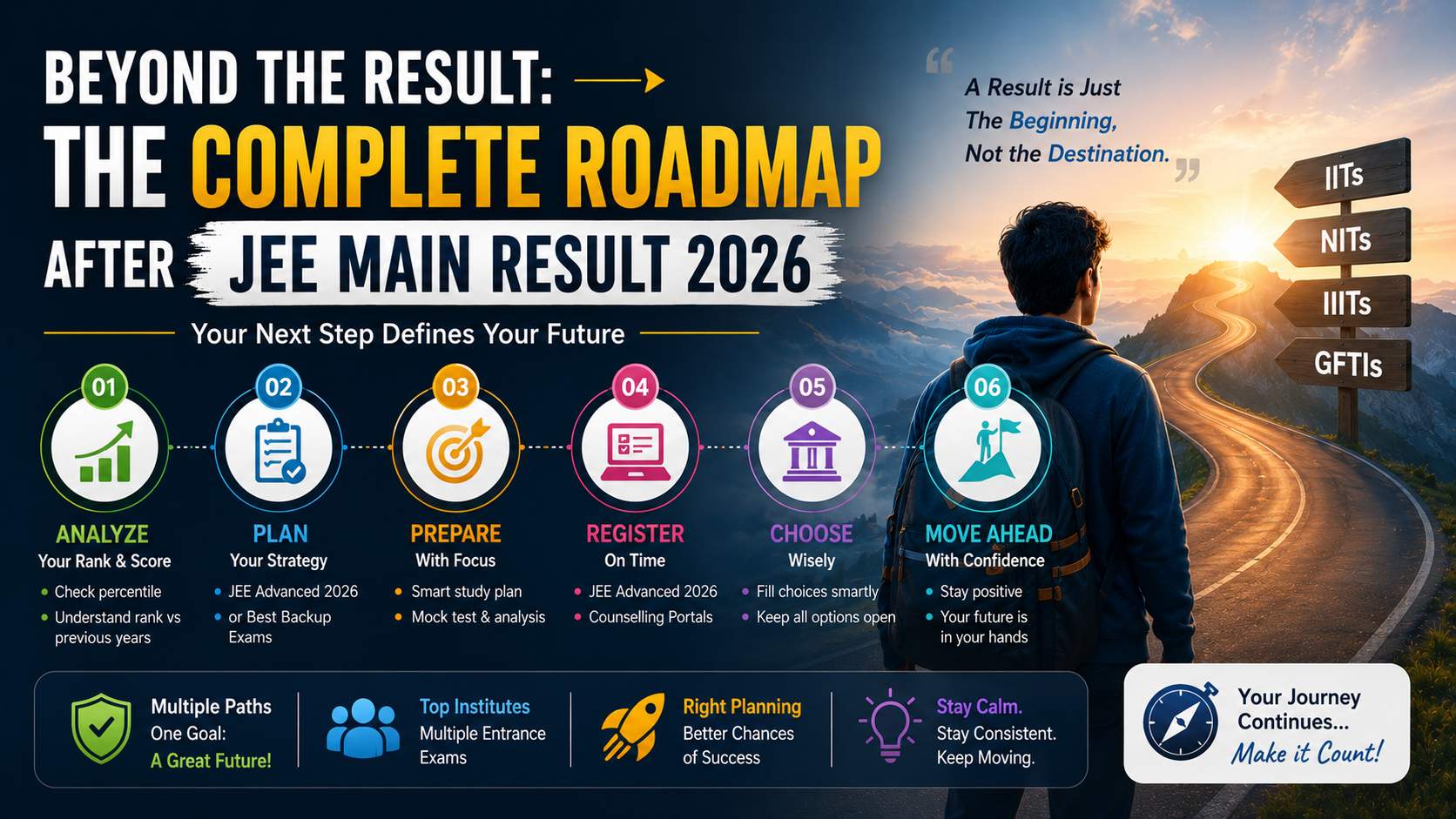
The declaration of the JEE Main result 2026 marks the formal conclusion of the acquisition phase for millions of engineering aspirants. In an academic cycle characterized by unprecedented competition, with candidate counts potentially exceeding 1.6 million, the release of the final percentile and All India Rank (AIR) shifts the objective from academic preparation to strategic execution. The immediate availability of the JEE Main cutoff 2026 and the JEE Main score vs rank 2026 trends provides the data required to transition from preparation mode to tactical execution mode.
The 30-day window following the results is the most critical period in a student's life. During this interval, decisions regarding IIT admission 2026 or NIT admission 2026 are finalized. A common error among candidates is the failure to realize that a high rank without a data-backed counseling strategy often results in suboptimal college placement. Conversely, a moderate rank paired with meticulous analysis of historical cutoff data can secure a seat in a Tier-1 institute. This guide provides the analytical framework required to navigate the JoSAA 2026 and CSAB 2026 landscape with professional precision.
JEE Advanced 2026: Success Blueprint
For candidates who have successfully cleared the qualifying JEE Main cutoff 2026, the focus immediately pivots to the most challenging undergraduate examination in the country: JEE Advanced 2026. Unlike the Main, which rewards speed and pattern recognition, the Advanced is an examination of first principles and conceptual resilience. The technical process for the 2026 cycle follows a strict timeline that leaves no room for administrative error.
JEE Advanced 2026 Registration & Timeline
| Event Milestone | Official 2026 Schedule / Technical Requirement |
|---|---|
| JEE Advanced 2026 Registration Window | Starts: April 23, 2026 | Closes: April 30, 2026 |
| Examination Date | May 17, 2026 (Paper 1: 9 AM - 12 PM | Paper 2: 2:30 PM - 5:30 PM) |
| Mandatory Documentation | Class 10 Cert (Age), Class 12 Cert (Eligibility), Category Cert (OBC-NCL/EWS issued on/after April 1, 2026). |
| JEE Advanced 2026 Admit Card | Scheduled for release in the second week of May 2026. |
Registration Protocol: Candidates must log in using their JEE Main result 2026 credentials on the official portal. It is imperative that category certificates, specifically for OBC-NCL and EWS, are issued on or after April 1, 2026. This date is non-negotiable as it ensures compliance with the current financial year's income criteria. Failure to produce a valid, timely certificate will lead to the candidate being treated as a General category applicant, which drastically alters rank dynamics and IIT admission 2026 outcomes.
Preparation Strategy: Conceptual Depth vs. Rote Memorization
The fundamental contrast between Main and Advanced is the question-time ratio. While JEE Main offers roughly 2 minutes per question, JEE Advanced 2026 allows for 4 to 6 minutes. This indicates that the problems will involve multi-concept integration—where a single physics problem might require the simultaneous application of fluid mechanics, thermodynamics, and calculus. Rote memorization of formulas is insufficient; the exam tests the ability to derive and apply concepts under novel constraints.
Mock-Test Analysis Framework
To maximize rank conversion, students must adopt a zero-gaps approach to mocks. Every full-length mock must be followed by a 4-hour analysis session structured as follows:
- Conceptual Missteps: Identifying questions where the fundamental law was incorrectly applied.
- Decision Failure: Identifying 'trap questions' that were attempted but consumed more than 8 minutes without a result.
- Conversion Efficiency: Calculating the ratio of questions correctly solved to those attempted. In Advanced, a 100% accuracy rate on a 40% attempt usually yields a better rank than a 70% accuracy rate on a 60% attempt.
JoSAA 2026 and CSAB 2026: Navigating the Counseling Maze
The JoSAA 2026 (Joint Seat Allocation Authority) is the centralized platform for admissions to 23 IITs, 31 NITs, IIEST Shibpur, 26 IIITs, and 40+ Other-GFTIs. Understanding the hierarchy of these institutes is essential for creating a realistic preference list. The priority is generally defined by legacy, research funding, and placement median scores: Old IITs > Top 5 NITs/Newer IITs > IIIT Hyderabad/Bangalore/Delhi > Tier-2 NITs > GFTIs.
JoSAA 2026 Choice Filling & Seat Allocation
JoSAA operates through multiple rounds of seat allocation. Upon receiving a seat, a candidate must exercise one of three options within a strict deadline: FREEZE (accept and exit), FLOAT (accept and seek better college), or SLIDE (accept and seek better branch in same college). The JoSAA choice filling 2026 phase is where most candidate errors occur, often by creating gaps in the hierarchy or failing to account for opening and closing rank volatility.
JEE Main College Predictor 2026
Analyze your 2026 rank against five years of historical JoSAA and CSAB cutoff data. Our algorithm calculates your percentage of probability for specific branches in NITs, IIITs, and GFTIs.
CSAB 2026 (Central Seat Allocation Board)
After JoSAA rounds conclude, the CSAB 2026 Special Rounds begin. These rounds are exclusive to NITs, IIITs, and GFTIs (IITs do not participate in CSAB). CSAB aims to fill vacant seats after the primary counseling concludes. CSAB is inherently volatile; seats in top NITs occasionally become available to lower ranks due to late withdrawals. However, this is a high-risk phase that requires real-time data monitoring and a different registration fee structure.
75 Percent Eligibility JEE 2026: The Critical Criteria
The 75 percent eligibility JEE 2026 rule is a mandatory academic requirement defined in the JoSAA Business Rules. Many students assume their school's "Best of 5" score will be utilized; this is incorrect. JoSAA follows a standardized 5-subject calculation: Physics, Mathematics, one of [Chemistry/Bio/Biotech/Technical Vocational], one Language, and one additional subject with the highest marks.
Top 20 Percentile Rule 2026
The top 20 percentile rule 2026 exists to protect students from "tough" boards where scoring 75% is statistically rare. If a candidate fails to meet the 75% aggregate requirement, they are still eligible if their total marks are equal to or higher than the Top 20 Percentile cutoff of their respective board for that specific year and category. This is calculated based on all successful candidates who appeared for the board exam in that year.
Common Miscalculation Risks
Students often fail to account for normalization. If your board gives marks out of 600 or 450, JoSAA will scale these marks to a base of 500. Furthermore, if you are a dropper, you must use the Top 20 Percentile data from your original passing year unless you appeared for improvement in all subjects in a subsequent year. Failing this criterion can lead to the immediate cancellation of an IIT admission 2026 seat during document verification.
Eligibility & Top 20 Percentile Tool
Before finalizing your JoSAA choice filling 2026, verify your board exam eligibility with surgical precision. This tool applies category-specific relaxations and board-wise percentile cutoffs instantly.
Risk Management: Top Engineering Colleges 2026 Beyond JEE
In a volatile ecosystem like JEE, diversification is not a sign of weakness; it is a fundamental principle of risk management. Top-tier aspirants must maintain leverage by appearing for exams that offer equivalent infrastructure to IITs and NITs. BITSAT (BITS Pilani), VITEEE (VIT), and MET (Manipal) are primary targets. Furthermore, state-level entrances such as WBJEE or MHT-CET offer ROI metrics that often exceed middle-tier NITs. These are the top engineering colleges 2026 options that every student should keep on their radar.
The rationale for diversification is leverage. If you hold an admission offer from BITS Pilani or IIIT Hyderabad (via UGEE), you can approach the JoSAA 2026 counseling with greater composure, allowing you to wait for the floating rounds without the fear of ending up with no seat at all. Treat these alternative exams as a hedge against the statistical variability of JEE Advanced 2026. The goal is to ensure that by July 2026, you have multiple Tier-1 options on the table.
Conclusion
The transition from Class 12 to a premier engineering institute is an exercise in data management and mental fortitude. Your JEE Main result 2026 is a significant data point, but it does not dictate your final destination. Success in the next month requires you to take full ownership of your career trajectory. Analyze the cutoffs, verify your eligibility with surgical precision, and create a choice-filling roadmap that respects both your ambition and reality. The goal is no longer just to study; the goal is to place. Proceed with clarity.
Need Mentorship?
Want a personalised career roadmap? Book a 1-on-1 counselling session.
College Predictor
Confused which college to target? Use our JEE Main Predictor to see your college options by rank.
Comments
Leave a Comment
Please log in to leave a comment.



Newsletter
GET STARTED WITH MARGDARSHAN
Get weekly: JEE strategy, college cutoff updates, career paths after PCM, and insider tips from IITians. Free. Unsubscribe anytime.