Cybersecurity Roadmap After PCM: How To Become An Ethical Hacker & Cybersecurity Expert In 2026
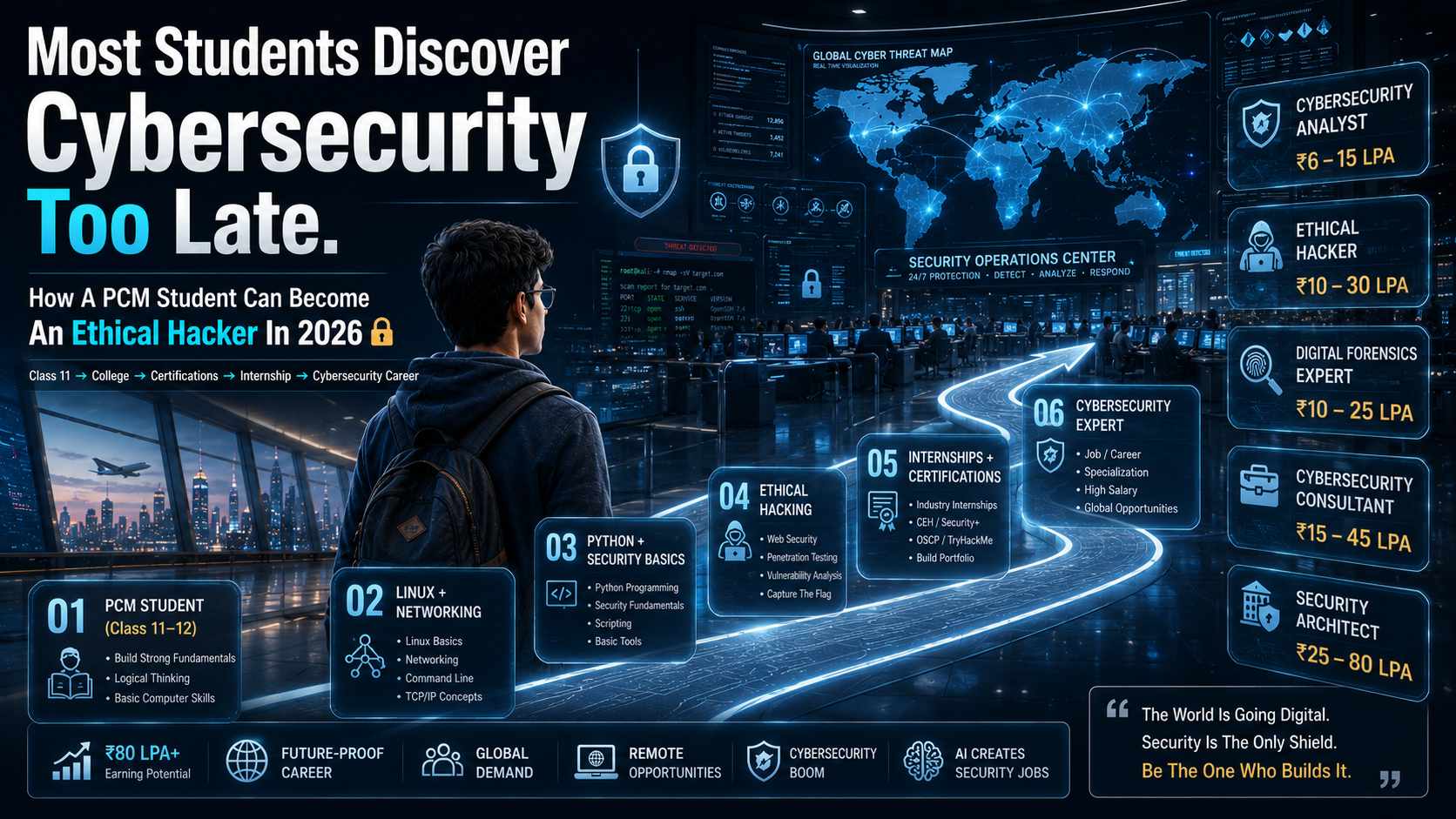
Most students discover cybersecurity too late.
While the majority of Class 11 and 12 PCM students are trapped in a collective tunnel vision—stressing exclusively over JEE Main cutoffs, chasing traditional Core Computer Science Engineering (CSE) packages, and treating the AI boom as the only tech frontier—a critical economic shift is quietly taking place.
Every company is becoming digital. Every company needs security. The digital world is expanding at a breakneck pace, but this rapid migration has exposed a massive vulnerability. The industry is facing a historic, global talent shortage. Organizations don't just need people who can build apps; they desperately need specialists who can defend them. If you have a solid background in Physics, Chemistry, and Mathematics, you already possess the exact analytical engineering framework required to succeed in this elite domain.
What Is Cybersecurity?
Strip away the textbook jargon about firewalls and cryptographic protocols. At its absolute core, cybersecurity is the digital equivalent of high-end tactical defense and counter-intelligence.
Think about your daily digital footprint. When you open your banking apps, make a lightning-fast payment over UPI, message on WhatsApp, or access government portals, a complex series of backend servers validate your identity. If a malicious entity intercepts that packet, the entire system collapses.
Cybersecurity professionals are the elite architects who design, test, and enforce the digital walls that secure our modern infrastructure from relentless attacks.
Why Cybersecurity Is Booming
The market dynamics of 2026 have turned cybersecurity from a basic IT line item into a core strategic boardroom priority.
- AI Creates New Security Risks: Malicious entities use custom LLMs to write polymorphic malware. Fighting an automated, AI-driven attacker requires an equally sophisticated, human-led security deployment.
- Digital India: With India processing billions of real-time digital transactions, the domestic target zone for cyberthreats is vast.
- Cloud Adoption & Remote Work: The classic perimeter defense model is dead. Employee endpoints are distributed globally, requiring Zero-Trust Architects to constantly verify every user and device.
- Massive Talent Shortage: There are millions of unfulfilled cybersecurity roles globally. The demand severely outweighs the supply of qualified professionals.
Cybersecurity Careers Explained
1. Cybersecurity Analyst
What they do: The first line of defense. Analysts monitor enterprise network environments, evaluate telemetry logs, and isolate anomalies before they turn into full-scale breaches.
Skills needed: Security Information and Event Management (SIEM) tools, traffic analysis, basic scripting.
Career progression: Security Analyst → Operations Lead → Chief Information Security Officer (CISO).
2. Ethical Hacker (Penetration Tester)
What they do: The offensive elite (Red Team). Your job is to think exactly like a malicious actor, legally break into corporate infrastructure, and find structural bugs via bug bounties and pen testing.
Skills needed: Metasploit, Burp Suite, Network sniffing, Web Application testing.
Career progression: Junior Pentester → Senior Red Teamer → Principal Security Consultant.
3. Digital Forensics Expert
What they do: The cyber detective. When a breach occurs, these specialists step in to trace the attacker's server origins, recover altered logs, and assemble evidence for government investigation roles.
Skills needed: Volatile memory analysis, filesystem forensics, malware disassembly.
Career progression: Forensics Investigator → Government Cyber Cell Consultant → Director of Incident Response.
4. Cybersecurity Consultant
What they do: The strategic business partner. Consultants audit an organization’s risk profile and advise executive leadership on capital allocation. Excellent for Big 4 opportunities.
Skills needed: Risk Assessment Frameworks (ISO 27001, NIST), compliance auditing, high-end communication skills.
Career progression: Associate Consultant → Practice Lead → Partner at a Big 4 Firm.
5. Security Architect
What they do: The grand planner. Architects design the entire secure enterprise cloud blueprint and define identity verification pathways from day one.
Skills needed: Enterprise Cloud Security Architecture (AWS/Azure), cryptography engineering, zero-trust models.
Career progression: Enterprise Security Architect → Principal Architect → VP of Security Engineering.
Complete Roadmap After PCM
| Phase | What You Should Do & Learn |
|---|---|
| Class 11–12 | Master your Math curriculum (logical thinking). Ditch Windows and install a Linux virtual machine. Learn networking basics (IP addresses, Routers) and Python basics. |
| College Year 1 | Master Linux bash scripting. Deep-dive into Networking (OSI Model, TCP/IP, Wireshark). Write your first Python automation scripts (e.g., a basic network port scanner). |
| College Year 2 | Learn Web Security (OWASP Top 10). Set up accounts on TryHackMe and Hack The Box. Earn your first foundational certifications (like Security+). |
| College Year 3 | Target off-campus Internships. Form a team for CTFs (Capture The Flag competitions). Start hunting for Bug Bounties and contribute to open-source security tools. |
| Final Year | Placement preparation. Build an active GitHub repository with your custom tools. Optimize your LinkedIn profile with technical write-ups of global data breaches. |
Best Degrees For Cybersecurity
- B.Tech CSE: Maximum flexibility and massive placement base. Pro: You learn core computing. Con: You must learn security on your own.
- B.Tech Cybersecurity / IT (Specialization): Direct access to security labs. Pro: Structured focus. Con: Can be restrictive if you want to pivot to pure software development later.
- B.Tech ECE: Deep understanding of hardware and physical signals. Pro: Invaluable for hardware hacking/IoT security. Con: Highly demanding curriculum.
- B.Tech Data Science: Pro: Excellent for building AI-driven threat defense platforms. Con: Misses core networking layers.
Best Colleges For Cybersecurity In India
- IIIT Delhi & IIIT Hyderabad: Exceptional research focus on cyber security, data privacy, and secure cryptography algorithms. The undisputed elite tier for product security.
- BITS Pilani (Pilani, Goa, Hyderabad): The "Zero Attendance Policy" allows students to deep-dive into complex labs, global CTF runs, and bug bounties freely.
- DTU & NSUT: Massive alumni presence in elite technology organizations and dynamic technical societies.
- VIT, SRM, & UPES: Excellent private universities offering comprehensive, dedicated specialization paths with modern industry certification tie-ins and strong placement support.
📊 JEE Advanced Predictor
Take the guesswork out of JoSAA counselling. Map your JEE Advanced rank to live 2026 data and see exactly which IIT branches you can secure.
Use Predictor Now🎯 Expert Mentorship
Confused between branch vs. college tag? Get 1-on-1 personalized strategic counselling from industry experts to build your tech roadmap.
Book a SessionCertifications That Actually Matter
Avoid certification overload. Do not collect random participation certificates. Focus on these:
- Security+: The definitive entry baseline. Validates core security concepts. (Do this in College Year 2).
- CEH (Certified Ethical Hacker - Practical): Hands-on challenge to test your ability to use major toolkits. (Do this in College Year 3).
- OSCP (Offensive Security Certified Professional): The gold standard for offensive security. A grueling 24-hour hands-on examination. (Target this in Final Year).
- CISSP: The pinnacle of strategic corporate security architecture. Requires 5 years of experience. (Target mid-career).
Skills Required Matrix
| Skill | Importance | Difficulty | Career Impact |
|---|---|---|---|
| Linux Administration | Critical | Low-Moderate | Bedrock for navigating systems and writing custom tools. |
| Networking & Protocols | Critical | Moderate | Crucial for reading raw traffic and pinpointing exploit vectors. |
| Python Scripting | High | Low-Moderate | Automating log parsers and scaling vulnerability scans. |
| Web Security (OWASP) | High | Moderate | Finding logical flaws in web forms and APIs. |
| Cloud Security (AWS/Azure) | Very High | High | Securing modern enterprise blueprints and containers. |
| SIEM Tools | High | Moderate | Triaging active threat indicators. |
| Digital Forensics | Niche | High | Disassembling binaries and memory dump triage. |
Salary Roadmap
| Experience Level | India Salary Range | Global / Remote Salary | Consulting / Freelance Potential |
|---|---|---|---|
| 0–2 Years | ₹6 – ₹15 LPA | $40,000 – $70,000 USD | Basic bug bounty payouts ($500 - $2000 per bug) |
| 3–5 Years | ₹15 – ₹30 LPA | $80,000 – $120,000 USD | High independent consulting rates & elite bounties |
| 5–10 Years | ₹30 – ₹60 LPA | $120,000 – $180,000 USD | Enterprise auditing contracts |
| 10+ Years (Leadership) | ₹60L – ₹1.2+ Cr | $200,000+ USD + Equity | Partner at Big 4 / Independent CISO advisory |
Can AI Replace Cybersecurity?
AI is an incredibly powerful weapon, but it requires a human architect to direct and secure its application. AI increases the demand for cybersecurity because hackers are now using AI to write malware faster. AI lacks contextual strategic intuition to secure a customized corporate network. Furthermore, security engineers are now tasked with defending enterprise AI pipelines against new attack vectors like Prompt Injection. AI will not replace you; it makes your defensive skills infinitely more valuable.
Biggest Mistakes Students Make
- Focusing only on certifications: Collecting theoretical certificates without ever building a single functional project.
- Ignoring networking: Running hacking scripts without understanding TCP/IP means you are just a "script kiddie."
- No projects or internships: Hands-on skill always beats a piece of paper.
- Chasing shortcuts: Expecting to secure premium packages after a 10-hour basic video course. Mastery requires sustained discipline.
Parent Guide: Why Cybersecurity is a Safe Bet
As a parent, your primary focus is stability. You might wonder: Is cybersecurity stable? Is it future-proof? Is it better than traditional IT? The answer is a definitive yes. A corporation might pause a new app development during an economic slowdown, but it can never shut down its digital defense grid. The regulatory penalties for a data breach are catastrophic. Cybersecurity is highly insulated from cyclical market swings and AI-driven layoffs, making it one of the most future-proof investments of effort your child can make.
Frequently Asked Questions (FAQs)
Absolutely. PCM provides the logical framework and mathematical maturity required to understand advanced encryption and networking.
Yes. Recruiters evaluate technical proficiency via hands-on labs, CTFs, and GitHub portfolios, completely bypassing baseline college tags.
Basic scripting (Python, Bash) is required, but it is not as code-intensive as full-stack software development unless you are building custom exploit tools.
Core CSE or a B.Tech with a Cybersecurity specialization are the most straightforward pathways.
The Offensive Security Certified Professional credential is a 24-hour practical, hands-on hacking exam. It is the gold standard for ethical hackers.
With consistent, daily structural focus, a student can reach junior job readiness within 18 to 24 months.
Incident response can be high-stakes during an active breach. However, consulting and architectural design tracks feature highly structured timelines.
Yes, cybersecurity has one of the highest rates of global remote work opportunities among all tech sectors.
A formal framework where tech giants (Google, Apple) legally invite you to audit their live assets and issue financial rewards for finding vulnerabilities.
Global tech providers, banking networks, the Big 4 (Deloitte, EY), fintech hubs, and government defense organizations.
Yes, it is invaluable if you want to enter hardware hacking, embedded systems, or IoT security.
A stable GPA passes HR filters, but your CTF scores and lab portfolio clinch the job.
Red Team is offensive (ethical hacking). Blue Team is defensive (monitoring and securing systems).
Only if you are confident in your rank increase. Otherwise, join a Tier-2 institute and invest that year into building real-world security skills.
No. Antivirus catches known legacy patterns. Security engineers hunt novel zero-day threats.
A security flaw that is unknown to the software vendor, leaving zero days to patch it before attackers exploit it.
Start with your Class 11/12 Math: Modular Arithmetic, Prime Number Theory, and Probability.
Capture The Flag competitions are educational hacking tournaments where you solve challenges to find a hidden string of text.
Dedicating 5–7 structured hours per week to practical labs alongside your regular curriculum is sufficient to build an elite portfolio by graduation.
Yes. Defense infrastructure hubs and law enforcement cyber cells aggressively hire civilian analysts to protect national security assets.
The Smartest Path Forward
Most students discover cybersecurity after college. The smartest students discover it before college.
The high-yield tech economy of the next decade does not reward generalists who passively follow the path of least resistance. It rewards those who observe where capital is moving and methodically build the skills required to secure that growth. Take control of your learning early, invest heavily in your networking and systems foundation, and build a career designed to last.
Need Mentorship?
Want a personalised career roadmap? Book a 1-on-1 counselling session.
College Predictor
Confused which college to target? Use our JEE Main Predictor to see your college options by rank.
Comments
Leave a Comment
Please log in to leave a comment.



Newsletter
GET STARTED WITH MARGDARSHAN
Get weekly: JEE strategy, college cutoff updates, career paths after PCM, and insider tips from IITians. Free. Unsubscribe anytime.